
The 50 Most Common House Plants with Pictures: Your Quick-Start Guide
The 50 most common house plants with pictures are listed below — a fast reference for anyone ready to bring greenery indoors:
| # | Plant Name | Light | Water | Beginner-Friendly? |
|---|---|---|---|---|
| 1 | Snake Plant | Low to bright indirect | Every 2-6 weeks | Yes |
| 2 | Pothos | Low to bright indirect | Every 1-2 weeks | Yes |
| 3 | ZZ Plant | Low to bright indirect | Every 2-3 weeks | Yes |
| 4 | Spider Plant | Bright indirect | Every 1-2 weeks | Yes |
| 5 | Peace Lily | Low to medium | Weekly | Yes |
| 6 | Monstera Deliciosa | Bright indirect | Every 1-2 weeks | Yes |
| 7 | Rubber Plant | Bright indirect | Every 1-2 weeks | Yes |
| 8 | Fiddle Leaf Fig | Bright indirect | Weekly | Moderate |
| 9 | Parlor Palm | Low to bright indirect | Every 1-2 weeks | Yes |
| 10 | Chinese Evergreen | Low to medium | Every 1-2 weeks | Yes |
| 11 | Aloe Vera | Bright direct/indirect | Every 2-4 weeks | Yes |
| 12 | Heartleaf Philodendron | Low to bright indirect | Weekly | Yes |
| 13 | Jade Plant | Bright indirect | Every 2-3 weeks | Yes |
| 14 | Boston Fern | Bright indirect | Twice weekly | Moderate |
| 15 | Bird of Paradise | Bright indirect | Every 1-2 weeks | Moderate |
| 16 | Areca Palm | Bright indirect | Every 1-2 weeks | Yes |
| 17 | String of Pearls | Bright indirect | Every 2 weeks | Moderate |
| 18 | Prayer Plant | Medium indirect | Weekly | Yes |
| 19 | African Violet | Bright indirect | Weekly | Moderate |
| 20 | Chinese Money Plant | Bright indirect | Weekly | Yes |
| 21 | Calathea | Medium indirect | Weekly | Moderate |
| 22 | Peperomia | Bright indirect | Every 1-2 weeks | Yes |
| 23 | Dracaena | Low to bright indirect | Every 1-2 weeks | Yes |
| 24 | Cast Iron Plant | Low | Every 2-3 weeks | Yes |
| 25 | English Ivy | Bright indirect | Weekly | Yes |
| 26 | Anthurium | Bright indirect | Weekly | Yes |
| 27 | Lucky Bamboo | Low to bright indirect | Weekly | Yes |
| 28 | Croton | Bright indirect | Weekly | Moderate |
| 29 | Money Tree | Bright indirect | Every 1-2 weeks | Yes |
| 30 | Hoya (Wax Plant) | Bright indirect | Every 2 weeks | Yes |
| 31 | Dieffenbachia | Medium indirect | Weekly | Yes |
| 32 | Air Plant (Tillandsia) | Bright indirect | Weekly misting | Yes |
| 33 | Ponytail Palm | Bright indirect | Every 2-3 weeks | Yes |
| 34 | Satin Pothos | Low to bright indirect | Every 1-2 weeks | Yes |
| 35 | Alocasia (Elephant Ear) | Bright indirect | Weekly | Moderate |
| 36 | String of Hearts | Bright indirect | Every 2 weeks | Yes |
| 37 | Bird’s Nest Fern | Low to medium | Weekly | Yes |
| 38 | Orchid | Bright indirect | Every 1-2 weeks | Moderate |
| 39 | Bromeliad | Bright indirect | Weekly | Yes |
| 40 | Nerve Plant | Low to medium | Weekly | Moderate |
| 41 | Rubber Plant | Bright indirect | Every 1-2 weeks | Yes |
| 42 | Wandering Dude | Bright indirect | Weekly | Yes |
| 43 | Yucca Cane | Bright direct | Every 2-3 weeks | Yes |
| 44 | Arrowhead Plant | Low to medium | Weekly | Yes |
| 45 | Weeping Fig | Bright indirect | Weekly | Moderate |
| 46 | Burro’s Tail | Bright indirect | Every 2-3 weeks | Yes |
| 47 | Monstera Adansonii | Bright indirect | Every 1-2 weeks | Yes |
| 48 | Holiday Cactus | Bright indirect | Every 2 weeks | Yes |
| 49 | Rex Begonia | Bright indirect | Weekly | Moderate |
| 50 | Gerbera Daisy | Bright direct/indirect | Weekly | Moderate |
Walk into any plant nursery and it’s easy to feel overwhelmed. Dozens of green leaves stare back at you, and you have no idea which ones will actually survive your busy schedule.
Here’s the truth: most houseplants are far more forgiving than people think. The most common ones became popular for a reason — they’re low-maintenance, beautiful, and adaptable to real homes with real people in them.
Whether you want cleaner air, a calmer space, or just something living to brighten up a shelf, there’s a plant on this list that fits your life. From nearly indestructible options like the Snake Plant to showstoppers like the Monstera, this guide covers everything you need to choose, buy, and keep your new green roommates thriving.
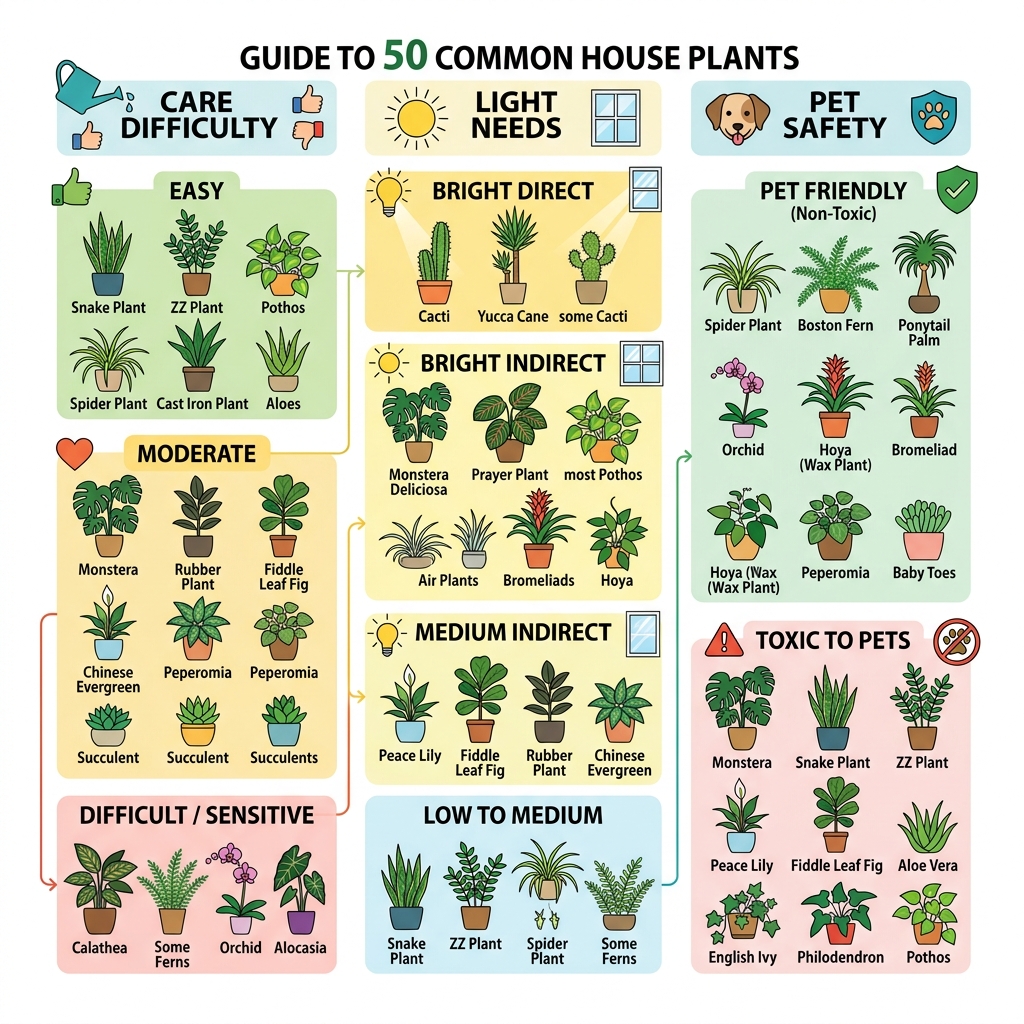
The 50 Most Common House Plants with Pictures and Care Guides
When we talk about the 50 most common house plants with pictures, we are looking at a diverse group of botanical companions that have survived the test of time in living rooms across the globe. Understanding their scientific names and growth habits is the first step toward becoming a confident plant parent.
Most of these plants fall into a few distinct categories: succulents that store water in their leaves, tropical broadleaf plants that love humidity, and vining beauties that want to climb or trail. A key factor in your success will be matching the plant’s native habitat to your home environment. For instance, understanding Indoor plant light requirements is non-negotiable; a desert cactus will never be happy in a windowless bathroom, just as a delicate fern will scorch in direct afternoon sun.
To help you navigate this green world, we’ve highlighted Easy to grow indoor plants throughout this list. These are the varieties that offer the most “bang for your buck” in terms of aesthetic appeal versus effort.
Low-Maintenance Legends: The 50 Most Common House Plants with Pictures for Beginners
If you are new to gardening or have a history of “accidental plant homicide,” these legends are for you. They are the backbone of the 50 most common house plants with pictures because they simply refuse to quit.
- Snake Plant (Dracaena trifasciata): Often called “Mother-in-Law’s Tongue,” this plant is as close to indestructible as it gets. It can survive weeks of neglect and low light levels. However, pet owners should note the ASPCA Snake Plant toxicity warning; it is toxic to cats and dogs if ingested.
- ZZ Plant (Zamioculcas zamiifolia): Known as the “Eternity Plant,” the ZZ plant features waxy, deep green leaves that look almost artificial. It stores water in potato-like rhizomes underground, making it one of the best Indoor plants that survive neglect.
- Pothos (Epipremnum aureum): Often called “Devil’s Ivy” because it remains green even in near-darkness, this vining plant is perfect for hanging baskets. It’s incredibly easy to propagate—just snip a vine and put it in water!
- Spider Plant (Chlorophytum comosum): A classic for a reason. It produces “babies” on long stems that look like tiny spiders. It’s excellent at filtering indoor air and is generally safe for curious pets.
Statement Makers and Tropical Favorites
Sometimes you want a plant that acts as a piece of living furniture. These statement makers are the “it” plants of the 2020s, dominating social media feeds and interior design magazines.
- Monstera Deliciosa: The “Swiss Cheese Plant” is famous for the natural holes (fenestrations) in its large leaves. According to the NC State Monstera profile, it can grow quite large, so ensure you have the floor space.
- Fiddle Leaf Fig (Ficus lyrata): The darling of the design world. It features massive, violin-shaped leaves. While it has a reputation for being finicky, providing consistent bright, indirect light is the secret to its success.
- Bird of Paradise (Strelitzia reginae): If you want a tropical jungle vibe, this is your plant. It features large, crane-like flowers and dramatic, upright foliage. It is among the Best indoor plants for apartments with large, sunny windows.
- Rubber Plant (Ficus elastica): With its thick, leathery leaves in shades of deep green or burgundy, the Rubber Plant is a sturdy choice that can eventually grow into a small indoor tree.
Trailing Beauties and Flowering Gems
Not every plant needs to stand tall. Some of the most charming members of the 50 most common house plants with pictures are those that cascade down bookshelves or provide a pop of seasonal color.
- String of Pearls (Curio rowleyanus): A unique succulent with bead-like leaves. It looks stunning trailing from a high shelf but requires very careful watering to avoid rot.
- Heartleaf Philodendron: Similar to Pothos but with distinct heart-shaped leaves. It is incredibly hardy and can handle lower light than most vining plants.
- Peace Lily (Spathiphyllum): One of the few common houseplants that flowers reliably indoors. It is famous for “fainting” (wilting dramatically) when it needs water, making it a great communicator for beginners. You can find more Low-maintenance flowering indoor plants like this to brighten your home.
- African Violet: A vintage favorite that produces clusters of purple, pink, or white flowers. They prefer bottom-watering to keep their fuzzy leaves dry.
- Coffee Plant (Coffea arabica): Did you know you can grow your own caffeine source? While it likely won’t provide your morning brew, the Batch Coffee plant flowers are small, white, and fragrant, eventually turning into red “cherries” containing coffee beans.
Essential Care Tips for Your Indoor Jungle
Maintaining the 50 most common house plants with pictures doesn’t require a degree in botany, but it does require a basic understanding of plant biology. Most indoor plant deaths are caused by “smothering love”—specifically, overwatering.

- Soil and Drainage: Always use a pot with drainage holes. Without them, water sits at the bottom, causing root rot. Use a high-quality, well-draining potting mix.
- Fertilizing: During the growing season (spring and summer), your plants need food. Use a balanced liquid fertilizer every 2-4 weeks.
- Watering: Instead of a schedule, use the “finger test.” Stick your finger an inch into the soil; if it’s dry, it’s time to water. For Low water indoor plants, you might wait until the soil is dry halfway down the pot.
Troubleshooting the 50 most common house plants with pictures
Even the best plant parents run into trouble. Here is how to handle the most common issues:
- Yellowing Leaves: This is usually a sign of overwatering. Check the roots; if they are mushy and brown, you have root rot.
- Pest Management: Keep an eye out for Spider mites (tiny webs) and Mealybugs (white, cottony spots). Isolate the plant immediately and treat it with neem oil or insecticidal soap.
- Leggy Growth: If your plant is getting tall and sparse, it’s “stretching” for light. Move it closer to a window.
For those with a packed schedule, focusing on Hardy indoor plants for busy people can minimize these troubleshooting headaches.
Propagation and Repotting Basics
One of the joys of owning the 50 most common house plants with pictures is making more of them for free!
- Propagation: Most vining plants like Pothos and Philodendron can be grown from stem cuttings. Simply snip a piece with at least one “node” (the bump where a leaf meets the stem) and place it in a jar of clean water.
- Repotting: If you see roots growing out of the drainage holes or the plant stops growing despite good care, it may be root-bound. Move it to a pot that is 1-2 inches wider than the current one. This is a great skill to learn when starting with Easy indoor plants for beginners.
Choosing the Right Plant for Every Room
Every room in your house has a unique “microclimate.” Matching the plant to the room is the secret to a thriving indoor garden.
- The Bathroom: High humidity and often low light. This is the perfect spot for “High-humidity heroes” like the Boston Fern, Air Plants, or the Peace Lily.
- The Bedroom: You want plants that are calming and potentially air-purifying. The Snake Plant is a top choice here because it releases oxygen at night.
- The Home Office: Studies show that plants can increase productivity and reduce stress. Look for Low-maintenance plants for offices that won’t distract you with complicated care needs.
If you have a particularly dark corner, don’t give up! There are many Indoor plants that thrive in low light like the ZZ plant or Cast Iron plant that can handle the shade.
Pet-Friendly and Non-Toxic Varieties
We love our furry friends, but many common plants can be dangerous to them. Always check the ASPCA guidelines before buying. If you have a cat that likes to chew, stick to these safe options:
- Calathea: Beautiful “Prayer Plants” that are entirely non-toxic.
- Parlor Palm: Adds a tropical touch without the risk.
- Boston Fern: A safe, lush choice for hanging baskets.
For more peace of mind, check out our guide on Indoor plants for beginners with pets.
Air-Purifying Powerhouses for the Home Office
The famous NASA Clean Air Study proved that certain plants are exceptionally good at removing toxins like formaldehyde and benzene from the air. Incorporating these into your workspace can lead to a significant productivity boost.
- Golden Pothos: Removes carbon monoxide and formaldehyde.
- Areca Palm: A powerhouse for removing general indoor toxins.
- Rubber Plant: Known for its ability to clear the air of various pollutants.
Check out our specific recommendations for Indoor plants for the home office to create your own healthy workspace.
Frequently Asked Questions about Common Houseplants
Which houseplants are the best for air purification?
According to the NASA Clean Air Study, the top performers include the Snake Plant, Spider Plant, and Peace Lily. These plants are particularly effective at absorbing common household chemicals found in carpets, glues, and cleaning products.
How do I know when it is time to repot my plant?
Look for these four signs:
- Roots are poking out of the drainage holes.
- The plant has formed a dense root mat on the surface.
- Growth has slowed down significantly during the spring.
- Water runs straight through the pot without being absorbed by the soil.
What is the easiest houseplant to keep alive?
The Snake Plant and ZZ Plant are the gold standards for “unkillable” plants. However, the Cast Iron Plant (Aspidistra elatior) also earns its name by surviving in conditions that would kill almost any other greenery. You can find more Hardy indoor plants in our dedicated guide.
Conclusion
At Futuro Ciencia, we believe that everyone deserves to live in a tranquil oasis. The 50 most common house plants with pictures we’ve discussed today are more than just decoration; they are roommates that work hard to purify your air and brighten your mood.
By following our indoor plant care schedules and choosing the right plants for your specific space, you can transform even the dullest corner into a vibrant sanctuary. Ready to start your green journey? Explore our full indoor plant care guides to find the perfect match for your home today!
