
Your Bedroom Air May Be More Polluted Than You Think
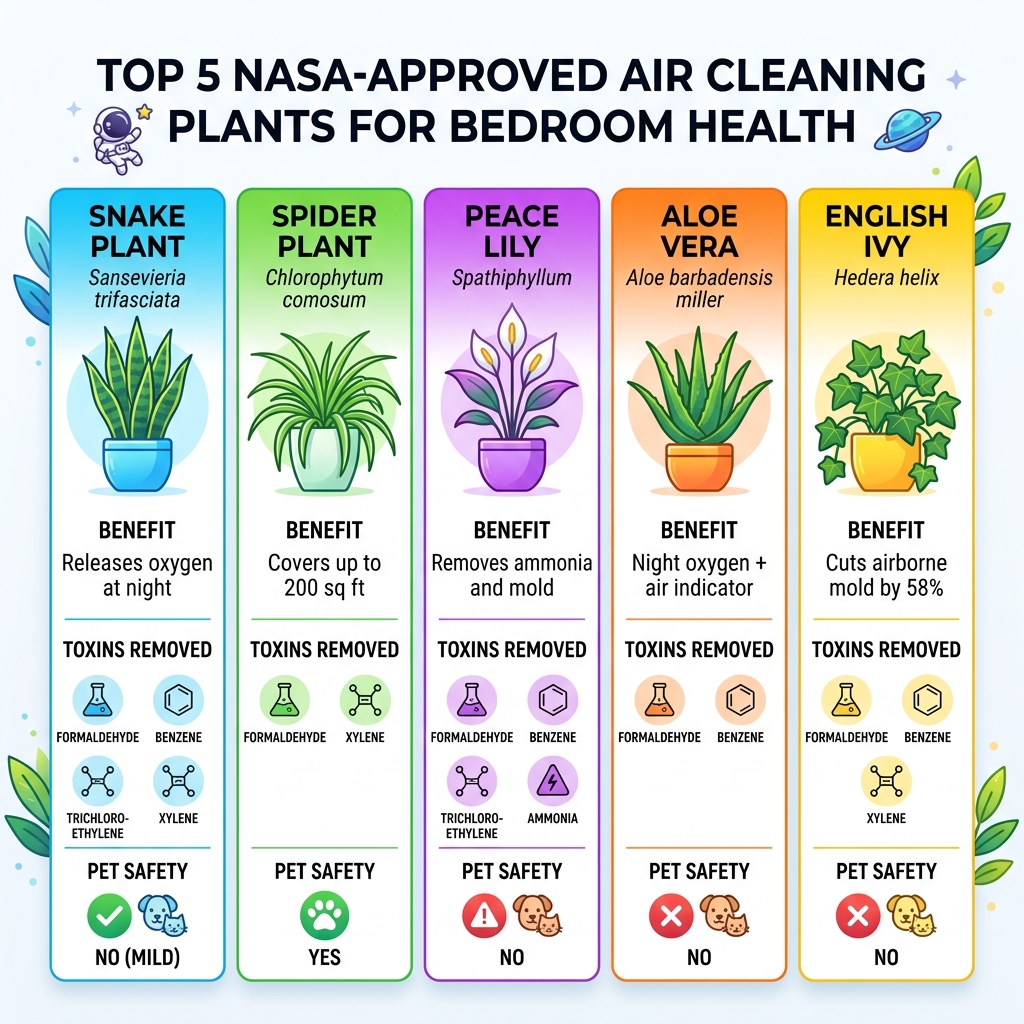
The best air cleaning plants for bedroom use, according to NASA’s Clean Air Study, include the Snake Plant, Spider Plant, Peace Lily, Aloe Vera, and English Ivy.
Here’s a quick reference:
| Plant | Key Benefit | Pet Safe? |
|---|---|---|
| Snake Plant | Releases oxygen at night | No (mild) |
| Spider Plant | Covers up to 200 sq ft | Yes |
| Peace Lily | Removes ammonia and mold | No |
| Aloe Vera | Night oxygen + air indicator | No |
| English Ivy | Cuts airborne mold by 58% | No |
Most of us know outdoor air pollution is a problem. But the air inside your bedroom? It can actually be worse.
Furniture, carpets, mattresses, and cleaning products quietly release chemicals like formaldehyde, benzene, and trichloroethylene into the air you breathe every night. The EPA estimates this affects indoor air quality in 90% of homes.
NASA scientists discovered something surprising back in 1989: common houseplants can pull these toxins out of the air. Their research — originally aimed at keeping air clean on space stations — found that certain plants are remarkably efficient at filtering volatile organic compounds (VOCs).
Even more striking, follow-up research linked better bedroom air quality to up to a 37% increase in deep sleep phases. That’s not a minor tweak. That’s the kind of sleep improvement most people spend hundreds of dollars chasing.
The good news? You may only need one medium-sized plant to start seeing results.
The Science Behind Air Cleaning Plants for Bedroom Air Quality
When we talk about plants “cleaning” the air, we aren’t just using a marketing buzzword. There is a fascinating biological process at work here called phytoremediation. Essentially, plants act as living filters. While we sleep, these green companions are hard at work absorbing gases through their leaves and roots.

The NASA Clean Air Study focused on “Sick Building Syndrome,” a condition where occupants experience health issues tied to time spent in a building. The culprits are often Volatile Organic Compounds (VOCs). Here are the three “big bads” these plants fight:
- Formaldehyde: Found in particleboard, carpets, and upholstery. It can irritate the nose and throat.
- Benzene: Often found in plastics, synthetic fibers, and detergents.
- Trichloroethylene: Usually enters the home via printing inks, lacquers, and adhesives.
NASA’s research proved that certain species could remove up to 87% of these toxins within just 24 hours. For a deeper dive, you can explore this complete list of plants that NASA vetted. If you’re more of a visual learner, we highly recommend watching this great video about a gentleman who used specific plants to “grow his own fresh air” in one of the world’s most polluted cities.
The Sleep Connection: Why 37% Matters
It isn’t just about removing “poisons.” It’s about the quality of your rest. Research follow-ups to the NASA studies found that in rooms with optimized air quality, deep sleep phases increased by up to 37%. When your brain doesn’t have to deal with microscopic irritants, it can transition more effectively into the restorative stages of sleep.
| Species | Formaldehyde Removal | Benzene Removal | Nighttime O2? |
|---|---|---|---|
| Snake Plant | High (94%) | Moderate | Yes |
| Peace Lily | Very High | High | No |
| English Ivy | Moderate | High | No |
| Aloe Vera | High | Moderate | Yes |
Top 5 NASA-Approved Species for Nighttime Oxygen
Most plants are “day shift” workers. They take in CO2 and release oxygen during the day, then flip the script at night, consuming a tiny bit of oxygen. However, a special group of plants uses CAM photosynthesis (Crassulacean Acid Metabolism). These plants evolved in arid climates and keep their pores (stomata) closed during the day to save water, opening them only at night to take in CO2 and release fresh oxygen.
This makes them the ultimate air cleaning plants for bedroom environments because they are literally refreshing your air while you sleep. Before you pick one, make sure to check our guide on indoor plant light requirements to ensure your bedroom has the right “vibes” for your new roommate. You can also read more about Sansevieria Trifasciata for improved indoor health to see the clinical side of these benefits.
Snake Plant (Dracaena trifasciata): The Ultimate Air Cleaning Plant for Bedroom Nighttime Oxygen
Commonly known as “Mother-in-law’s tongue” (due to its sharp, pointed leaves), the Snake Plant is the undisputed heavyweight champion of the bedroom. According to the scientific profile of Dracaena trifasciata, this plant is incredibly resilient.
It is famous for its nighttime O2 release and its ability to scrub xylene and toluene from the air. It’s also nearly indestructible. If you struggle with keeping things alive, this is your plant. It thrives even with indoor plant care for low light, making it perfect for those of us who keep the blackout curtains drawn.
Spider Plant: The Low-Maintenance Air Cleaning Plant for Bedroom Beginners
The Spider Plant (Chlorophytum comosum) is like that one friend who is always chill and never demands much. NASA found it can absorb carbon monoxide and nitrogen dioxide. Remarkably, one spider plant can effectively filter the air in a 200 square foot room.
It’s also one of the few truly pet-safe options on the list. For the best results, check out our indoor plant placement tips to see where “Spidey” will do the most work.
Peace Lily (Spathiphyllum): Best for Humidity and Ammonia
If you wake up with a dry throat, the Peace Lily is for you. It has high transpiration rates, providing a 5% humidity boost to your room. It’s also a specialist at removing ammonia (often found in cleaning products) and reducing mold spores in the air.
Because they love moisture, it’s worth reviewing our humidity tips for houseplants to keep those white blooms looking sharp. Just keep in mind they prefer indirect light; direct sun will scorch their delicate leaves.
Aloe Vera: The Sleep-Enhancing Succulent
Aloe Vera isn’t just for sunburns! It’s a CAM plant, meaning it releases oxygen at night. It also acts as a biological “air quality monitor.” If the air is heavily polluted, the leaves may develop brown spots, letting you know it’s time to open a window.
Since it’s a succulent, it needs very little water, especially during the colder months. Be sure to follow our advice on indoor plant care during winter to avoid root rot.
English Ivy: Reducing Airborne Mold and Allergens
English Ivy (Hedera helix) is a powerhouse for allergy sufferers. Research from the University of Georgia showed it can reduce airborne mold by up to 58% in just six hours. By capturing these particles, it can significantly reduce nighttime sneezing and congestion.
It looks beautiful in a hanging basket, which is a great way to save space in smaller rooms. If you’re in a studio, check out our tips for low light indoor plants for apartments to see how Ivy fits in.
Maximizing Benefits: Placement and Quantity Guidelines
To get the most out of your air cleaning plants for bedroom setup, you can’t just stick a tiny cactus in the far corner and expect miracles. NASA’s guidelines suggest one medium-sized plant (6-8 inch pot) per 100 square feet of space. For most standard bedrooms, two plants are the “sweet spot.”
- The 3-5 Foot Rule: Place the plant within 3 to 5 feet of your head. This ensures you are in the “zone” of the freshest oxygen and filtered air.
- Clustering: Grouping 3-5 plants together can increase local humidity by up to 15% through collective transpiration.
- Airflow: Don’t tuck plants behind heavy furniture. They need a bit of air circulation to move the toxins toward their leaves.
Mastering the art of indoor plant placement can turn a cluttered room into a functional, breathing sanctuary.
Potential Drawbacks and Safety Considerations
While we love our green friends, we have to be responsible “plant parents.”
- Pet Toxicity: Many air-purifying plants, like the Snake Plant and Peace Lily, are toxic if ingested by cats or dogs. Always check the ASPCA database before buying. If you have a nibbler, stick to Spider Plants or Areca Palms.
- Mold Prevention: Overwatering is the #1 mistake. Damp soil can grow mold, which defeats the purpose of an air-cleaning plant! Always use pots with drainage holes.
- Allergies: If you are highly sensitive to pollen, avoid flowering plants like the Peace Lily. Stick to leafy greens.
For more safety tips, see our indoor plant placement tips-2 guide to keep your plants out of reach of curious paws and toddlers.
Frequently Asked Questions about Bedroom Air Purifying Plants
Do bedroom plants really outperform electric air purifiers?
It’s a different game. Electric air purifiers with HEPA filters are better at catching large particulate matter like dust and pet dander. However, plants are often better at removing specific chemical VOCs and providing psychological benefits (reducing stress by 40-50%). We recommend a combined approach: use a purifier for dust and plants for chemicals and oxygen.
How long does it take to notice better sleep after adding plants?
Most people notice a difference in “air freshness” within 24 hours. However, for sleep quality, it usually takes 10-14 days to notice subtle changes, and about 4 weeks for significant improvements in deep sleep phases. If you use a sleep tracker, keep an eye on your “Deep Sleep” stats after adding a Snake Plant!
Are there any pet-safe air cleaning plants for bedroom spaces?
Absolutely! The Spider Plant, Areca Palm, and Boston Fern are all non-toxic to cats and dogs. These are excellent choices for a worry-free bedroom oasis.
Conclusion
Creating a healthy sleep environment doesn’t require expensive gadgets or a complete home renovation. By strategically choosing air cleaning plants for bedroom use, you can tap into NASA-proven science to scrub toxins, boost oxygen, and potentially increase your deep sleep by 37%.
At Futuro Ciencia, we believe your bedroom should be a tranquil oasis. We’re here to help you maintain that greenery with easy-to-follow care schedules and guides so you can spend less time worrying about your plants and more time enjoying the fresh air they provide.
Ready to breathe easier? Transform your bedroom with Futuro Ciencia and start your journey toward a purer, brighter home today.
