
What You Need to Know About Caladium Care Indoor (At a Glance)
Caladium care indoor comes down to five core needs. Get these right and your plant will reward you with stunning, colorful foliage for months.
| Care Factor | What to Do |
|---|---|
| Light | Bright, indirect light — north or east-facing window |
| Water | Keep soil evenly moist; water when top 25% of soil surface is dry |
| Humidity | Aim for 60–75%; use a pebble tray or humidifier |
| Temperature | Keep between 60°F–80°F (16°C–27°C); avoid drafts |
| Dormancy | Expect leaves to die back in winter — this is completely normal |
If you’ve ever watched a caladium go from a jaw-dropping centerpiece to a sad, drooping mess in a matter of weeks, you’re not alone.
These plants are natives of the tropical rainforests of South and Central America. They’re used to warm, humid, shaded jungle conditions — not the dry air and inconsistent light of a typical home. That gap between their natural habitat and your living room is exactly why so many people struggle with them.
The good news? Once you understand what caladiums actually need, they’re not that hard to keep happy. They just have a few non-negotiable requirements — and one quirk that surprises almost every new owner: they go dormant every winter, no matter what you do. Leaves die back, the pot looks empty, and everything seems dead. It’s not. The tuber is just resting underground, waiting for spring.
Caladiums grow from underground tubers (sometimes called corms), reach 12–30 inches tall, and produce those iconic heart-shaped leaves splashed with pink, red, white, and green. They belong to the Araceae family — the same family as peace lilies and philodendrons — and they go by nicknames like “Heart of Jesus” and “elephant ears.”
Think of them less like a typical houseplant and more like a seasonal performer that needs specific backstage conditions to put on a great show.
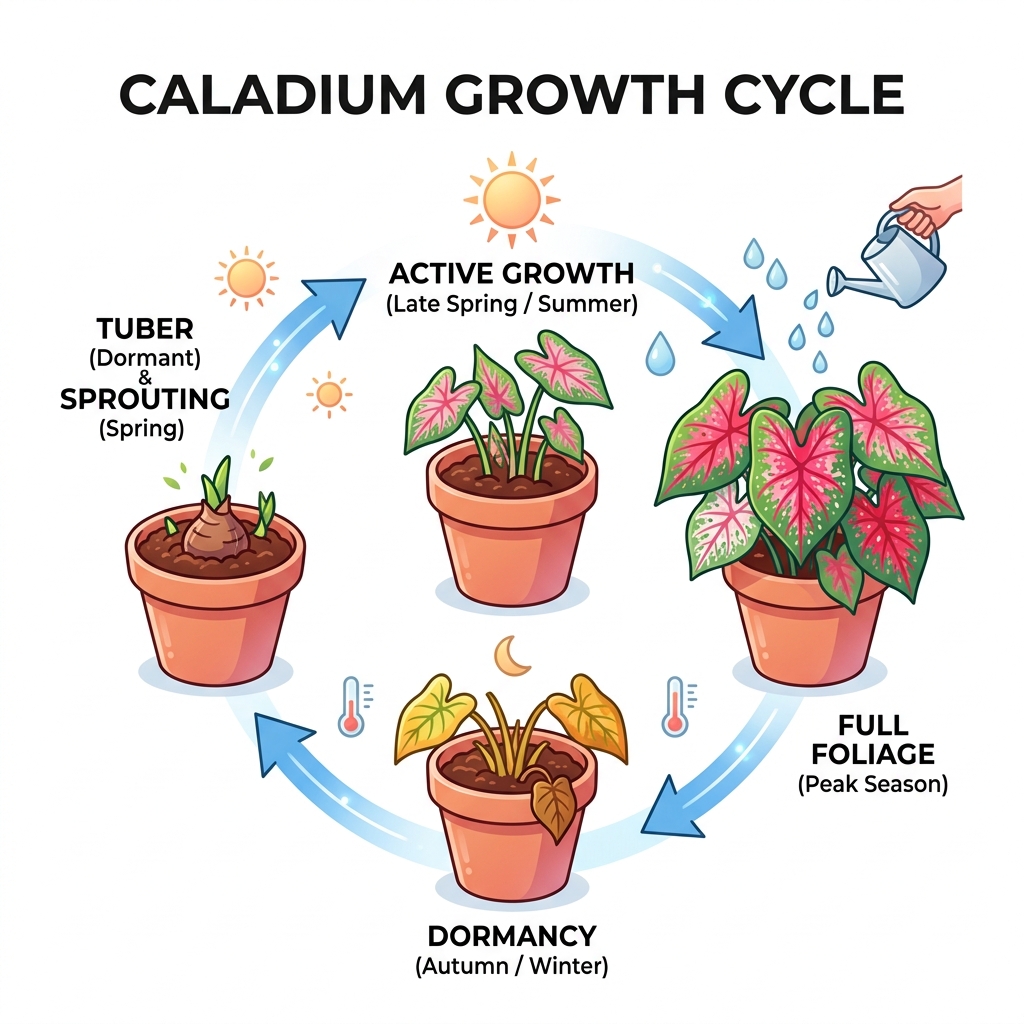
Know your caladium care indoor terms:
Essential Environmental Needs for Caladium Care Indoor
Creating a tropical oasis inside a modern home can feel like a bit of a balancing act. To master caladium care indoor, we have to remember that these plants are “understory” residents. In the wild, they live on the jungle floor, protected by a thick canopy of taller trees. This means they love heat and moisture but absolutely hate direct, scorching sun.
When we bring them inside, we are essentially trying to replicate a humid, dappled-light microclimate. If your home feels like a dry desert in the winter or a dark cave in the summer, your caladium will be the first to let you know. Understanding indoor plant light requirements is the first step to ensuring those vibrant neon pinks and snowy whites don’t fade into a dull, crispy brown.
Optimal Light Levels for Caladium Care Indoor
Light is perhaps the most misunderstood aspect of caladium care indoor. Because they are often sold as “shade plants” for gardens, many people put them in dark corners of their homes. Indoors, however, “shade” can quickly become “too dark.”
We recommend placing your caladium near a North-facing or East-facing window. These spots provide gentle, filtered light that mimics the dappled shade of a jungle. If you only have a bright, South-facing window, don’t panic—just use a sheer curtain to diffuse the intensity.
Direct midday sun is the enemy; it will cause “leaf scorch,” leaving ugly brown holes or bleached patches on the delicate, paper-thin foliage. Interestingly, varieties with narrower leaves tend to have a slightly higher tolerance for sun than the massive, broad-leaved types, but “bright indirect” remains the gold standard for all.
Humidity and Temperature for Caladium Care Indoor
If there is one thing that makes a caladium feel at home, it’s “thick” air. These plants thrive when the humidity is between 60% and 75%. In most homes, especially during the winter when the heater is running, humidity can drop to 20% or 30%. This is often why leaves begin to curl at the edges.
To boost moisture, you can:
- Use a pebble tray: Fill a shallow tray with pebbles and water, then set the pot on top (ensuring the bottom of the pot doesn’t touch the water).
- Mist regularly: Use a fine spray bottle to gently dampen the leaves.
- Group plants: Caladiums love friends! Grouping them with other tropicals creates a localized humid zone.
- Humidifier: This is the most effective way to keep your tropicals happy year-round. Check out our humidity tips for houseplants for more hacks.
Temperature is equally critical. Caladiums are heat-seekers. They prefer daytime temperatures between 70°F and 75°F and shouldn’t drop below 60°F at night. According to scientific research on tropical plant temperature needs, cold drafts from air conditioners or drafty winter windows can shock the plant into premature dormancy.
Potting, Soil, and Nutrient Management
The foundation of any healthy houseplant is what’s happening below the surface. For caladium care indoor, you want a soil that is rich but “fluffy.” Think of it as a sponge that holds moisture but never stays soggy.
A peat-rich potting mix is ideal because it provides the slightly acidic environment (pH 5.5 to 6.2) that caladiums crave. We always suggest using a pot with ample drainage holes. Without them, water sits at the bottom, leading to the dreaded “mushy tuber” syndrome. You can learn more about choosing the best soil for indoor plants to give your tubers the best start.
Mastering the Moisture Balance
Watering a caladium is a “Goldilocks” situation—not too much, not too little. You want the soil to stay evenly moist during the active growing season (spring through early autumn).
A good rule of thumb is to check the soil every few days. If the top 25% of the soil surface feels dry to the touch, it’s time to water.
- Overwatering signs: Soft, mushy stems and yellowing leaves that fall off easily. This often leads to root rot.
- Underwatering signs: Drooping leaves and crispy, brown edges.
Consistency is key. To keep yourself on track, we recommend following an indoor plant care schedule to ensure you don’t forget your thirsty tropicals.
Feeding for Foliage
Because caladiums grow so much foliage in a short amount of time, they are hungry plants. During the spring and summer, we suggest a monthly fertilization routine. Use a balanced liquid fertilizer diluted to half-strength.
Avoid high-dose fertilizers, as they can burn the sensitive roots. Also, remember to only fertilize when the soil is already moist; applying fertilizer to bone-dry soil can cause chemical shock. Once the plant begins to enter its natural dormancy in the fall, stop feeding entirely. You can find more timing tips in our indoor plant maintenance checklist.
Navigating the Dormancy Cycle and Winter Storage
One of the most common mistakes in caladium care indoor is throwing the plant away in October because it “died.” In reality, the plant is just going to sleep. As the days get shorter and temperatures drop, caladiums naturally shed their leaves to conserve energy in the tuber.
When the leaves start to yellow and droop in late autumn, stop watering. Let the foliage wither completely, then snip it off about an inch above the tuber. You have two choices for the winter:
- The Lazy Method: Leave the tuber in its pot of dry soil. Move the pot to a cool, dark, dry spot (like a basement or closet) where temperatures stay above 55°F. Do not water it until spring.
- The Pro Method: Dig the tubers up, gently brush off the soil, and pack them in a breathable bag with dry peat moss or vermiculite. This prevents the tubers from shriveling or rotting.
For a deeper dive into seasonal transitions, check out our guide on indoor-plant-care-during-winter/. When spring returns and temperatures hit a consistent 65°F-70°F, it’s time to learn how to repot indoor plants and wake those tubers up!
Transitioning from Outdoor to Indoor
If you’ve been growing your caladiums on a patio or in the garden, you must bring them inside before the first frost. Caladiums have zero frost tolerance.
Move them inside in early fall when night temperatures start dipping toward 60°F. This “acclimatization” period is vital. Inspect the leaves thoroughly for “hitchhiking” bugs and give the plant a gentle prune if needed. If the plant is too large, this is also a great time for tuber division—splitting the main tuber into smaller sections to create brand new plants for the following year.
Troubleshooting Pests, Toxicity, and Common Issues
Even with the best caladium care indoor, problems can arise. The key is to catch them early.
Common pests include aphids and spider mites, which love the underside of those large leaves. If you see tiny webs or sticky residue, it’s time to act. Check out indoor-plant-pests-and-how-to-remove-them/ for safe removal methods.
If your leaves are turning yellow, it could be a sign of overwatering or a lack of nutrients. If they are brown and crispy, your humidity is likely too low. We have a specific guide on how to fix yellow leaves on houseplants that can help you diagnose the exact cause.
Toxicity and Safety Warnings
While they are beautiful, caladiums come with a “look but don’t touch” (and definitely don’t eat) warning. All parts of the plant contain calcium oxalate crystals.
According to scientific research on Caladium toxicity, if ingested by humans or pets, these crystals cause intense burning and irritation of the mouth, throat, and stomach. The sap can also cause skin irritation for some people. Always keep these plants out of reach of curious cats, dogs, and toddlers. If you have sensitive skin, consider wearing gloves when pruning or repotting.
Common Growth Problems
One odd thing you might see is your caladium producing a flower—a small, greenish-white spathe. While interesting, these flowers aren’t particularly showy and they drain a lot of energy from the plant. We recommend snipping them off immediately. This redirects all that “fuel” back into producing those spectacular leaves.
If you notice soft, mushy stems at the base, you might be dealing with a fungal issue or root rot. In these cases, reducing water and applying an indoor-plant-fungus-treatment/ can sometimes save the plant if caught early.
Frequently Asked Questions about Caladiums
How do I propagate Caladiums indoors?
Propagation is done through tuber division. In late winter or early spring, before you replant, look at your tubers. You will see small bumps called “eyes” (similar to a potato). Using a sterile knife, cut the tuber into sections, ensuring each piece has at least one healthy eye. Let the cut ends dry for a day to “callus” over before planting them in fresh soil.
What are the best Caladium varieties for indoor growth?
Some varieties handle the lower light and humidity of a home better than others.
- White Christmas: Large, striking white leaves with green veins.
- Miss Muffet: A dwarf variety that stays small (around 8 inches), making it perfect for desks.
- Puppy Love: Features heart-shaped pink leaves with a thin green margin.
- Creamsicle: Vibrant orange-red centers with green borders.
Can Caladiums grow indoors year-round?
Technically, yes, but they still require a dormancy period. You cannot force a caladium to keep its leaves 12 months a year; the plant’s internal clock will eventually trigger a shutdown. However, because indoor environments are controlled, the “active” season is often much longer than it would be outdoors.
Conclusion
At Futuro Ciencia, we believe that every home deserves the vibrant energy that only a tropical plant can provide. While caladium care indoor requires a bit more attention than a typical cactus, the reward is a living work of art that brightens even the dullest corner.
By respecting their need for humidity, filtered light, and a winter nap, you can transform your space into a tranquil oasis. If you’re just starting your journey, our indoor-plant-care-tips-for-beginners/ is a great place to build your confidence.
Growth vs. Dormancy: A Quick Comparison
| Feature | Active Growth (Spring/Summer) | Dormancy (Fall/Winter) |
|---|---|---|
| Watering | Keep soil consistently moist | Stop watering entirely |
| Fertilizer | Monthly half-strength liquid | Do not fertilize |
| Light | Bright, indirect sunlight | Can be kept in a dark area |
| Temperature | 70°F–80°F is ideal | Above 55°F to protect tubers |
| Foliage | Lush, colorful, heart-shaped | Leaves yellow, die, and are removed |
Ready to learn more? Explore our full library for more info about indoor plant care and keep your green friends thriving!
