
Your Office Deserves More Green (and Less Stress)
Easy care office plants are the simplest upgrade you can make to your workspace before your next big meeting. Here are the top picks to buy right now:
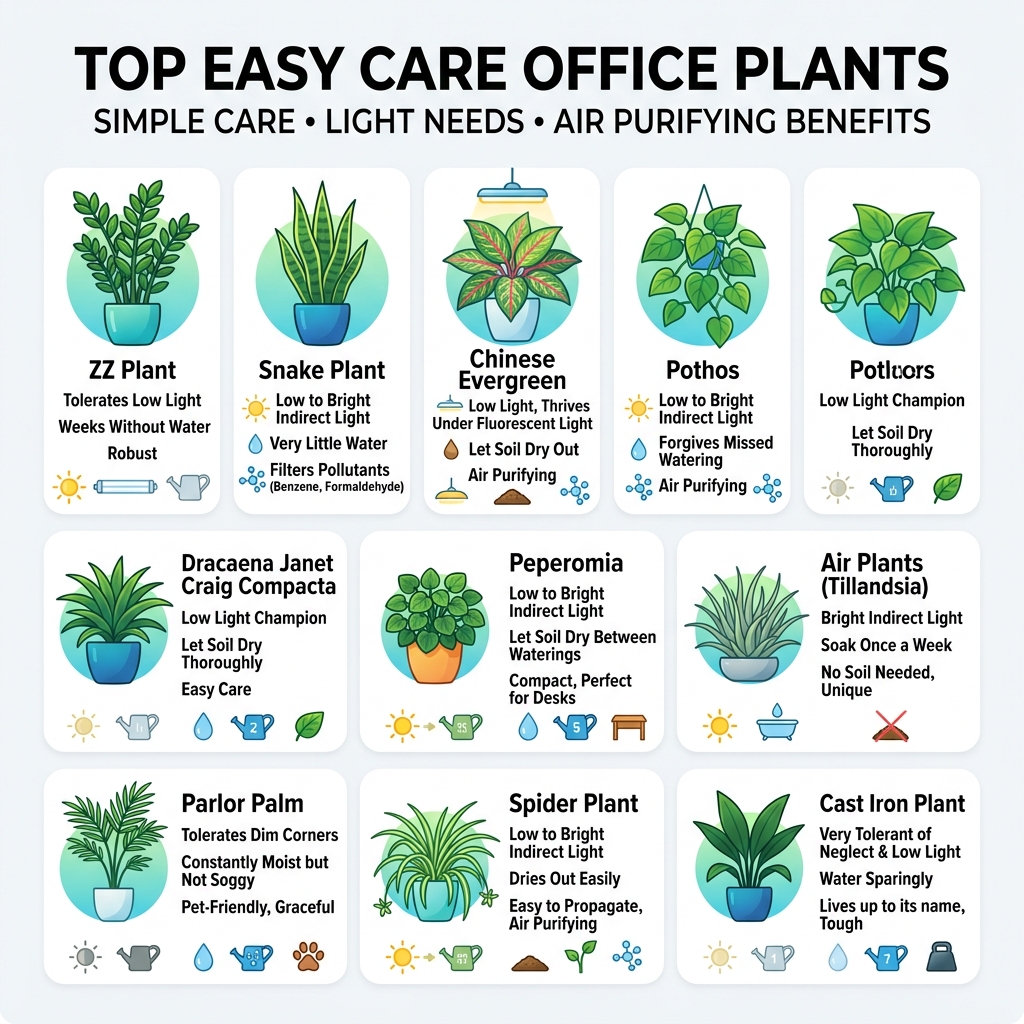
Best Easy Care Office Plants at a Glance:
- ZZ Plant – tolerates low light and weeks without water
- Snake Plant – nearly indestructible, filters air pollutants
- Chinese Evergreen – thrives under fluorescent lighting alone
- Pothos – trails beautifully, forgives missed watering
- Dracaena Janet Craig Compacta – slow-growing, low-light champion
- Peperomia – compact, perfect for small desks
- Air Plants (Tillandsia) – no soil needed, soak once a week
- Parlor Palm – pet-friendly and tolerates dim corners
- Spider Plant – easy to propagate, low fuss
- Cast Iron Plant – lives up to its name
Think about how much time you actually spend at your desk. Probably more than you’d like. Yet most offices look exactly the same: white walls, gray carpet, and zero greenery.
That’s a problem worth solving.
Research shows indoor plants can boost worker productivity by 15%. They also filter out harmful pollutants like benzene and formaldehyde that off-gas from synthetic office furniture. And studies from NASA confirm that plants genuinely clean the air in enclosed indoor spaces.
The catch? Most people worry they’ll kill anything they bring in. Between back-to-back meetings, travel, and forgetting to water, keeping plants alive at work feels like one more thing to fail at.
Here’s the good news: you don’t need a green thumb. You just need the right plants. The varieties in this guide are specifically chosen because they tolerate neglect, low light, and the dry air that comes with most office HVAC systems.
Less than 1% of known plant species can actually survive typical office conditions — so choosing from that shortlist matters. This guide does that work for you.
Top Easy Care Office Plants for Windowless Workspaces
If your office feels more like a dungeon than a corner suite, don’t despair. Many of the most popular easy care office plants actually hail from the floors of tropical rainforests. In their natural habitat, they live under a dense canopy that blocks out most direct sun. This makes them perfectly adapted to the “artificial canopy” of your office ceiling.
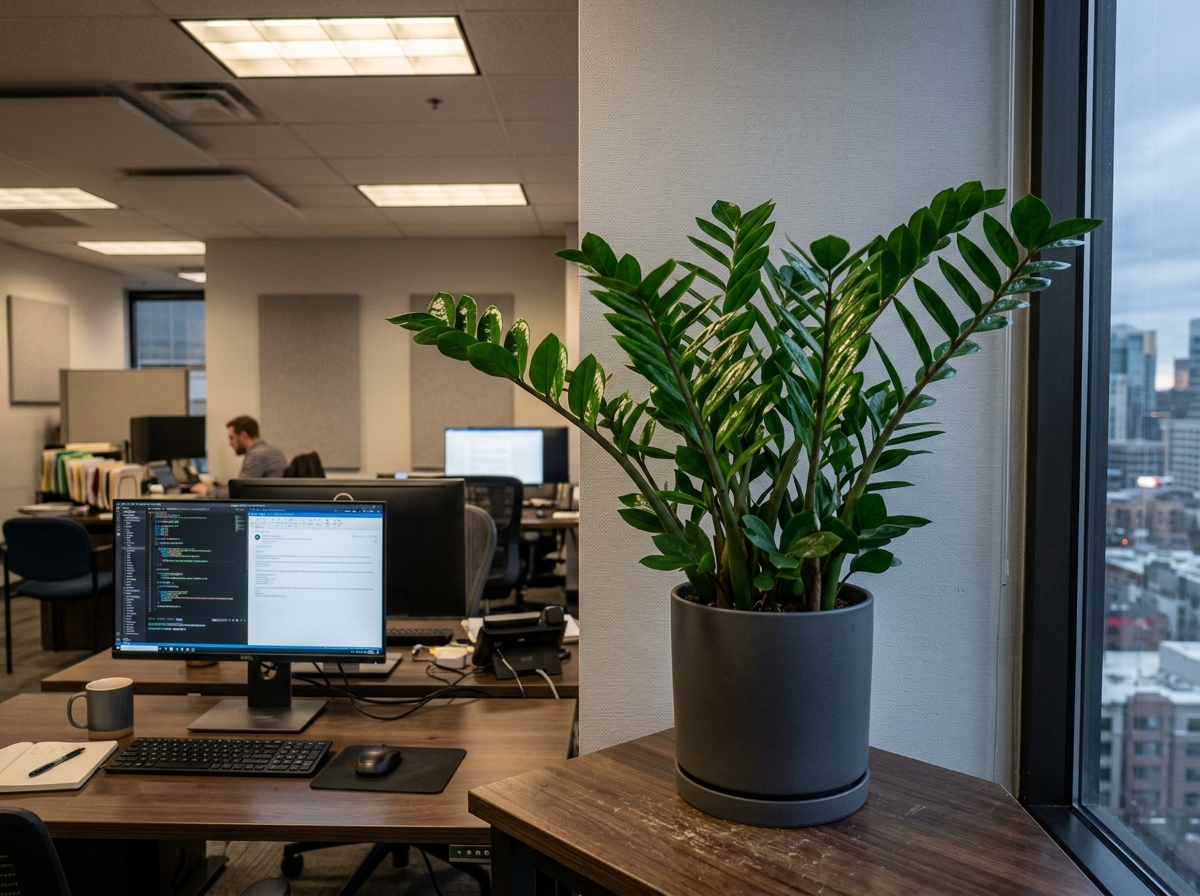
Windowless offices often rely entirely on fluorescent lighting. While humans might find these bulbs a bit clinical, many plants can actually use this spectrum for photosynthesis. The key is choosing varieties with high chlorophyll density—those dark green leaves are essentially high-efficiency solar panels designed to catch every stray lumen.
The Chinese Evergreen is a hall-of-fame candidate for these conditions. It is remarkably sturdy and comes in various patterns, from silvery-green to deep emerald. It grows slowly, meaning it won’t take over your desk by next quarter, and it is widely considered one of the toughest plants for beginners.
To help you choose, we’ve put together a quick reference for the best low-maintenance plants for offices that can handle dim environments:
| Plant Variety | Light Requirement | Watering Frequency | Best Feature |
|---|---|---|---|
| ZZ Plant | Low to Medium | Every 3-4 weeks | Indestructible; shiny leaves |
| Snake Plant | Low to Bright | Every 2-3 weeks | Air purifier; vertical shape |
| Chinese Evergreen | Low to Medium | Every 1-2 weeks | Patterned foliage; very hardy |
| Cast Iron Plant | Low | Every 1-2 weeks | Tolerates dust and drafts |
| Peace Lily | Low to Medium | Once a week | Signals thirst by drooping |
The Indestructible ZZ Plant: A Low-Maintenance Office Plant
The ZZ Plant (Zamioculcas zamiifolia) is the ultimate “set it and forget it” greenery. If you have a habit of going on two-week vacations or getting buried under end-of-month reporting, this is your plant.
What makes it so special? Evolution equipped the ZZ plant with thick, potato-like underground structures called rhizomes. These act like internal water tanks, storing moisture for long periods of drought. This is why it’s often featured in lists of indoor plants that survive neglect.
Its waxy, succulent-like leaves are so shiny they often look fake, which adds a high-end, polished look to any workspace. It handles low light like a pro and won’t throw a tantrum if the office AC kicks into high gear. Just remember the golden rule: when in doubt, don’t water it. Overwatering is the only real way to hurt this resilient beauty.
Snake Plants: Architectural Easy Care Office Plants
Commonly known as “Mother-in-Law’s Tongue,” the Snake Plant is a staple of biophilic design. Because it grows vertically rather than spreading out, it’s perfect for flanking a doorway or sitting at the end of a communal desk without invading anyone’s personal space.
Beyond its looks, the Snake Plant is a powerhouse of air purification. It is one of the few plants that continues to convert CO2 into oxygen at night, and it’s famous for filtering out benzene and trichloroethylene. If you’re looking for low-water indoor plants, this is a top contender. It can easily go three weeks without a drink, making it the perfect companion for a busy professional.
Best Desk Plants for Small Cubicles and Shared Spaces
Space is a premium in the modern office. You might not have room for a six-foot palm, but that doesn’t mean you can’t have a personal jungle. The best desk plants are those that stay compact or can be easily pruned to fit their surroundings.
For a refined, architectural look in a small footprint, consider the Dracaena Janet Craig Compacta. Unlike its larger cousins, the ‘Compacta’ variety stays small and maintains a tight, tufted appearance. It is a favorite for professional interiorscapers because it holds its shape for years without stretching toward the light.
If you want something with a bit of movement, the Pothos is a classic choice. Its heart-shaped leaves trail beautifully over the edge of a monitor stand or a bookshelf. It’s one of the most easy indoor plants for beginners because it grows quickly and is incredibly easy to propagate—just snip a vine, put it in water, and you have a new plant for your coworker.
Soil-Free Options: Air Plants and Lucky Bamboo
Worried about soil spilling on your keyboard or attracting “office gnats”? You might want to skip the dirt entirely.
Air Plants (Tillandsia) are fascinating little creatures that don’t need soil to grow. They absorb moisture and nutrients through their leaves. In an office setting, you can display them in glass globes, on decorative driftwood, or even mounted to a wall. Care is simple: give them a thorough soak in a bowl of water for about 20 minutes once a week, let them dry completely, and put them back.
Lucky Bamboo is another mess-free favorite. It’s typically grown in a vase of water with pebbles for stability. It’s highly adaptable to low light and adds a zen-like quality to a stressful cubicle. Just make sure to top off the water every week and change it completely once a month to keep it fresh. These are excellent indoor succulents that are easy to care for alternatives for those who want a unique look.
Hardy Favorites for Busy Professionals
For the executive who is rarely at their desk, we recommend the Cast Iron Plant (Aspidistra elatior). It earned its name by surviving the dim, smoky, and drafty parlors of Victorian England. It can handle nearly anything: low light, poor air quality, and irregular watering.
If you prefer something with more color, Peperomia varieties offer thick, rubbery leaves in various shades of green, red, and cream. They are slow-growing and rarely outgrow their original pots, making them ideal hardy indoor plants for busy people.
Why Your Workspace Needs Greenery Before Your Next Meeting
Adding plants to your office isn’t just about aesthetics; it’s a strategic move for your health and performance. We spend roughly 90% of our time indoors, often in “sick buildings” where air circulation is poor and synthetic materials release low levels of toxins.
Here is why you should consider indoor plants for the home office or corporate space:
- Productivity Boost: A UK study found that introducing plants into a previously “lean” office space increased productivity by 15%. The presence of nature helps our brains recover from “directed attention fatigue”—that feeling you get after staring at spreadsheets for four hours.
- Stress Reduction: Seeing greenery lowers cortisol levels and heart rates. It creates a “micro-break” for the eyes, reducing the strain of screen time.
- Air Quality: Plants act as natural air filters. They absorb carbon dioxide and release fresh oxygen, while their roots and soil microbes work together to neutralize volatile organic compounds (VOCs).
- Humidity Management: Office air is notoriously dry due to air conditioning. Plants release moisture through a process called transpiration, which can help prevent dry skin and throat irritation.
Essential Care Tips to Keep Your Office Plants Thriving
The biggest mistake most office dwellers make is “smothering” their plants with too much attention. 80% of indoor plant problems are caused by either improper lighting or overwatering.
To keep your easy care office plants in top shape, follow these Futuro Ciencia best practices:
- The Finger Test: Before you reach for the watering can, stick your finger an inch into the soil. If it feels damp, walk away. Most office plants prefer to dry out slightly between waterings.
- Drainage is Non-Negotiable: Never let a plant sit in a pool of water at the bottom of a decorative pot. This leads to root rot, which is almost always fatal. If your planter doesn’t have a hole, keep the plant in its plastic “nursery pot” and take it to the breakroom sink to water it.
- Dust the Leaves: In an office, dust accumulates quickly. A layer of dust on the leaves blocks sunlight and prevents the plant from “breathing.” Give the leaves a gentle wipe with a damp cloth every few weeks.
- Avoid Drafts: Don’t place your plants directly under an AC vent or right next to a heater. Extreme temperature fluctuations are stressful for tropical plants.
For more detailed guidance, check out our indoor plant care tips for beginners and our specialized indoor plant care tips for busy people.
Frequently Asked Questions about Office Greenery
Can office plants survive under fluorescent lighting?
Yes! Many indoor plants that need little care are perfectly happy with artificial light. Fluorescent bulbs provide the blue-spectrum light that plants need for foliage growth. While they might not grow as quickly as they would in a sunny window, varieties like the ZZ Plant, Snake Plant, and Pothos will remain healthy and vibrant under standard office lights.
Which office plants are pet-safe or non-toxic?
If you work in a pet-friendly office or a home office with a curious cat, safety is a priority. While many popular plants (like the Snake Plant and ZZ Plant) are mildly toxic if ingested, there are great low-maintenance plants for offices-2 that are completely non-toxic. The Parlor Palm, Spider Plant, and most Calathea varieties are safe for both cats and dogs.
How often should I water my office plants?
There is no “one size fits all” schedule, but most easy care office plants thrive on a 1-2 week watering cycle. Succulents and Snake Plants can go longer—often 3 weeks or more. It is always better to underwater than to overwater. If you’re looking for low-water indoor plants-2, focus on those with thick, waxy leaves, as they are designed to store moisture.
Conclusion
Transforming your workspace doesn’t require a major renovation. By strategically choosing easy care office plants, you can turn a sterile cubicle into a tranquil oasis that actually helps you work better. Whether you’re looking to purify the air, boost your mood before a high-stakes presentation, or simply add a splash of color to your desk, there is a low-maintenance option that fits your lifestyle.
At Futuro Ciencia, we believe that everyone deserves a greener, healthier workspace. Our guides are designed to take the guesswork out of plant ownership, ensuring your new green coworkers thrive as much as you do.
Transform your workspace with Futuro Ciencia’s low-maintenance plant guides
