
Why Your Indoor Air Is Begging for a Humidity-Loving Plant
The best plants for humidifiers — meaning plants that naturally release moisture into the air — include Boston Fern, Areca Palm, Spider Plant, Peace Lily, English Ivy, Bamboo Palm, Rubber Plant, Philodendron, Calathea, Alocasia, Bird’s Nest Fern, and Jade Plant.
Quick answer — top picks at a glance:
- Boston Fern — highest transpiration rate of common houseplants
- Areca Palm — consistent, reliable moisture output; a 6-foot plant can release nearly a quart of water per day
- Peace Lily — great all-rounder; also purifies air
- Spider Plant — beginner-friendly; effective even in smaller spaces
- Bamboo Palm — strong performer; suits low-light corners
- English Ivy — one of the highest transpiration rates among houseplants
You’ve probably felt it before. The air inside gets dry, your skin feels tight, and you keep getting little static shocks off the doorknob. It happens a lot during winter, when heating systems strip moisture right out of the air.
The good news? Certain houseplants naturally push moisture back in. They do it through a process called transpiration — absorbing water through their roots and releasing it as vapor through their leaves. No filter to replace. No tank to refill. Just a living plant doing what it does naturally.
And the effect is real. Research shows that the right plants, placed strategically, can raise indoor humidity by 1–4% — enough to make a noticeable difference in everyday comfort.
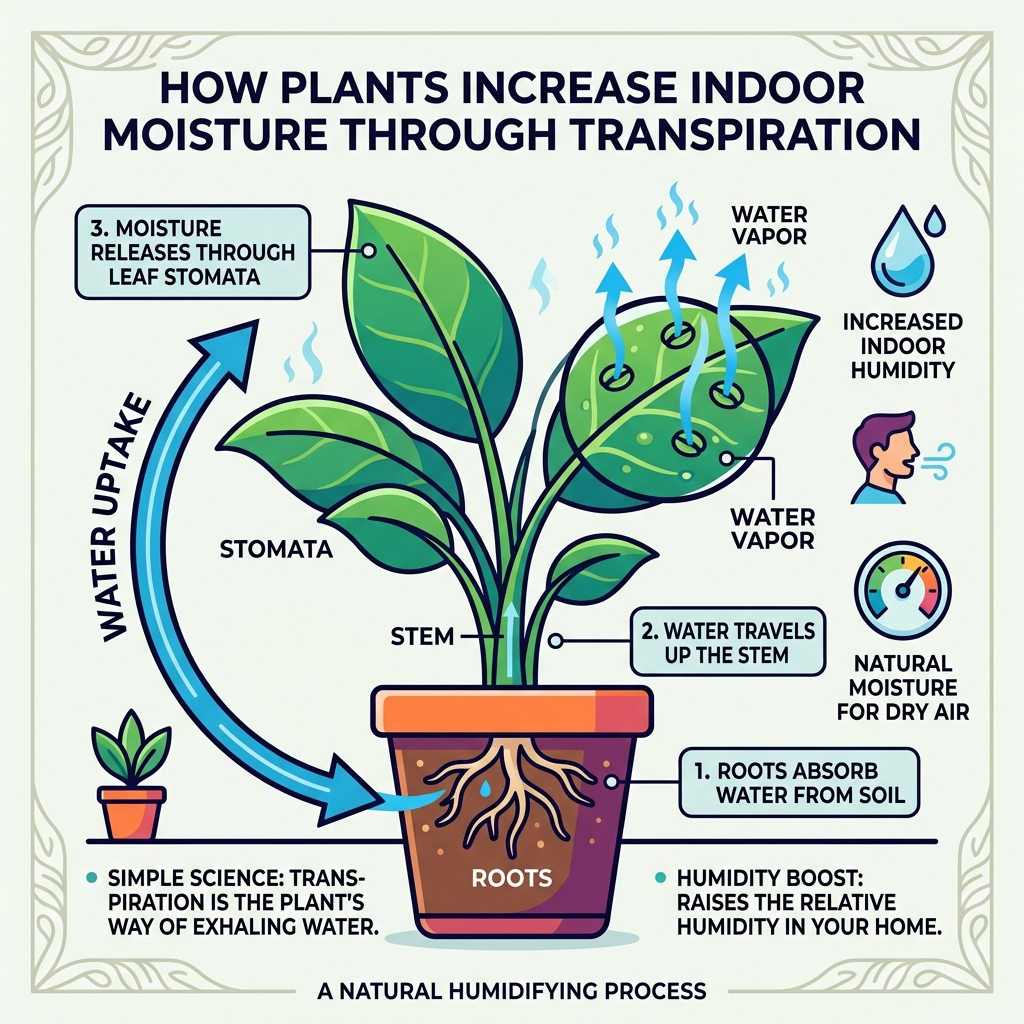
How Humidifier Plants Naturally Boost Indoor Moisture
To understand why some species are the best plants for humidifiers, we have to look at the science of “transpiration.” Think of it as a plant’s way of breathing and sweating at the same time. Plants absorb water through their roots, move it up through their stems, and eventually release it as moisture vapor through tiny pores in their leaves called stomata.
According to research on Humidifying Plants: 12 Houseplants for Dry Indoor Air, this process is actually part of a larger cycle called evapotranspiration. This includes both the water evaporated from the soil surface and the water transpired by the plant itself. When you bring these plants into a dry room, they act as living, breathing humidifiers that increase the relative humidity of your indoor environment.
The rate at which a plant humidifies your home depends on its size, leaf surface area, and thirst. A plant with many large, thin leaves generally transpires more than a succulent with thick, waxy leaves (though there are exceptions!).
| Plant Species | Transpiration Rate / Humidifying Power | Best Feature |
|---|---|---|
| Areca Palm | Very High (up to 1 quart/24 hrs) | Massive leaf surface area |
| Boston Fern | High (up to 2.2% RH increase) | Efficient “evaporator” |
| Spider Plant | Moderate | Great for small 200 sq ft rooms |
| Peace Lily | Moderate (1.5% RH increase) | Filters toxins simultaneously |
By choosing plants with high transpiration rates, we can naturally combat the “desert-dry” air caused by air conditioners and heaters.
The Best Plants for Humidifiers and Dry Rooms
When we talk about the best plants for humidifiers, we are looking for the heavy hitters of the plant world. These are the species that don’t just sit there looking pretty; they work overtime to pump moisture back into your living space.

Boston Fern (Nephrolepis exaltata)
The Boston Fern is arguably the champion of natural humidification. Because it has hundreds of tiny fronds, it has a massive amount of surface area to release moisture. In fact, studies show it can increase humidity by up to 2.2% in a standard 100-square-foot room. It loves consistent moisture, so keeping it well-watered is key to keeping its “humidifier” engine running.
Areca Palm (Dypsis lutescens)
If you have a larger room, the Areca Palm is your go-to. NASA research has highlighted this palm as one of the most efficient air-purifying and humidifying plants available. A six-foot-tall Areca palm can transpire nearly one quart of water every 24 hours! It thrives in bright, filtered light and adds a tropical, lush feel to any corner.
Spider Plant (Chlorophytum comosum)
The Spider Plant is a beginner’s dream. Not only is it incredibly hardy, but 2015 research suggests it is one of the most effective plants for increasing indoor humidity. NASA also found that it removes toxins like carbon monoxide and formaldehyde. One spider plant in a 200-square-foot room is often enough to act as an effective air filter and moisture booster. For more details on maintaining these moisture levels, check out our humidity-tips-for-houseplants.
English Ivy (Hedera helix)
Don’t let its delicate look fool you. English Ivy has one of the highest transpiration rates among common houseplants. It is particularly effective at increasing relative humidity and is even known to help remove airborne mold. It looks stunning in a hanging basket, where its trailing vines can release moisture at eye level.
Bamboo Palm and Rubber Plant
The Bamboo Palm is another NASA favorite, known for its ability to filter benzene and trichloroethylene while pumping out moisture. Meanwhile, the Rubber Plant (Ficus elastica) uses its broad, thick leaves to release moisture. It is a sturdy choice for those who want a “set it and forget it” plant that still contributes to a healthier atmosphere.
Jade Plant (Crassula ovata)
Interestingly, the Jade Plant increases relative humidity mostly in the dark. Unlike many other plants, it performs much of its evapotranspiration at night, making it a unique addition to a bedroom where you might want a humidity boost while you sleep.
Top Humidity-Loving Species for Beginners
While the plants above help create humidity, some plants simply crave it. If you already use a mechanical humidifier, these species will be your best friends because they thrive in the misty environment you’ve created.
Alocasia and Bird’s Nest Fern
Alocasia (Elephant Ear) and Bird’s Nest Ferns are tropical natives. In the wild, they live on the humid forest floor. In a dry home, they often suffer from “browning tips”—a classic sign that the air is too parched. Placing these near your humidifier will keep their leaves lush and vibrant.
Philodendron and Peace Lily
Philodendrons are famously easy to care for, but they truly shine when the humidity is between 40% and 60%. The Peace Lily is another fantastic choice; it’s a thirsty plant that “tells” you when it needs water by drooping slightly, then bounces back quickly once refreshed.
Why Calathea is one of the best plants for humidifiers
Calatheas, often called “Prayer Plants” because their leaves fold up at night, are the divas of the plant world—but they are worth the effort. They require high humidity to prevent their beautiful, painted leaves from turning crispy at the edges. They prefer indirect light and consistently moist (but not soggy) soil. If you’re struggling with lighting, our guide on indoor-plant-care-for-low-light can help you find the perfect spot for them.
Caring for the best plants for humidifiers in low light
Not everyone has a sun-drenched sunroom. Luckily, many of the best plants for humidifiers are perfectly happy in lower light conditions.
- Pothos: Arguably the easiest houseplant to grow. It handles low light gracefully and still contributes to air moisture. Check out more indoor-plants-that-thrive-in-low-light for your darker corners.
- Snake Plant: Nicknamed “Mother-in-law’s tongue,” this plant is nearly indestructible. While it transpires less than a fern, it is a powerhouse at cleaning the air at night.
- Dracaena: Perfect for apartments, these upright plants add height without needing a lot of floor space. We have more tips for these in our low-light-indoor-plants-for-apartments and low-light-indoor-plants-for-apartments-2 guides.
Maximizing the Humidifying Effect in Your Home
Just owning a plant isn’t always enough to change the air quality of a whole house. You need a strategy to maximize the “humidifier” effect.
The Power of Grouping
Plants are social creatures—well, sort of. When you group multiple plants together, they create a “microclimate.” The moisture released by one plant is trapped by the leaves of its neighbors, raising the collective humidity in that specific area. This is much more effective than scattering single plants across a large room.
Proximity Strategy
If you want to feel the benefits, you need to be close to the source. Place your humidifying plants within 3 to 5 feet of where you spend the most time—like your bedside table, your office desk, or next to your favorite reading chair.
Pebble Trays and Misting
A classic trick is the pebble tray. Fill a shallow tray with pebbles and water, then set your plant pot on top (making sure the bottom of the pot isn’t touching the water). As the water evaporates, it creates a humid “halo” around the plant. While misting provides a very temporary boost, it’s a great way to clean dust off leaves.
Leaf Maintenance
Dust is the enemy of transpiration. If a plant’s leaves are covered in dust, the “pores” (stomata) get blocked, and the plant can’t release moisture into the air. We recommend wiping your plant leaves with a damp cloth once a week to keep them functioning at 100% efficiency.
Frequently Asked Questions about Humidifying Plants
Which humidifier plants are safe for pets?
Safety is a top priority for us at Futuro Ciencia. If you have curious cats or dogs, stick to these non-toxic options:
- Spider Plants: Completely safe and fun for cats to bat at (though we don’t recommend letting them eat the leaves!).
- Areca Palms: A safe, non-toxic way to get high-volume humidification.
- Boston Ferns: Safe for both cats and dogs.
Warning: Peace Lilies, English Ivy, and Philodendrons are toxic if ingested. Keep these on high shelves or in hanging baskets away from pets.
How many plants are needed to notice a difference in humidity?
To see a real impact, the “two-plant rule” is a good baseline: aim for at least two good-sized (10-12 inch pot) plants per 100 square feet of space. For a standard 200-square-foot bedroom, 4 to 5 medium-to-large plants will create a noticeable shift in air comfort.
Can plants replace a mechanical humidifier?
In very dry climates (where humidity is below 20%), plants likely won’t be enough on their own to replace a machine. However, they are excellent “supplemental” humidifiers. They can provide a 1–4% boost, which often makes the difference between “uncomfortably dry” and “just right.” We often recommend a hybrid approach: use a small mechanical humidifier during the peak of winter and let your “humidifier plants” do the rest of the work year-round.
Conclusion
Transforming your home into a tranquil oasis doesn’t require expensive machinery or complex setups. By choosing the best plants for humidifiers, you are opting for a natural, beautiful, and science-backed way to improve your indoor air quality. Whether it’s the high-performance Areca Palm or the beginner-friendly Spider Plant, these green companions work tirelessly to brighten your space and soothe your skin.
At Futuro Ciencia, we are dedicated to helping you succeed in your plant journey. From providing indoor plant care schedules to offering expert humidity-tips-for-houseplants, we make it easy to maintain a lush, healthy, and perfectly humid home. Happy planting!
