
Why a Low Maintenance Plant Schedule Changes Everything
A low maintenance plant schedule is simply a repeating care routine that tells you what to do, when to do it, and how often — so your plants thrive even when life gets busy.
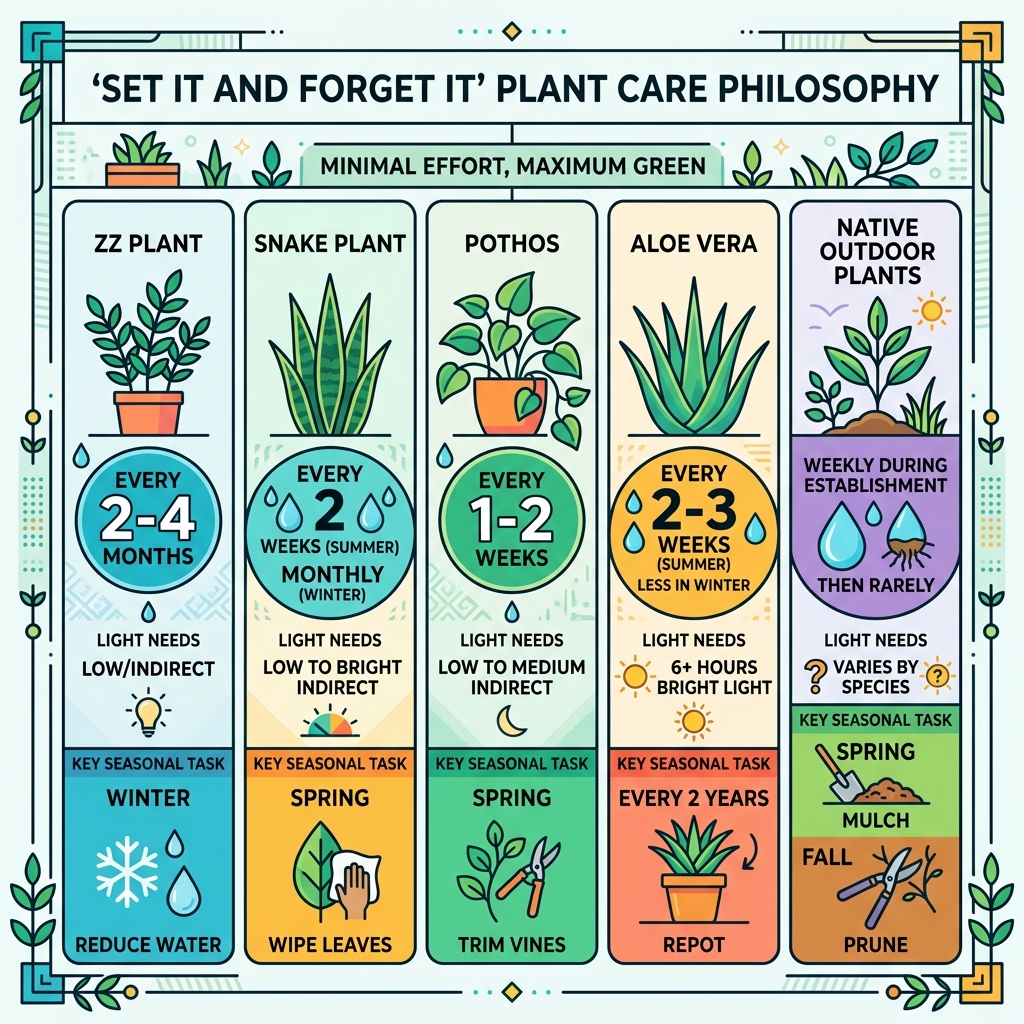
Here’s a quick-reference schedule to get started:
| Plant Type | Watering Frequency | Light Needs | Key Seasonal Task |
|---|---|---|---|
| ZZ Plant | Every 2-4 months | Low/indirect | Reduce water in winter |
| Snake Plant | Every 2 weeks (summer), monthly (winter) | Low to bright indirect | Wipe leaves in spring |
| Pothos | Every 1-2 weeks | Low to medium indirect | Trim vines in spring |
| Aloe Vera | Every 2-3 weeks (summer), less in winter | 6+ hours bright light | Repot every 2 years |
| Native outdoor plants | Weekly during establishment, then rarely | Varies by species | Mulch in spring, prune in fall |
If you’ve ever come home to a drooping, yellowing plant and thought “I killed another one” — you’re not alone. Most busy people don’t fail at plants because they don’t care. They fail because nobody gave them a system.
The good news? The right plants on the right schedule barely need you at all.
Some indoor plants like the ZZ Plant can go 2 to 4 months without water. Native outdoor plants, once established, rarely need irrigation at all thanks to their deep root systems. The secret isn’t a green thumb — it’s matching the plant to your lifestyle.
This guide covers both indoor and outdoor plants, with simple schedules you can actually stick to.
The Ultimate Low Maintenance Plant Schedule for Indoor Greenery

When we talk about indoor plants that require minimal effort, we are looking for the “survivors.” These are species that have evolved in harsh environments, allowing them to tolerate the occasional (or frequent) bout of neglect. At Futuro Ciencia, we believe that your home should be a tranquil oasis, not a source of stress.
The ZZ Plant (Zamioculcas zamiifolia) is often cited as the gold standard for a low maintenance plant schedule. Why? It possesses water-storing rhizomes—thick, bulb-like structures under the soil—that act as reservoirs. This plant can literally survive for months without a single drop of water. It is nearly indestructible and thrives even in the dim corners of an office.
Next in line is the Snake Plant (Sansevieria). Not only is it incredibly tough, but it is also a powerhouse for air purification. Unlike most plants that release CO2 at night, the Snake Plant continues to produce oxygen, making it a perfect bedroom companion. On a standard low maintenance plant schedule, you only need to water this beauty every two weeks during the growing season and once a month in the winter.
For those who love the look of trailing vines, the Pothos (often called ‘Devil’s Ivy’ because it’s so hard to kill) is a must-have. It can survive in low light and will actually “tell” you when it’s thirsty by slightly drooping its leaves. Finally, the Cast Iron Plant (Aspidistra elatior) earns its name by surviving in conditions that would kill almost any other plant—low light, poor air quality, and irregular watering.
To keep these plants thriving, we recommend following a structured indoor-plant-care-schedule and keeping an indoor-plant-maintenance-checklist handy.
Indoor low maintenance plant schedule Essentials
The foundation of any successful low maintenance plant schedule is understanding three variables: watering, light, and soil.
- Watering Frequency: Most indoor plant deaths are caused by over-watering rather than under-watering. For our low-maintenance favorites, the rule of thumb is to wait until the top 1-2 inches of soil are completely dry. For succulents like Aloe Vera, wait until the soil is dry all the way through.
- Light Requirements: While many of these plants are “low light tolerant,” they still need some light to photosynthesize. “Bright indirect light” is the sweet spot for most. This means a spot where the plant can see the sky but not the sun itself.
- Soil and Drainage: Always use pots with drainage holes. If water sits at the bottom of the pot, it leads to root rot, which is the fast track to a dead plant.
For those of us with packed calendars, focusing on hardy-indoor-plants-for-busy-people and establishing a consistent indoor-plant-care-routine can make all the difference.
Signs of Over-watering vs. Under-watering
Learning to read your plant’s “body language” is a skill that pays off. Even on a low maintenance plant schedule, environmental factors like a sudden heatwave or a dry winter heater can change a plant’s needs.
- Over-watering Signs: If you notice mushy, yellowing leaves or a lingering damp smell from the soil, you’re likely loving your plant too much. Mushy stems are a sign of root rot, which requires immediate action—usually repotting into fresh, dry soil and cutting away the decayed roots.
- Under-watering Signs: Puckered or wrinkled foliage, brown, crispy leaf tips, and soil that has pulled away from the edges of the pot are all cries for help.
Check out our indoor-plant-care-tips-for-busy-people for more advice on balancing these needs without spending hours every week on maintenance.
Seasonal Outdoor Maintenance: A Calendar for Native Landscapes
If you want a garden that “grows itself,” native plants are the answer. Native species have spent millennia adapting to your specific local climate, soil types, and pests. This means they require significantly less intervention than exotic ornamentals.
Research shows that native plants typically require minimal irrigation once established because they develop deep root systems that can tap into underground moisture. Furthermore, they have coevolved with local wildlife. For instance, “keystone” native plants support 90% of butterflies and moths in their ecoregions.
To manage an outdoor space effectively, you should consult a Native Landscape Maintenance Schedule or a general Landscape Maintenance Schedule.
Creating a Native low maintenance plant schedule for Outdoors
Outdoor maintenance is all about timing. By following a seasonal low maintenance plant schedule, you can prevent problems before they start.
- Spring: This is the time for cleanup. Remove any winter-damaged branches and apply a 2-3 inch layer of mulch. Mulching can reduce your summer yard maintenance by up to 70% by suppressing weeds and retaining moisture.
- Summer: For established native plants, you may not need to water at all unless there is an extreme drought. For new plantings, water deeply (at least one inch) once a week. It’s better to water deeply and infrequently than to give them a light sprinkle every day.
- Fall: This is the best time for planting new trees and shrubs, as the soil is still warm but the air is cool. It’s also the time to leave the leaves! Fallen leaves provide essential overwintering habitat for beneficial insects.
- Winter: Maintenance is minimal. Check for “winter burn” on evergreens and ensure newly planted trees stay hydrated if the ground isn’t frozen and there’s a lack of snow or rain.
For a more technical breakdown, see this Maintenance: General Plant & Turf Maintenance Schedule.
Establishing a Wildflower Meadow or Lawn Alternative
Standard turf grass is one of the most high-maintenance “plants” you can own. It requires constant mowing, fertilizing, and watering. Many homeowners are now switching to wildflower meadows or native grass alternatives to slash their low maintenance plant schedule.
| Feature | Traditional Turf Lawn | Wildflower Meadow |
|---|---|---|
| Mowing Frequency | Weekly | 1-2 times per year |
| Watering Needs | High (1 inch/week) | Very Low (once established) |
| Fertilizer | Required 4x per year | Not recommended |
| Wildlife Value | Low (biological desert) | High (pollinator haven) |
| Maintenance Effort | High | Low |
If you are sticking with a lawn for now, follow a Wisconsin Lawn Care Calendar (or your local equivalent) to ensure you are aerating and overseeding at the right times to keep the grass healthy enough to crowd out weeds naturally.
Pro Strategies to Reduce Your low maintenance plant schedule
Efficiency is the name of the game. We want maximum beauty with minimum labor. Here are three pro strategies to refine your low maintenance plant schedule:
- Mulching is Magic: As mentioned, a thick layer of organic mulch (like shredded bark or leaf compost) is the single best thing you can do for an outdoor garden. It prevents weed seeds from germinating and keeps the soil cool.
- Group Your Pots: If you have container plants, group them together. This creates a small microclimate with higher humidity and allows the pots to shade each other, reducing the frequency of watering.
- Automated Irrigation: For outdoor beds, a soaker hose or drip irrigation system on a timer can take the “chore” out of gardening entirely.
Regional timing is also critical. For example, the Landscape Maintenance Calendar for Boston Homeowners emphasizes that New England landscapes often fail not because of design, but because owners miss the critical windows for care.
Smart Planting Locations and Soil Preparation
The “Right Plant, Right Place” philosophy is the secret to a low maintenance plant schedule. Before you buy a plant, check your USDA zone. If you plant a tropical palm in a zone 5 winter, no amount of care will save it.
- Sun Exposure: A shade-loving plant in full sun will scorch and require constant watering to survive. A sun-lover in the shade will become leggy and prone to disease.
- Xeriscaping: This is a landscaping method developed for arid climates that uses drought-tolerant plants and efficient irrigation. Even if you don’t live in a desert, xeriscaping principles can drastically reduce your workload.
For indoor spaces, choosing indoor-plants-that-need-little-care and placing them in their preferred light zones is the first step toward a successful “set it and forget it” home.
Pruning and Wildlife Support
In a low-maintenance garden, we often do less pruning, not more.
- Deadheading: While removing spent blooms can encourage more flowers, many low-maintenance gardeners choose varieties that don’t require it.
- Nesting Sites: For native gardens, leave your perennial stems standing at about 12-24 inches high in the spring. These provide critical nesting sites for native bees.
- Keystone Species: By choosing “keystone” plants, you ensure that your garden is doing the most ecological work for the least amount of effort.
Using low-maintenance-plants-for-offices can also bring these benefits into the workspace, where time for plant care is even more limited.
Choosing the Right Species: Pet Safety and Air Quality
Many of us share our “tranquil oases” with furry friends. It is vital to ensure your low maintenance plant schedule doesn’t include species that could harm your pets.
The Spider Plant (Chlorophytum comosum) is a champion here. It is completely non-toxic to cats and dogs, incredibly easy to grow, and even produces “pups” that you can easily propagate to grow your collection. On the flip side, Aloe Vera, while great for human skin, can be toxic to dogs and cats if ingested, causing digestive upset.
When selecting plants, always cross-reference with the ASPCA guidelines for toxicity levels. For those who want color without the fuss, low-maintenance-flowering-indoor-plants like the Peace Lily are beautiful, but keep in mind they are mildly toxic to pets.
In office settings, low-maintenance-plants-for-offices-2 should be chosen based on light levels and their ability to handle the dry air of air-conditioned buildings.
Top Air-Purifying Plants for Beginners
If your goal is to brighten your space and clean the air, a few specific plants stand out on a low maintenance plant schedule:
- Snake Plant: As mentioned, it’s an oxygen factory. It also filters out toxins like formaldehyde and benzene.
- Peace Lily: Excellent at removing mold spores from the air. It is very communicative—it will droop dramatically when it needs water and perk back up within hours of a drink.
- Rubber Tree: With its broad, dark green leaves, it is a master at absorbing airborne chemicals.
You can find more suggestions in our category/low-maintenance-plants section.
Frequently Asked Questions about Low Maintenance Gardening
What is the hardiest indoor plant for a dark office?
The ZZ Plant is the undisputed king of dark offices. It can thrive under fluorescent lighting and tolerate the low humidity often found in office buildings. Because it stores water so efficiently, it won’t mind if you forget about it during a two-week vacation.
How often should I water native outdoor plants?
During the first year (the establishment period), they generally need about an inch of water per week. Once their deep roots are established (usually by the second or third year), they should only need supplemental watering during periods of extreme, prolonged drought.
Which low-maintenance plants are safe for cats and dogs?
The Spider Plant, Parlor Palm, and Boston Fern are all excellent low-maintenance choices that are safe for pets. Always double-check the ASPCA list if you are unsure about a specific species.
Conclusion
At Futuro Ciencia, our mission is to help you transform your living and working spaces into tranquil oases. By choosing the right species and following a low maintenance plant schedule, you can enjoy the air-purifying and stress-reducing benefits of greenery without the guilt of “black thumb” syndrome.
Whether you are planting a native wildflower meadow to support local bees or placing a Snake Plant in your bedroom for better sleep, the best garden is one that fits your life. Start small, pick hardy species, and let nature do the heavy lifting.
