
Why Most Indoor Plants Die — And How a Low Light Plant Watering Guide Changes That
A low light plant watering guide helps you water less often, check soil moisture before each session, and adjust for seasons — so your plants stay alive without guesswork.
Here’s the quick answer:
| Step | What To Do |
|---|---|
| Check moisture | Push finger 1-2 inches into soil. Only water if dry. |
| Water frequency | Every 10-14 days in low light (vs. weekly near bright windows) |
| Water amount | Water slowly until it drains out the bottom. Empty the saucer. |
| Winter adjustment | Cut back by 30-50% when growth slows |
| Watch for trouble | Yellow leaves = too much water. Crispy edges = too little. |
Over 60% of indoor plant problems come from improper watering — and low-light conditions make it even easier to get wrong.
Here’s why: when a plant sits in a dim corner, it photosynthesizes more slowly. It uses less water. Soil stays damp far longer than you’d expect. So the watering habits that work for a sunny windowsill plant will quietly drown a plant in the back of your living room.
Busy schedules make this worse. You water on a routine instead of reading the plant. You forget to check the soil. Then one day the leaves turn yellow, and you’re not sure if you’ve given it too much or too little.
The good news? Low-light plants are actually forgiving — if you understand their rhythm. They don’t need constant attention. They need the right attention.

Why You Need a Specialized Low Light Plant Watering Guide
At Futuro Ciencia, we believe that any corner of your home can become a tranquil oasis, but the rules of engagement change when the lights go down. A specialized low light plant watering guide isn’t just a suggestion; it’s a biological necessity for your greenery.
When a plant is placed in a low-light environment—think 3 to 4 meters away from a window or in a room with only north-facing exposure—its entire metabolic engine slows down. This is where indoor-plant-care-for-low-light becomes a game of patience. In bright light, plants act like high-performance athletes, consuming water rapidly to fuel growth. In low light, they are more like hibernating bears.
The Science of the Slowdown
Scientific research, such as the study on light signals and growth, highlights how light quality regulates a plant’s development. In dim conditions, stomatal activity—the opening and closing of tiny pores on the leaves—decreases. This means the plant “breathes” out less water vapor through transpiration. If the plant isn’t releasing water into the air, it certainly isn’t pulling much from the soil.
Furthermore, evaporation rates in shaded corners are significantly lower. Without the sun’s warmth to dry out the top layers of the medium, moisture retention increases. If you water a Snake Plant in a dark hallway as often as one on a sunny patio, you’re creating a swamp where the roots will eventually suffocate due to a lack of root respiration. Many of these species are evolved for “jungle floor mimicry,” where they deal with dappled light and high humidity, but even in nature, they never sit in stagnant, soggy soil.
Mastering the Low Light Plant Watering Guide: Tools and Techniques
Mastering your watering routine requires moving away from the “calendar method” and toward an “observation method.” We often see well-meaning plant parents watering every Monday regardless of whether the plant actually needs it. Our watering-schedule-for-indoor-plants emphasizes that the soil’s condition is your only true North Star.
The Importance of the Pot and Soil
The vessel you choose is just as important as the water you pour.
- Drainage Holes: These are non-negotiable. Without them, excess water pools at the bottom, leading to the dreaded root rot.
- Terracotta vs. Plastic: Statistics show that plants in unglazed terracotta may need water twice as often as those in plastic or glazed pots because the clay is porous and allows for better aeration. For low-light plants, plastic or glazed ceramic can be risky because they trap moisture for much longer.
- Bottom Watering: This technique involves placing the pot in a tray of water and letting the soil “wick” moisture upward. It’s excellent for preventing soil compaction and ensuring the roots at the bottom get hydrated without getting the foliage wet.
Precision Tools for Your Low Light Plant Watering Guide
If you want to take the guesswork out of the equation, a few simple tools can save your plants’ lives:
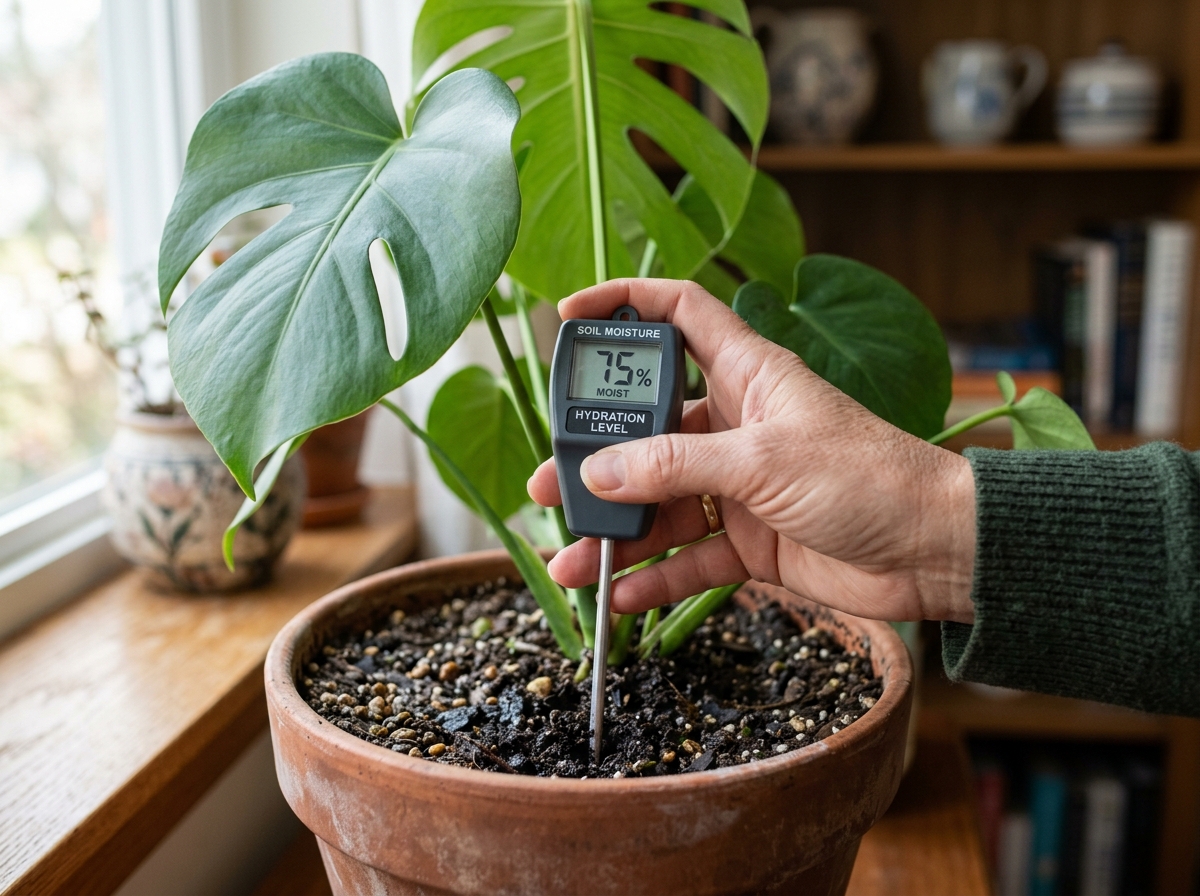
- Hygrometer: While often used for air humidity, many plant enthusiasts use a hygrometer/moisture probe to check deep into the root ball. This is especially helpful for ZZ plants, which store water in thick, succulent stems and can go a full month without a drink in low light.
- The Finger Test: The most reliable (and free!) tool. Push your finger two inches into the soil. If it feels even slightly damp, walk away.
- Pot Weight: Pick up your plant right after watering, then again a week later. You’ll eventually learn the “light as a feather” feel of a plant that is truly thirsty.
- Long-Spout Cans and Squeeze Bottles: These allow you to direct water exactly where it’s needed—the soil—without splashing leaves, which can lead to fungal issues in low-airflow, low-light spots.
Specialized Care for Hanging Varieties
Hanging plants like Pothos and Heartleaf Philodendron are staples for low-light-indoor-plants-for-apartments, but they present unique challenges. Because heat rises, the air near the ceiling is often drier and warmer, which can throw off your watering rhythm.
- Drip Trays: Ensure your hanging baskets have attached saucers so you don’t ruin your flooring.
- Rotation: Rotate your hanging plants 90 degrees every week. This ensures all sides get equal access to the limited light available, preventing one side from becoming “bald” or leggy.
- Self-Watering Globes: Use these with caution in low light. They can easily over-saturate a plant that isn’t growing fast enough to use the constant supply.
Seasonal Shifts and Environmental Factors
Your low light plant watering guide must change as the Earth tilts. Even indoors, plants sense the shift in seasons. During the winter, indoor light levels can drop to one-fifth of their summer intensity. This triggers a period of dormancy or semi-dormancy.
| Factor | Summer Strategy | Winter Strategy |
|---|---|---|
| Water Frequency | Every 7-10 days | Every 14-21 days |
| Water Volume | Thorough soak | 30-50% less volume |
| Humidity | Natural levels usually okay | Increase via humidifier |
| Fertilizer | Half-strength monthly | None (Skip entirely) |
As we discuss in our guide on indoor-plant-care-during-winter, the biggest winter threat isn’t just the dark—it’s the heater. Radiator heat can dry out soil surfaces prematurely while the roots remain wet, leading to confusing signals. Always check deep into the pot, not just the surface, before adding more water.
Troubleshooting and Reviving Distressed Plants
Even the most careful indoor gardeners make mistakes. The key is recognizing the signs of distress early enough to intervene.
Identifying Overwatering in Your Low Light Plant Watering Guide
Overwatering is the #1 killer of low-light houseplants. Because growth is slow, the plant cannot “work off” the extra moisture.
- Symptoms: Mushy stems, yellowing lower leaves, and a musty, “basement” smell from the soil.
- The Science: According to research on plant stress pathways, excess water deprives roots of oxygen, triggering a hormonal response that leads to leaf drop.
- The Fix: If you catch it early, stop watering immediately. If the soil is a swamp, you may need to repot into fresh, dry soil and prune away any black, slimy roots. Check out our list of common-indoor-plant-care-mistakes for more recovery tips.
Signs of Underwatering and Dehydration
While less common in low light, underwatering still happens, especially with “drama queens” like the Peace Lily.
- Symptoms: Crispy, brown leaf edges, drooping stems, and soil that has shrunk away from the sides of the pot.
- The Fix: A thorough soak is usually enough. For extremely dry soil that has become hydrophobic (repels water), bottom-watering in a sink for 30 minutes is the best way to rehydrate the root ball.
Frequently Asked Questions about Low Light Watering
Does water temperature or type impact plant health?
Absolutely. Tropical plants are sensitive to “cold shock.” Always use room-temperature water (around 20-22°C).
- Chlorine and Fluoride: Many low-light favorites, like Dracaenas and Spider Plants, are sensitive to chemicals in tap water. This often manifests as brown leaf tips. As noted in our indoor-plant-care-tips-for-beginners, letting tap water sit in an open container for 24 hours allows chlorine to evaporate. For fluoride, you may need to use rainwater or filtered water.
How does low light affect fertilizer needs?
Low light equals low energy. If a plant isn’t growing, it doesn’t need “food.” Adding fertilizer to a resting plant can cause nutrient buildup and root burn.
- The Rule: Only fertilize during the active growing season (Spring and Summer).
- The Dose: Dilute your liquid fertilizer to half or even a quarter of the recommended strength. Our indoor-plant-maintenance-checklist suggests flushing the soil with plain water once every few months to wash away any salt buildup.
Can I use grow lights to adjust my watering schedule?
Yes! If you find your “low light” corner is a bit too dark, adding full-spectrum LEDs can boost the photosynthetic rate. This will naturally increase the plant’s water consumption. If you use grow lights for 12-14 hours a day, you should revert to a more “medium light” watering schedule, checking the soil every 7 days rather than every 14.
Conclusion
At Futuro Ciencia, our mission is to help you transform your home into a tranquil oasis. Low-light plants are the unsung heroes of interior design—they purify our air and brighten our darkest corners with minimal demands. By following this low light plant watering guide, you’re not just keeping a plant alive; you’re mastering the art of mindful care.
Ready to take the next step in your plant parent journey? Explore our customized indoor-plant-care-schedule to find the perfect rhythm for your unique space. Remember: when in doubt, wait a day. Your plants will thank you for the restraint!
