
The Arrowhead House Plant: What You Need to Know Before You Grow
The arrowhead house plant is one of the easiest and most rewarding tropical plants you can grow indoors. It’s forgiving, fast-growing, and comes in a stunning range of colors — from deep green to blush pink.
Here’s a quick-reference overview for busy plant owners:
| Care Factor | What You Need to Know |
|---|---|
| Scientific Name | Syngonium podophyllum |
| Family | Araceae (same family as pothos and monstera) |
| Origin | Tropical forests of Central and South America |
| Light | Bright, indirect light; at least 4-6 hours daily |
| Water | When the top 1-2 inches of soil feel dry |
| Temperature | 60-85°F (15-29°C) |
| Humidity | 40-60% ideal |
| Toxicity | Toxic to pets and humans if ingested |
| Growth | Bushy when young; vining up to 3-6 feet at maturity |
The arrowhead plant earns its name from its distinctively shaped leaves. Young plants grow broad, heart-shaped leaves. As the plant matures, those leaves stretch and taper into a sharper, arrow-like point. It’s a subtle transformation that makes this plant genuinely interesting to watch over time.
It’s been a popular houseplant for over a hundred years — and for good reason. It thrives in typical home conditions, tolerates lower light better than many tropical plants, and bounces back quickly when you miss a watering or two. For a busy urban homeowner, that kind of resilience is exactly what you want.
This guide covers everything: light, water, soil, pruning, pests, propagation, and the most beautiful varieties to grow.

Essential Care for Your Arrowhead House Plant
To keep your arrowhead house plant looking like it just stepped out of a botanical garden, we need to mimic its native tropical home. In the wild, Syngonium podophyllum lives on the jungle floor and climbs up trees, meaning it loves dappled sunlight and airy, nutrient-rich soil.
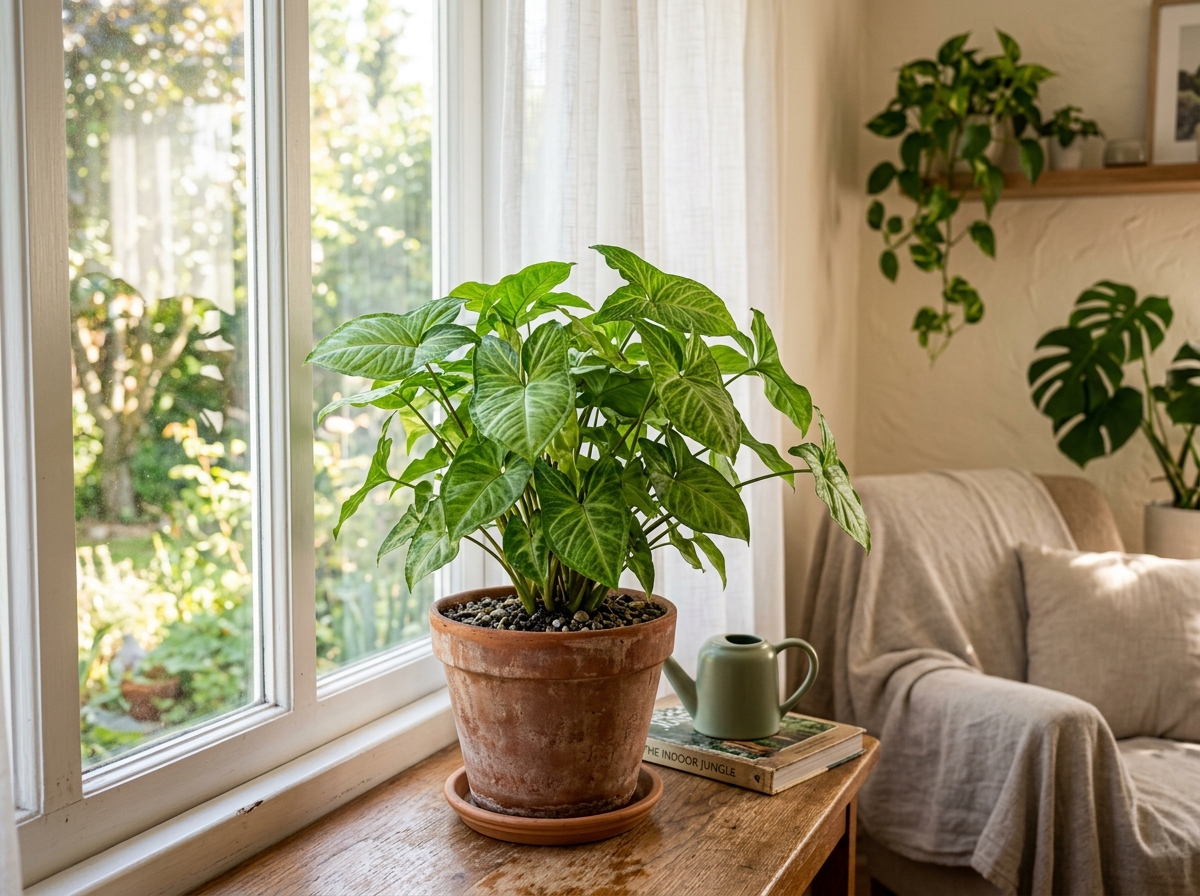
Light Requirements
Your plant needs at least 4 to 6 hours of soft, indirect light daily. While it is famous for being a “low-light” survivor, there is a difference between surviving and thriving. In very dim corners, the stems will stretch out (becoming “leggy”) and the beautiful variegation—those white or pink splashes—might fade back to plain green.
| Variety | Light Tolerance | Best Placement |
|---|---|---|
| White Butterfly | Moderate | Near an East-facing window |
| Neon Robusta | High Indirect | 3 feet from a South window |
| Green Gold | Low to Moderate | North-facing window or office desk |
The Perfect Soil Mix
Don’t just grab the cheapest bag of dirt! We recommend a “chunky” mix that allows the roots to breathe. A standard peat-only mix stays too wet for too long, which can lead to the dreaded root rot. Our favorite recipe for a happy arrowhead house plant is:
- 50% High-quality potting soil
- 25% Perlite (for drainage)
- 25% Orchid bark (for aeration)
The ideal soil pH should sit between 6.0 and 7.5. This slightly acidic to neutral range ensures the plant can actually “eat” the nutrients you provide via fertilizer.
Temperature and Humidity
These plants are tropical through and through. They prefer temperatures between 60°F and 85°F (15-29°C) during the day. At night, ensure it stays above 60°F. While they can technically tolerate a dip down to 35°F, they really shouldn’t go below 50°F if you want them to keep growing.
Humidity is the secret sauce. While they tolerate average home humidity, they truly shine in the 40-60% range. If your home is dry (especially in winter), consider a pebble tray or a humidifier.
Watering Your Arrowhead House Plant Correctly
Watering is where most plant parents go wrong. We often say the arrowhead house plant would rather be a little too dry than too wet.
- The Finger Test: Stick your finger into the soil. If the top 1 to 2 inches feel dry, it’s time for a drink.
- Summer Schedule: During active growth, you’ll likely water every 5 to 7 days.
- Winter Schedule: Growth slows down in the cold months, so stretch your watering to every 10 to 14 days.
- The Water: Use room-temperature water. Cold water straight from the tap can shock the tropical roots.
Always ensure your pot has drainage holes. If water sits at the bottom of the pot, the roots will suffocate. For more detailed tips, check out our guide on indoor plant care.
Ideal Light and Environment
North-facing or East-facing windows are usually the “sweet spots.” They provide bright morning light without the scorching heat of the afternoon sun. If you see bleached, pale patches on the leaves, your plant is likely getting sunburned and needs to be moved back from the glass.
If you have a window in your bathroom, that’s often the best room in the house! The steam from your shower provides a natural humidity boost that Syngonium loves.
Maintaining a Lush Arrowhead House Plant: Pruning and Feeding
Left to its own devices, an arrowhead house plant will eventually start to vine. While some people love the 3 to 6-foot trailing look, others prefer a compact, bushy mound that sits neatly on a desk.
How to Keep It Bushy
To maintain a height of 6 to 15 inches, you need to practice tip pruning. This involves “pinching” off the new growth at the ends of the stems. When you cut the tip, the plant sends a signal to grow two new stems from the nodes below the cut, making the plant twice as full!
The 25% Rule: Never remove more than 25% of the plant’s foliage at one time. Pruning is best done in the spring or summer when the plant has the energy to bounce back.
Feeding Your Plant
Think of fertilizer as a multivitamin. During the spring, summer, and fall, feed your plant once a month with a balanced, liquid indoor plant fertilizer diluted to half-strength. In the winter, you can skip the food entirely as the plant enters a rest phase.
Some plant enthusiasts suggest that even a couple of tablespoons of coffee grounds on the soil surface can provide a natural nutrient boost and improve acidity, but don’t overdo it!
Supporting and Training Your Vines
If you want to lean into the vining nature of the arrowhead house plant, you’ll need to give it something to grab onto. In nature, they use aerial roots to climb trees.
- Moss Poles: These are excellent because you can keep the moss damp, providing humidity directly to the climbing roots.
- Trellises: Simple bamboo or metal stakes work well for a “cleaner” look.
- Hanging Baskets: If you don’t want to go up, go down! Let the stems trail over the sides of a bookshelf for a “jungle waterfall” effect.
Best Indoor Uses and Styling
Because of their versatility, these plants fit anywhere. Compact varieties like ‘Mini Pixie’ are perfect for office desks, while larger vining types look great on high shelves. Beyond aesthetics, the arrowhead house plant is a functional addition to your home. It was featured in the NASA Clean Air Study for its ability to purify indoor air, removing common toxins like formaldehyde.
Propagation and Repotting Your Syngonium
One of the best things about the arrowhead house plant is how easy it is to make “babies” for your friends.
Propagation Step-by-Step
- Find a Node: Look for the little bumps on the stem where a leaf meets the main branch. This is where new roots will grow.
- The Cut: Use sterilized scissors to take a 4-inch cutting just below a node.
- Rooting in Water: Place the cutting in a jar of room-temperature water. Ensure no leaves are submerged. Roots usually form in 1 to 2 weeks.
- Rooting in Soil: Alternatively, dip the end in rooting hormone and tuck it into a pot of moist soil. Roots typically take 2 to 3 weeks here.
- Potting Up: Once the roots are 1-2 inches long (usually around the six-week mark), your new plant is ready for its own permanent home.
Repotting Like a Pro
You’ll typically need to repot every 1 to 3 years. A clear sign it’s time is when you see roots circling the bottom of the pot or poking out of the drainage holes.
- Size Matters: Choose a new pot that is only 1 to 2 inches larger in diameter than the current one. If the pot is too big, the excess soil stays wet too long, causing root rot.
- The Process: Gently slip the plant out, loosen the root ball, and settle it into fresh soil at the same depth it was previously growing.
Troubleshooting Your Arrowhead House Plant
Even the best plant parents run into trouble. Most issues with the arrowhead house plant are related to water or light.
Common Leaf Problems
- Yellow Leaves: Usually a sign of overwatering. If the soil is soggy, let it dry out completely. If the yellowing is only on older, bottom leaves, it might just be the plant’s natural lifecycle.
- Brown, Crispy Edges: This screams low humidity or underwatering. Mist your plant more often or use a pebble tray.
- Pale or Bleached Leaves: Your plant is getting too much direct sun. Move it a few feet away from the window.
- Wilting/Drooping: Usually, the plant is thirsty. Check the soil. If the soil is wet but the plant is drooping, you likely have root rot, and the roots can no longer drink.
Managing Pests and Diseases
Keep an eye out for these uninvited guests:
- Spider Mites: Look for tiny webs. Treat with neem oil or a forceful spray of water.
- Mealybugs: These look like tiny cotton balls. Dab them with a cotton swab dipped in isopropyl alcohol.
- Fungus Gnats: These little flies love wet soil. Letting the top 2 inches of soil dry out usually solves the problem.
For fungal issues like bacterial leaf spot, ensure good airflow and avoid getting water on the leaves when you hydrate the plant. Experienced growers note that keeping the foliage dry is key to preventing many common diseases. For a reliable toxicity reference, the ASPCA guide to arrowhead vine is a helpful external resource for pet owners.
Safety and Toxicity Concerns
This is a vital point for families: the arrowhead house plant is toxic. It contains calcium oxalate crystals. If a leaf is chewed or swallowed, it can cause intense mouth pain, swelling, and drooling in pets and humans. The sap can also cause skin irritation for some people.
- Pro Tip: Always wear gloves when pruning and keep the plant on high shelves out of reach of curious cats, dogs, and toddlers.
Popular Varieties and Cultivars
The world of Syngonium is incredibly diverse. Here are some of our favorites to look for:
- White Butterfly: The classic. Creamy white leaves with green borders.
- Pink Allusion: Features beautiful silvery-pink foliage with green veins.
- Neon Robusta: A showstopper with solid, dusty pink leaves.
- Berry Allusion: Light green leaves with subtle pink and cream accents.
- Albo Variegatum: Highly sought after for its dramatic “half-moon” white splashes.
- Mini Pixie: A dwarf variety that stays small and bushy, perfect for terrariums.
Frequently Asked Questions about Arrowhead Plants
Can Arrowhead Plants grow in low light?
Yes, they can survive in low light, making them great for offices. However, they will grow much slower, and variegated types will eventually turn solid green as the plant tries to produce more chlorophyll to catch what little light is available.
Why is my Arrowhead Plant drooping?
If the soil is dry, it’s just thirsty. If the soil is wet, it’s a sign of root stress. Ensure your pot has drainage and you aren’t letting the plant sit in a saucer of water.
How do I keep my Arrowhead Plant bushy?
Regular “pinching” or pruning is the only way. If you don’t cut the long vining stems, the plant will naturally put all its energy into growing longer rather than fuller. Also, rotate your pot 90 degrees every week so all sides get equal light!
Conclusion
The arrowhead house plant is more than just a piece of decor; it’s a living, breathing companion that adapts to your lifestyle. Whether you want a climbing vine to frame your window or a bushy burst of pink for your nightstand, Syngonium podophyllum is ready to deliver.
At Futuro Ciencia, we believe that everyone deserves a tranquil indoor oasis. By following these care schedules and tips, you can transform your home into a lush, air-purifying sanctuary. Ready to start your journey? Transform your home with expert indoor plant care and see how easy it is to grow the sharpest plant in the room!
