
Why Spider Mites Are Every Houseplant Owner’s Hidden Enemy
How to control spider mites on houseplants comes down to five core steps:
- Isolate the infested plant immediately
- Blast leaves with water, focusing on undersides
- Apply insecticidal soap or neem oil every 7-10 days
- Repeat for at least 2-6 treatment cycles
- Prevent reinfestation by maintaining humidity above 40-60% and quarantining new plants
Imagine keeping your plants alive for three years straight — then discovering the “cobwebs” you thought came from spiders were actually a full-blown spider mite colony quietly destroying your collection. That scenario is more common than most plant owners realize.
Spider mites are tiny arachnids — related to spiders and ticks, not insects — measuring roughly 1/50 of an inch long. They live in colonies of hundreds on the undersides of leaves, piercing plant cells and draining chlorophyll. You often won’t notice them until the damage is already significant.
They thrive in exactly the conditions most homes provide: warm temperatures, low humidity, and dry air — especially in winter when heating systems run constantly.
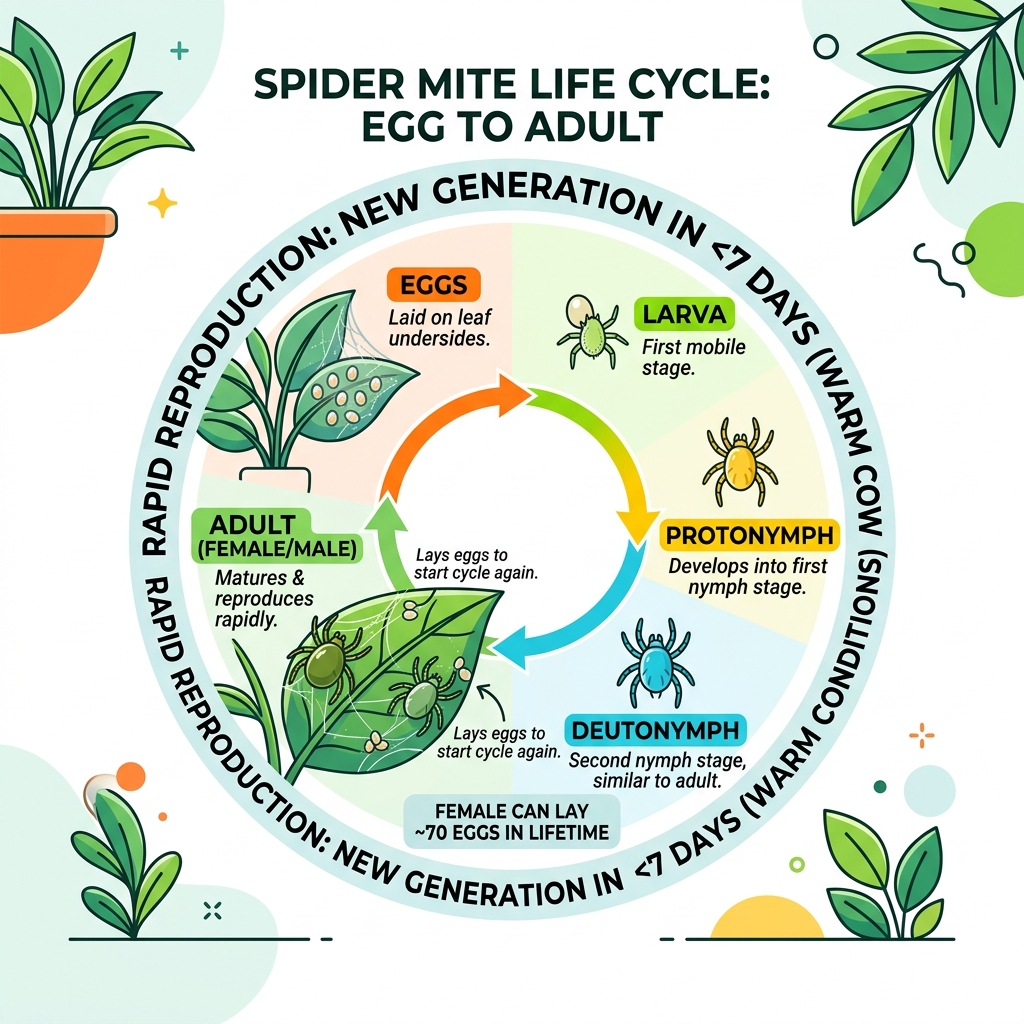
The biology makes them particularly tricky. A single female can lay up to 70 eggs in her lifetime, producing a dozen per day. Under warm conditions, a new generation can mature in less than a week. That’s why a small problem can spiral fast if you miss it.
The good news? Caught early, spider mites are very manageable. The key is knowing what to look for and acting quickly.
Identifying the Enemy: Signs of an Infestation
The first step in learning how to control spider mites on houseplants is knowing how to spot them before they stage a total coup. Because these pests are microscopic (often less than 1/20 of an inch), we usually see the damage before we see the “bugs.”
Visual Damage Cues
We often notice a “dusty” or “gritty” feel on the leaves. This is actually a mix of cast-off exoskeletons and the mites themselves. Other common signs include:
- Stippling: Tiny pale dots or yellow/white flecks on the leaf surface. This happens because the mites pierce individual plant cells to suck out the juices.
- Chlorotic Spots: As feeding continues, these tiny dots coalesce into larger yellow patches.
- Bronzing: In severe cases, the leaves take on a metallic, bronze, or scorched appearance.
- Silky Webbing: This is the definitive sign of a heavy infestation. Mites use this webbing to protect themselves and their eggs, and to travel between plant parts.
The White Paper Test
If you suspect an infestation but your eyes aren’t quite what they used to be, try the “white paper test.” Hold a plain sheet of white paper under a leaf and give the leaf a sharp tap. If you see tiny specks that start walking around on the paper, you’ve got mites.
If you crush one of these specks with your finger and it leaves a rust-colored streak, that is a confirmed kill. For more technical identification, you can use a 10X or 15X magnifying lens to see their eight legs and the two dark spots on their translucent bodies. You can find more detailed identification tips in this guide on Managing Spider Mites on Houseplants.

How to Control Spider Mites on Houseplants Organically
When we discover our green friends are under attack, our first instinct might be to reach for the heaviest chemical spray available. However, we’ve found that organic and mechanical methods are often more effective and much safer for indoor environments.
The Water Blast
The simplest way to start treatment is a forceful stream of lukewarm water. We recommend taking your plant to the sink or shower and hosing down both sides of every leaf. This physically dislodges the mites and washes away the webbing. While this won’t kill the eggs, it drastically reduces the adult population instantly.
Insecticidal Soaps and Neem Oil
For a more thorough approach, we use OMRI-listed insecticidal soaps or horticultural oils. These work by suffocating the mites on contact.
- Insecticidal Soap: These are specifically formulated to be tough on pests but gentle on plants. Avoid using standard dish detergents, as many contain degreasers that can strip the protective waxy coating off your plant’s leaves.
- Neem Oil: This is a fantastic multi-purpose tool. It acts as a miticide and also disrupts the hormonal system of the pests, preventing them from maturing and laying more eggs.
For a broader look at managing various intruders, check out our guides on how-to-combat-houseplant-pests and indoor-plant-pests-and-how-to-remove-them.
Effective DIY sprays for how to control spider mites on houseplants
If you prefer a home remedy, you can mix your own effective sprays using common household items.
- Soap Dilution: Mix 1 tablespoon of mild liquid soap (like Dr. Bronner’s) per liter of water.
- Alcohol Spray: Mix 1 cup of 70% isopropyl (rubbing) alcohol with 4 cups of water. This helps dissolve the mites’ outer shells. Always test this on one leaf first, as some thin-leaved plants are sensitive to alcohol.
- Essential Oil Boost: Adding a few drops of peppermint or tea tree oil to your soap mix can act as a powerful repellent.
For more on the science of why some home remedies work better than others, read about Spider Mites on Your Houseplants.
Proper application techniques for how to control spider mites on houseplants
The biggest mistake we see is “drive-by spraying.” If you don’t hit the mite, you won’t kill the mite.
- Target the Undersides: Spider mites live and lay eggs almost exclusively on the undersides of leaves. You must flip the leaves and ensure they are dripping wet with your solution.
- Morning Application: Apply treatments in the early morning or evening. Applying oils or soaps in the heat of the day or under direct grow lights can cause “phytotoxicity” (leaf burn).
- Check for Stress: Never spray a plant that is already wilting from thirst. Water the plant well a few hours before treatment to ensure it’s hydrated.
Understanding the difference between a pest problem and a biological issue is vital; see our article on understanding-and-treating-houseplant-diseases for more clarity.
Establishing a Treatment Schedule for Total Eradication
One treatment is never enough. Because most organic sprays only kill active mites and not the eggs, we have to time our follow-up treatments to catch the next generation as they hatch.
The Life Cycle Logic
In a warm home (around 80°F), spider mites can go from egg to adult in just 5 to 7 days. If you wait two weeks to spray again, those new adults have already laid a fresh batch of eggs.
| Temperature | Generation Time | Recommended Spray Interval |
|---|---|---|
| 60°F (15°C) | 2-3 Weeks | Every 10 Days |
| 75°F (24°C) | 7-10 Days | Every 5-7 Days |
| 85°F+ (29°C+) | 5 Days | Every 3-4 Days |
The 6-Week Protocol
For a moderate infestation, we recommend a 6-week protocol. Even if you don’t see mites after the second week, keep going! Eggs can be incredibly resilient.
- Week 1: Initial water blast + Soap/Oil spray.
- Weeks 2-4: Weekly sprays.
- Weeks 5-6: Observation and spot treatment.
During this time, it is vital to prune and dispose of any leaves that are more than 50% damaged. They won’t recover, and they provide too many hiding spots for mites. To learn more about long-term pest maintenance, visit indoor-plant-pests-and-how-to-remove-them-2.
Cultural Practices and Environmental Prevention
In permaculture and professional greenhouse management, spider mites are often seen as “indicators.” They tell us that the environment is out of balance. By changing the environment, we make it impossible for them to thrive.
Humidity is Your Best Friend
Spider mites hate moisture. They feed more aggressively in dry air because low humidity allows them to evaporate the excess water they excrete more easily. By keeping your relative humidity (RH) around 70%, you can often stop an infestation in its tracks without any chemicals at all.
- Humidifiers: Placing a small room humidifier near your plants is the most effective method.
- Pebble Trays: Trays filled with gravel and water beneath your pots can provide a localized humidity boost.
- Grouping: Crowding plants together creates a “micro-jungle” effect where they share transpired moisture.
Dust Removal and Airflow
Dusty leaves are a spider mite’s playground. Dust provides a scaffold for their webbing and interferes with the plant’s ability to photosynthesize, weakening its natural defenses. We recommend wiping leaves with a damp cloth at least once a month.
Furthermore, stagnant air allows mites to “balloon” (float on silk strands) easily from one plant to another. Using a small oscillating fan or HEPA air filtration system keeps the air moving and the mites grounded.
Nutrient Balance and Soil Health
Did you know that over-fertilizing can actually attract mites? High levels of nitrogen can lead to an accumulation of ammonium in the plant sap, which is like junk food for spider mites. Use high-quality, sterile compost and balanced fertilizers to keep your plants strong but not “over-sugared.”
Advanced Biological Controls: The Role of Predatory Mites
If you have a large indoor collection or a conservatory, spraying every single leaf can be an exhausting task. This is where we call in the cavalry: predatory mites.
Meet the Good Guys
The most common beneficial mite is Phytoseiulus persimilis. These are the “lions” of the mite world. They are slightly larger, pear-shaped, and much faster than spider mites. They don’t eat plants; they only eat other mites.
- The 1:10 Ratio: For effective control, you generally need one predator for every ten spider mites.
- Ecosystem Balance: Predators require a food source. If you release them when there are zero spider mites, they will starve and die. We wait until we see a “hotspot” before releasing them.
- Chemical-Free Zone: You cannot use predatory mites and insecticidal soaps at the same time, as the soap will kill the good guys too.
Other beneficial insects like ladybugs and lacewings can also help, though they are more prone to flying toward your windows rather than staying on the plants.
Frequently Asked Questions about Spider Mite Control
Should I quarantine or discard a severely infested houseplant?
If a plant has lost more than 60-70% of its foliage or is covered in a thick “shroud” of webbing, it might be time to say goodbye. The risk of cross-contamination to your healthy plants often outweighs the cost of the infested one. If you choose to keep it, isolate it in a separate room immediately and bag it in plastic during transport to prevent mites from falling off onto other plants.
Are there houseplants that are more resistant to spider mites?
Yes! Mites prefer plants with thin, tender leaves (like Alocasia, Calathea, and Ivy). If you struggle with persistent mites, consider switching to “tougher” species with thick, waxy, or succulent leaves:
- Snake Plants (Sansevieria)
- ZZ Plants (Zamioculcas zamiifolia)
- Jade Plants (Crassula ovata)
- Rubber Trees (Ficus elastica)
Can spider mites live in the soil or be reused?
This is a common myth. Spider mites are “foliar” pests, meaning they live on leaves, not in the dirt. However, eggs can sometimes fall into the top layer of soil or hide in fallen leaf debris. While you don’t usually need to replace the soil, we do recommend a neem drench (watering with diluted neem oil) to catch any stray crawlers and cleaning the pot thoroughly with alcohol.
Conclusion
At Futuro Ciencia, we believe that your home should be a tranquil oasis, not a battlefield. Understanding how to control spider mites on houseplants is a rite of passage for every indoor gardener. By combining vigilant monitoring, mechanical cleaning, and environmental adjustments like increased humidity, you can keep these tiny terrors at bay.
The best defense is a healthy plant. Use our indoor plant care schedules to ensure your green companions are getting the right light and water to stay strong. If you’re currently facing an infestation, don’t panic — just follow the schedule, stay persistent, and watch your oasis return to its former glory.
