
What You Need to Know About Bamboo Palm Care Indoor
Bamboo palm care indoor is simpler than you might think — and the payoff is a lush, tropical statement plant that can live for decades with the right routine.
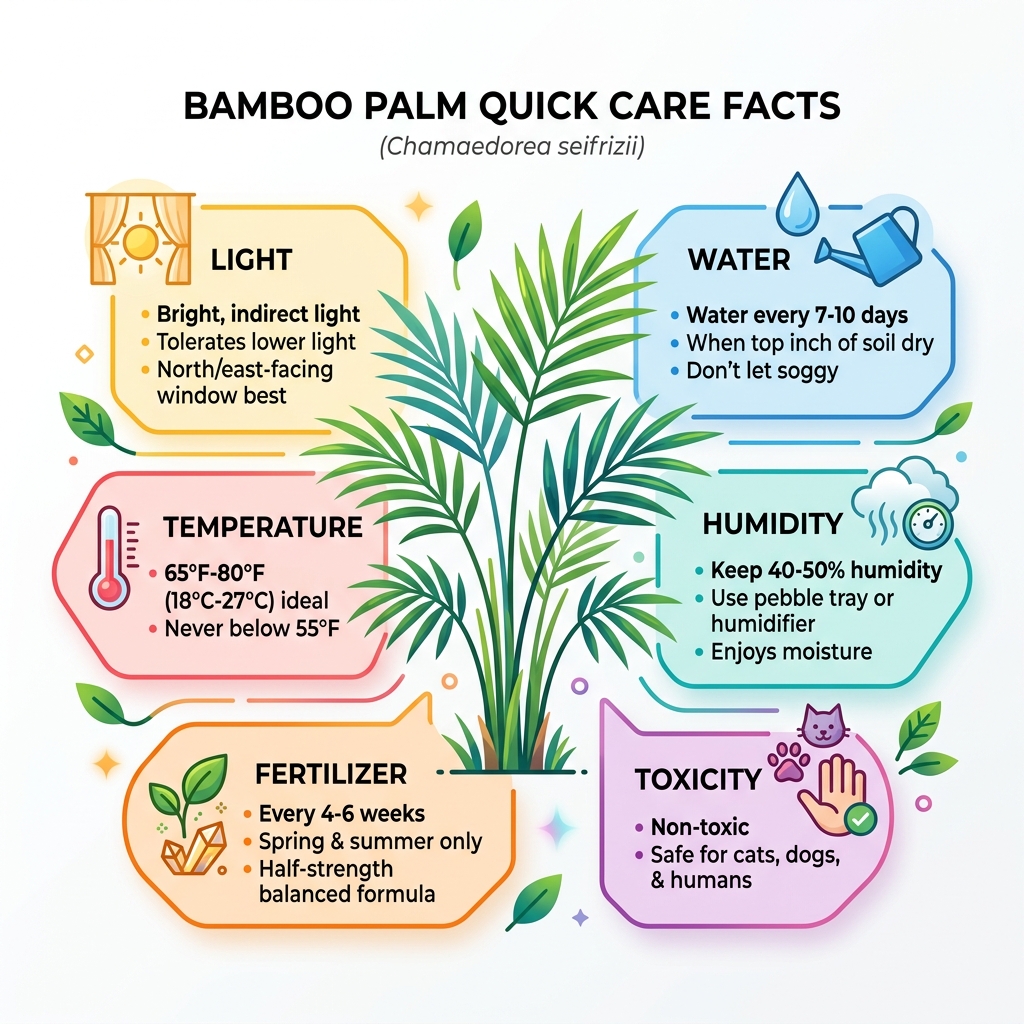
Here’s a quick-reference summary to get you started:
| Care Factor | What to Do |
|---|---|
| Light | Bright, indirect light; north or east-facing window works well |
| Water | Water every 7-10 days when the top inch of soil is dry |
| Humidity | Keep at 40-50%; use a pebble tray or humidifier |
| Temperature | 65°F-80°F (18°C-27°C); never below 55°F |
| Fertilizer | Every 4-6 weeks in spring and summer, half-strength balanced formula |
| Repotting | Every 2-3 years, one pot size up |
| Toxicity | Non-toxic to cats, dogs, and humans |
The Bamboo Palm (Chamaedorea seifrizii) is native to the rainforest understories of Mexico and Central America. That origin story matters — it means this plant evolved to thrive in filtered, dappled light with steady warmth and moisture. Indoors, it adapts remarkably well to those same conditions.
It’s one of the few palms that genuinely tolerates lower light levels, making it a smart pick for rooms that don’t get a lot of sun. It also topped NASA’s Clean Air Study for removing indoor pollutants like formaldehyde, xylene, and toluene. And unlike many dramatic tropical plants, it won’t punish you immediately for missing a watering day.
That said, consistent care beats perfect care. A bamboo palm that gets steady attention to moisture, light, and humidity will reward you with years — even decades — of growth.
Creating the Perfect Environment for Bamboo Palm Care Indoor
To truly master bamboo palm care indoor, we need to think like a rainforest. In their native habitat, these palms live under a canopy of taller trees. They never see the harsh, direct sun, but they bask in a constant, warm glow. When we bring them into our homes, our goal is to recreate that soft, humid sanctuary.
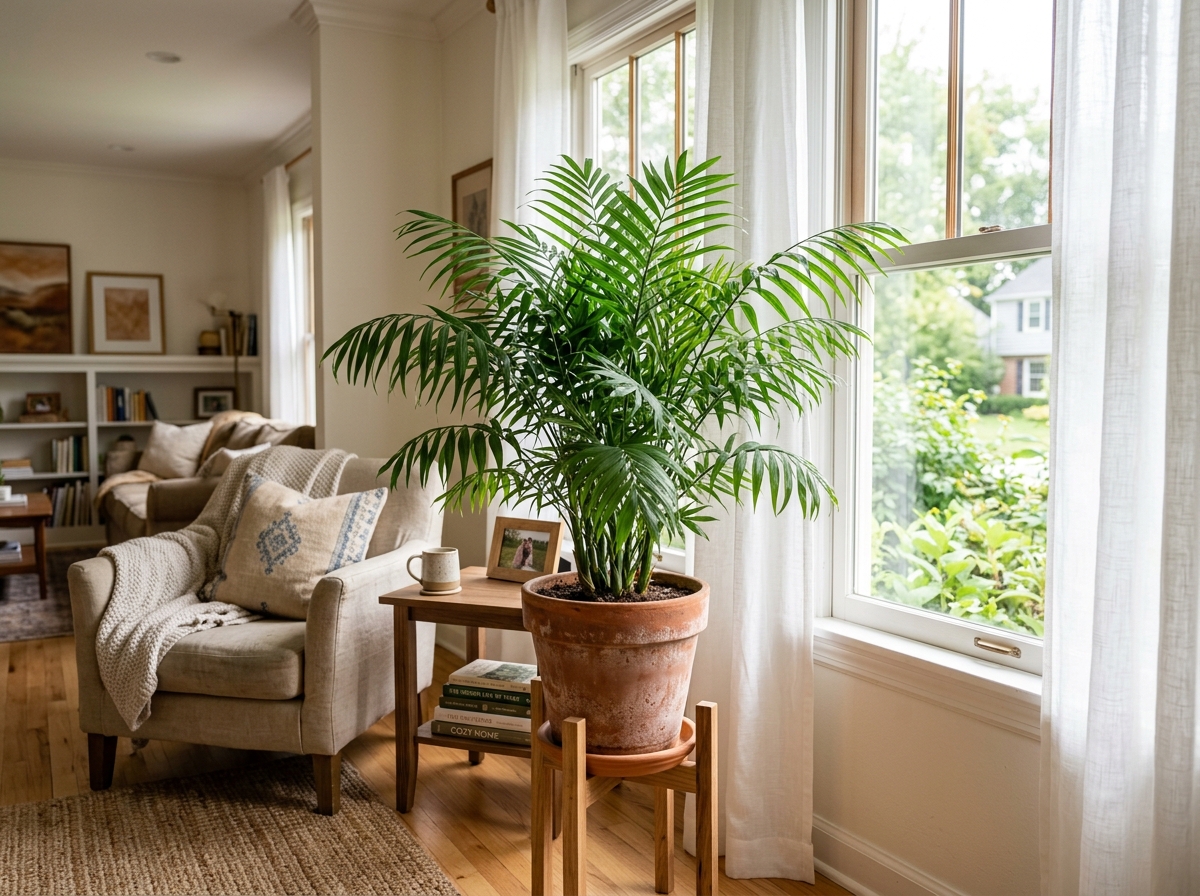
The foundation of a healthy palm starts with placement. We recommend finding a spot that offers bright, indirect light. If you have a north-facing window, you’re in luck! While many tropical plants struggle in the lower light of a north window, the Bamboo Palm finds it quite cozy. Ideally, your palm should receive between 1,000 and 2,000 lux for about 8 to 10 hours a day. If you aren’t sure how much light your corner is getting, using a Light meter can take the guesswork out of the equation.
Beyond light, stability is the name of the game. These plants thrive in temperatures ranging from 65°F to 80°F (18°C to 27°C). They can handle a brief dip down to 55°F, but any lower and they start to protest. Humidity is the “invisible essential” — we aim for a relative humidity of 40–50%. If your home feels like a desert in the winter, your palm will be the first to tell you with crispy leaf tips. You can monitor these levels easily with a Hygrometer to ensure your green friend stays comfortable. For more detailed strategies, check out our more info about humidity tips to keep your indoor jungle lush.
Optimal Lighting for Bamboo Palm Care Indoor
While the Bamboo Palm is often marketed as a “low-light” plant, we like to clarify that “low light” doesn’t mean “no light.” In deep shade, your palm won’t die immediately, but its growth will stall, and the stems may become weak and “leggy”—a process known as etiolation.
The gold standard is filtered sun. Imagine the light coming through a sheer curtain; that’s the sweet spot. South-facing windows can work, but you must keep the plant several feet back from the glass. Direct afternoon sun is the enemy here; it can scorch those delicate feathery fronds within just 48 hours, leaving permanent brown burn marks.
If your apartment is naturally dim, don’t lose hope. You can supplement with Full-spectrum Lighting to give your palm the energy it needs to produce those deep green canes. Understanding the nuances of more info about light requirements is the first step in moving from a “plant owner” to a “plant whisperer.”
Temperature and Humidity Stability
Bamboo Palms are sensitive souls when it comes to drafts. We always advise keeping them away from air conditioning vents, heating units, and drafty doors. Sudden temperature swings of more than 10°F in a single day can stress the plant, leading to leaf drop.
Since our homes often lack the heavy moisture of a Mexican rainforest, we have to get creative with humidity. Misting is a popular habit, but honestly? It’s not very effective because the droplets evaporate in about 90 seconds. Instead, we suggest:
- Pebble Trays: Fill a shallow tray with pebbles and water, then set the pot on top (ensure the bottom of the pot isn’t touching the water).
- Grouping Plants: Plants “breathe” out moisture; huddling them together creates a microclimate.
- Humidifiers: This is the most reliable way to maintain that 40-50% sweet spot.
During the colder months, bamboo palm care indoor changes slightly. Growth slows down, and the dry indoor air becomes more of a threat. Read our guide on indoor-plant-care-during-winter/ to help your palm navigate the dark half of the year safely.
Watering and Feeding Your Palm for Longevity
Watering is where most people run into trouble with bamboo palm care indoor. It’s not about following a strict calendar; it’s about responding to the soil. We follow the “top-inch” rule: stick your finger into the soil, and if the top inch feels dry, it’s time for a drink.
Typically, this happens every 7 to 10 days, but environmental factors like heat and pot size will change that rhythm. To be precise, a Moisture meter is a fantastic tool. Aim for a reading of 3 or 4; you want the soil to be consistently moist but never like a swamp. For more tips on timing, see our watering-schedule-for-indoor-plants/.
One expert secret: Bamboo Palms are quite picky about what they drink. They are sensitive to the chlorine and fluoride found in most tap water. Over time, these chemicals build up in the leaves, causing the tips to turn brown and crispy. If you can, use filtered water, rainwater, or distilled water. If tap is your only option, let it sit out overnight in an open container to allow some of the chemicals to dissipate.
Mastering the Bamboo Palm Care Indoor Watering Routine
Drainage is non-negotiable. If your pot doesn’t have holes, your palm is living on borrowed time. Water that sits at the bottom of the pot cuts off oxygen to the roots, leading to the dreaded root rot. If you notice the leaves turning a pale, sickly yellow or the stems feeling mushy at the base, you are likely overwatering.
Conversely, if the new growth is coming in brown or the plant looks generally “droopy,” it might be thirsty. We recommend a deep soak until water runs out of the drainage holes, then emptying the saucer immediately. Never let your palm sit in a pool of standing water. You can find more troubleshooting tips in this Bamboo Palm Plant Care Guide.
Fertilization and Soil Requirements
When it comes to feeding, we say “less is more.” Bamboo Palms are relatively slow growers. During the active growing season (spring and summer), we use a balanced liquid fertilizer, like an NPK 10-10-10 or 20-20-20, but we always dilute it to half-strength. Feeding every 4 to 6 weeks is plenty. We like Espoma fertilizer for its gentle, organic approach. Avoid fertilizing in the winter when the plant is dormant, as the salts can build up and damage the roots.
Soil structure is equally vital. Standard “all-purpose” potting soil is often too heavy and retains too much water for a palm. We prefer a peat-based mix amended with perlite or coarse sand to ensure rapid drainage. A good DIY recipe is:
- 3 parts peat moss or coco coir
- 1 part perlite
- 1 part pine bark
Bamboo Palms are also prone to magnesium deficiency, which shows up as yellowing between the leaf veins. If you see this, a tiny bit of Epsom salts (about a tablespoon per gallon of water) once a month can work wonders. For a deeper dive into potting media, visit our guide on the best-soil-for-indoor-plants/.
Maintenance: Pruning, Repotting, and Troubleshooting
Maintenance isn’t just about aesthetics; it’s about keeping the plant’s energy focused on new, healthy growth. Because the Bamboo Palm has a clumping habit, it will naturally produce new “canes” from the base over time.
One of the best things about bamboo palm care indoor is that these plants actually prefer to be slightly root-bound. You don’t need to rush into repotting every year. In fact, we only suggest repotting every 2 to 3 years, or when you see roots literally pushing their way out of the drainage holes. When you do repot, only go up one size (about 1-2 inches wider in diameter). A pot that is too large will hold too much moisture, increasing the risk of rot. Learn the ropes with our tutorial on how-to-repot-indoor-plants/.
If you want to grow your collection, propagation is possible, though it requires patience.
| Method | Success Rate | Best Time | Establishment Time |
|---|---|---|---|
| Division | High | Early Spring | 4–6 weeks |
| Seed | Low/Moderate | Year-round (warm) | 6–12 months |
Division is the most realistic method for home gardeners. During repotting, you can gently separate a clump of 3-4 stems that have their own established root system using a sterile knife.
Pruning for Health and Beauty
Pruning a Bamboo Palm is mostly about “housekeeping.” Unlike some plants that need heavy hacking to stay small, we only prune to remove dead, yellow, or diseased fronds. Use a pair of sharp, Pruning shears that have been sterilized with rubbing alcohol to prevent the spread of bacteria.
Cut the dead fronds as close to the main stem as possible. Never “top” a palm by cutting off the growing tip of a cane; this will stop that specific cane from growing entirely. If a leaf is just slightly brown at the tip, you can trim the brown part off with scissors, following the natural shape of the leaf. For more professional grooming advice, check our pruning-tips-for-indoor-plants/.
Managing Pests and Common Problems
Even with the best bamboo palm care indoor, pests can sometimes crash the party. The most common uninvited guests are spider mites, mealybugs, and scale.
- Spider Mites: These tiny arachnids love dry air. If you see fine webbing on the undersides of leaves, you have an infestation. Increase humidity and wash the leaves with soapy water.
- Mealybugs: These look like tiny bits of white cotton tucked into the leaf joints. Dab them with a cotton swab dipped in 70% isopropyl alcohol.
- Brown Tips: Usually caused by low humidity, tap water chemicals, or inconsistent watering.
- Yellow Leaves: Often a sign of overwatering or a lack of nitrogen/magnesium.
For a complete breakdown of how to handle these issues, visit indoor-plant-pests-and-how-to-remove-them/.
Frequently Asked Questions about Bamboo Palms
Is the Bamboo Palm toxic to pets or humans?
Good news for pet parents! According to the ASPCA, the Bamboo Palm is non-toxic to cats, dogs, and horses. It’s a much safer alternative to the Sago Palm, which is highly toxic. While it’s generally safe, we still recommend keeping it out of reach of “nibblers,” as ingesting large amounts of any plant material can cause mild gastrointestinal upset. You can keep track of your plant’s safety status with our indoor-plant-maintenance-checklist/.
How large can a Bamboo Palm grow indoors?
In a typical home setting, a Bamboo Palm will reach between 4 and 12 feet tall and about 3 to 5 feet wide. However, their growth rate is relatively slow—expect about 6 to 10 inches of vertical growth per year under ideal conditions. In lower light, this might drop to only 2 or 3 inches. Their ultimate size is often dictated by the size of their pot; they won’t outgrow their space overnight! This makes them one of the best hardy-indoor-plants-for-busy-people/.
Why are my palm’s leaves turning brown at the tips?
This is the most common question we hear. It’s almost always a humidity issue. When the air is too dry, the plant can’t move moisture to the very tips of the long fronds fast enough, and the tissue dies. It can also be a sign of “salt burn” from too much fertilizer or chemicals in your tap water. If you suspect salt buildup, “flush” the soil by pouring distilled water through the pot until it runs clear for several minutes. If you’re worried about the roots, see our indoor-plant-root-rot-solutions/.
Conclusion
At Futuro Ciencia, we believe that bringing a Bamboo Palm into your home is more than just a decor choice—it’s an investment in your well-being. By following these steps for bamboo palm care indoor, you aren’t just keeping a plant alive; you are cultivating a tranquil oasis that cleans your air and brightens your spirit.
With a little patience and the right environmental balance, your Bamboo Palm will be a faithful companion for 20 years or more. It’s all about long-term stewardship and enjoying the quiet, tropical elegance this plant brings to your space. For more help on your gardening journey, explore more info about indoor plant care and let us help you grow your best indoor jungle yet.
