
Aloe Care Indoors for Beginners
Why Aloe Vera Is the Perfect Low-Maintenance Houseplant
Aloe vera plant care indoors is simpler than most people think — and getting it right means you’ll have a thriving, useful plant for a decade or more.
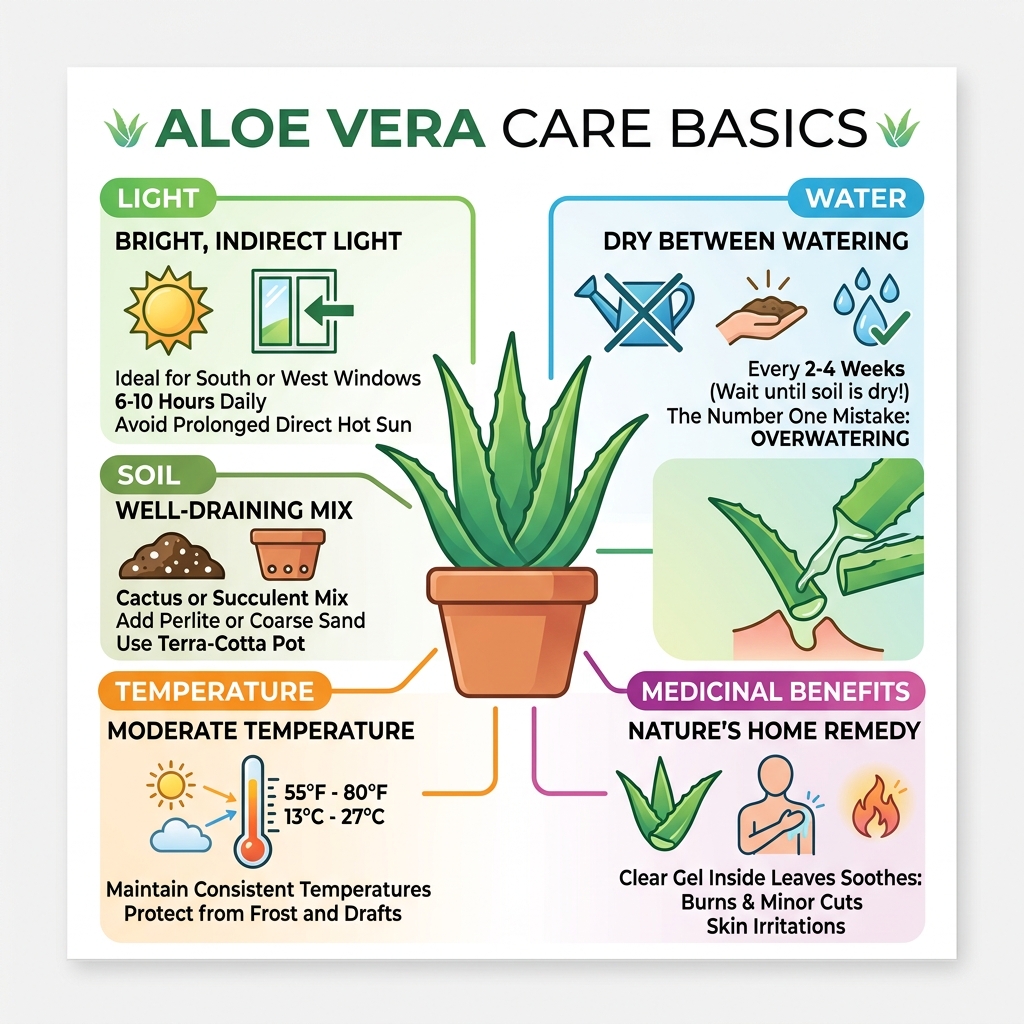
Here’s what your aloe vera needs to stay healthy indoors:
| Care Factor | What to Do |
|---|---|
| Light | Bright, indirect light near a south or west window (6-10 hours daily) |
| Watering | Every 2-4 weeks; let soil dry completely between sessions |
| Soil | Well-draining cactus or succulent mix with perlite or coarse sand |
| Pot | Terra-cotta or porous material with at least one drainage hole |
| Temperature | Keep between 55°F and 80°F (13°C-27°C); protect from frost |
| Fertilizer | Once a month in spring/summer at half strength; skip in winter |
Aloe vera (Aloe barbadensis miller) is a succulent native to North Africa. It stores water in its thick, fleshy leaves — which is exactly why it forgives a missed watering or two.
That also makes it ideal for busy people who don’t have time for fussy plants.
Beyond its good looks, aloe vera has real practical value. The clear gel inside its leaves has been used for centuries to soothe burns, minor cuts, and skin irritation. Some studies also suggest it helps purify indoor air.
The most common mistake? Overwatering. It’s the number one cause of death for aloe vera plants indoors. We’ll cover exactly how to avoid it — and fix it if it’s already happening.
Essential Light and Temperature for Aloe Vera Plant Care Indoors
When we bring an aloe vera plant into our homes, we have to remember its origins. These plants evolved in arid, sunny climates like the Arabian Peninsula and North Africa. In their natural habitat, they bask in intense sun and handle high heat with ease. Indoors, our goal is to mimic those conditions as closely as possible.
Finding the Sweet Spot for Light
Light is the “food” for your aloe. According to A Guide on How to Grow and Care for Aloe Vera Indoors and Outside, these succulents need a minimum of 6 hours of direct sunlight per day to maintain their compact, architectural form. If you can provide 8 to 10 hours, even better!
The best placement is usually a south-facing window, which receives the most consistent light throughout the day. A west-facing window is a solid runner-up, though the afternoon sun there can sometimes be quite intense.
Watch for these light-related signals:
- Leggy growth: If your aloe’s leaves are stretching out, becoming thin, and looking “floppy,” it is likely suffering from etiolation. This is the plant’s way of desperately reaching for more light.
- Leaf scorch: While they love sun, the glass in our windows can sometimes act like a magnifying glass. If you notice your leaves turning a reddish-brown or developing singed, dry patches, the light might be too direct and hot.
- Flat leaves: If the leaves are growing outward horizontally rather than upward in a tight rosette, it’s often a sign of insufficient light.
If your home is naturally dark, don’t worry! We can successfully grow aloe vera under artificial grow lights. These should be kept on for about 14-16 hours a day and positioned 6 to 12 inches above the plant to compensate for the lack of natural UV rays.
Temperature and the “Comfort Zone”
One of the reasons we love aloe vera is that it shares our “comfort zone.” They thrive in temperatures between 55°F and 80°F (13°C-27°C). If you are comfortable in your living room, your aloe likely is too.
However, they are incredibly sensitive to frost. Because their leaves are 99% water, a freeze will literally turn the plant to mush as the water inside the cells expands and ruptures. If you move your plants outdoors for the summer, always bring them back inside when nighttime temperatures threaten to dip below 50°F.
During the winter, aloe vera enters a period of dormancy. Growth slows down significantly, and the plant requires less of everything—less water, no fertilizer, and slightly cooler (but not freezing) temperatures. A 10°F fluctuation between day and night temperatures actually mimics their desert home and can help the plant stay vigorous.
Watering and Soil: The Foundation of Aloe Health
The most important lesson in aloe vera plant care indoors is that “less is more” when it comes to hydration. In the wild, these plants survive months without rain. In a pot on your windowsill, they are far more likely to die from your kindness (too much water) than from neglect.
Proper drainage is the non-negotiable foundation of health. Without it, water sits at the base of the roots, cutting off oxygen and inviting rot-causing fungi to take over.
Overwatering vs. Underwatering: How to Tell the Difference
It can be tricky to diagnose a struggling plant because both overwatered and underwatered aloes can look “wilted.” Here is a handy guide to help you tell them apart:
| Sign | Overwatered (The Danger Zone) | Underwatered (The Dry Zone) |
|---|---|---|
| Leaf Texture | Soft, mushy, or “squishy” to the touch | Thin, shriveled, or brittle |
| Color | Pale, yellowing, or translucent | Dark brown or curled edges |
| Base of Plant | Discolored (brown/black) and smelly | Firm but the soil is pulling away from the pot |
| Leaf Shape | Drooping or folding over on themselves | Curled inward like a straw |
If you find that the center leaves of your aloe have gone squishy, it is often too late to save the plant. However, if only the outer leaves are affected, you can usually rescue it by immediately stopping all watering and repotting it into fresh, dry soil.
Mastering the Watering Schedule for Aloe Vera Plant Care Indoors
Instead of watering on a set day of the week, we recommend the “finger test.” Stick your finger into the soil. If it doesn’t feel bone-dry at least 2 to 3 inches deep, walk away!
Our Expert Watering Tips:
- The Deep Soak: When you do water, do it thoroughly. Pour water until it runs out of the drainage holes at the bottom.
- Drain the Saucer: Never let your aloe sit in a saucer of standing water. After 10-15 minutes, dump out any excess.
- Seasonal Shifts: In the spring and summer, you might water every 2-3 weeks. In the winter, you can often go 4-6 weeks between sessions.
- Water at the Base: Avoid getting water in the “crown” (the center where the leaves meet). Trapped water there can cause heart rot.
Best Soil and Pots for Aloe Vera Plant Care Indoors
The soil you use is just as important as the water you provide. Standard “all-purpose” potting soil is designed to hold onto moisture—which is the exact opposite of what an aloe needs.
We always recommend a dedicated cactus or succulent mix. These mixes usually contain perlite, lava rock, or coarse sand to ensure water zips right through. If you only have regular potting soil, you can “succulent-proof” it by mixing it 1:1 with perlite or coarse sand.
The Pot Matters:
- Material: Terra-cotta is our favorite. Because it’s a porous clay, it allows the soil to “breathe” and helps moisture evaporate from the sides of the pot, not just the top.
- Drainage: This is a requirement, not a suggestion. Your pot must have at least one large drainage hole.
- Size: Aloe vera actually prefers a “snug” fit. Don’t put a small plant in a giant pot; the extra soil will hold too much moisture and lead to rot.
- The “Drainage Layer” Myth: Contrary to old gardening myths, you do not need to put a layer of gravel or stones at the bottom of the pot. Research shows this actually raises the “perched water table,” keeping the roots wetter for longer. Just use good soil and a hole in the bottom!
Maintenance, Repotting, and Troubleshooting Common Issues
Even a low-maintenance superstar like the aloe vera needs a little spa day now and then. Maintaining your plant involves more than just watering; it’s about keeping the environment clean and providing the right nutrients at the right time.
Fertilizing and Pruning
Aloe vera is a light feeder. In fact, they thrive in the “poor” soils of the desert. Over-fertilizing can actually lead to weak, leggy growth or “fertilizer burn” on the roots.
We recommend feeding your indoor aloe once a year in the early spring, right as the growing season begins. Use a balanced, water-soluble houseplant fertilizer or a specific succulent formula, but always dilute it to half-strength. If your plant looks healthy and is producing new leaves, you can skip the fertilizer altogether!
Pruning is mostly for aesthetics. If the tips of your leaves turn brown—which often happens due to dry indoor air—you can trim them off. However, avoid “blunt cutting” the leaves unless necessary, as it can look unnatural. If a leaf is completely dead or shriveled, use a clean, sharp pair of shears to snip it off as close to the base as possible.

When and How to Repot
You’ll know it’s time to repot (usually every 2-3 years) when:
- The plant becomes “top-heavy” and threatens to tip over.
- Roots are growing out of the drainage hole.
- The mother plant has produced so many “pups” (offsets) that there’s no room left for soil.
Pro-Tip: When repotting, choose a pot that is wider rather than deeper. Aloe roots tend to grow outward rather than downward. Also, do not water your aloe for at least a week after repotting. This allows any roots that were damaged during the move to callous over, preventing rot.
Dealing with Pests and Disease
While aloes are generally tough, they aren’t invincible. The most common indoor pests are mealybugs and scale.
- Mealybugs: These look like tiny bits of white cotton tucked into the crevices of the leaves. They suck the sap and weaken the plant.
- Scale: These appear as small, hard brown bumps on the leaves.
The Treatment: For a small infestation, dip a cotton swab in rubbing alcohol and dab the insects directly. For larger issues, we recommend using neem oil or an insecticidal soap. Always check the undersides of the leaves, as that’s where pests love to hide!
Fungal diseases, like root rot or leaf spot, are almost always caused by high humidity or overwatering. If you see black spots or mushy stems, improve the airflow around your plant and let the soil dry out completely.
Propagation and Harvesting Your Aloe Vera
One of the most rewarding parts of aloe vera plant care indoors is that the plant eventually gives you “gifts.” These are called pups or offsets—tiny clones of the mother plant that sprout from the base.
How to Propagate Aloe Pups
When a pup is about one-fifth the size of the mother plant (or has its own set of 2-3 leaves), it’s ready for its own “apartment.”
- Remove the plant from the pot: This allows you to see where the pup is attached to the mother.
- Separate with a clean knife: You may be able to wiggle them apart, but a sharp, sterile knife is often needed to cut the connecting root. Ensure the pup has at least a small root system of its own.
- The Callous Phase: This is the most important step! Lay the pups out on a paper towel in a dry spot for 2-3 days. The “wound” where you cut them needs to dry and form a callous. If you plant them while the cut is “wet,” they will likely rot.
- Potting: Place the calloused pup in a small pot with fresh succulent mix. Wait a week before watering for the first time.
Harvesting the Healing Gel
To use your aloe for a burn or skin irritation, always choose the most mature leaves—these are the ones on the very outside of the rosette.
- The Method: Use a sharp knife to cut the leaf as close to the main stem as possible.
- The Prep: You might notice a yellow liquid (called aloin) leaking from the cut. This can be irritating to the skin, so stand the leaf upright in a glass for 10 minutes to let the aloin drain out.
- The Extraction: Slice the leaf lengthwise and scoop out the clear, gooey gel with a spoon.
- Topical Use Only: While some people use aloe in smoothies, we recommend keeping it for topical use. The “skin” of the leaf and the aloin can be toxic if ingested in large quantities.
Frequently Asked Questions about Aloe Vera Plant Care Indoors
We get a lot of questions about the “inner workings” of these plants. Here are the most common things we hear from our community:
Can aloe vera bloom indoors?
Technically, yes, but it is quite rare! In the wild, mature aloes send up a tall, impressive stalk of orange or yellow tubular flowers. Indoors, most homes don’t provide the sheer volume of intense, direct light required to trigger a bloom. To encourage it, ensure your plant is at least 4 years old and gets as much “real” sun as possible during the spring and summer.
Is aloe vera toxic to pets?
This is a very important question. Aloe vera is considered toxic to dogs, cats, and horses. While the clear gel is often used topically, the plant contains saponins and anthraquinones. If your pet chews on the leaves, it can cause vomiting, diarrhea, lethargy, and tremors. Always keep your aloe plants on high shelves or in rooms where your furry friends can’t reach them.
Why is my aloe vera turning brown?
Browning is a “stress signal,” but the cause depends on the type of brown:
- Mushy Brown: Overwatering. The plant is rotting.
- Crispy/Dry Brown Tips: Low humidity or underwatering.
- Reddish-Brown/Orange Hue: Sunburn. The plant is getting too much direct, intense light and is trying to protect itself.
- Dark Brown Spots: This could be a fungal leaf spot. Increase air circulation and keep the leaves dry.
If your plant is stressed, don’t panic! Aloes are incredibly resilient. Adjust their light or water, and they can often bounce back within a few weeks.
Conclusion
Mastering aloe vera plant care indoors is a journey that rewards you with a beautiful, functional, and air-purifying companion. By respecting its desert heritage—providing plenty of light, using well-draining soil, and resisting the urge to overwater—you can transform your living space into a tranquil oasis.
At Futuro Ciencia, we believe that every home deserves the brightening presence of healthy plants. Whether you’re using your aloe’s gel for a kitchen burn or simply admiring its architectural silhouette on a sunny ledge, we’re here to help you every step of the way.
Ready to expand your indoor jungle? Check out More indoor plant care tips to keep all your green friends thriving!
