
Top Air Purifying Plants for a Fresh Home
Why Air Purifying Plants Indoors Can Transform Your Home
The best air purifying plants indoors include Snake Plants, Peace Lilies, Golden Pothos, Spider Plants, Boston Ferns, and Areca Palms – all proven effective at removing common household toxins like formaldehyde, benzene, and trichloroethylene.
Top picks at a glance:
| Plant | Best For | Difficulty |
|---|---|---|
| Snake Plant | Low light, beginners | Very easy |
| Golden Pothos | Any room, fast growth | Very easy |
| Peace Lily | Low light, blooms | Easy |
| Spider Plant | Pet-safe households | Easy |
| Boston Fern | Humidity, xylene removal | Moderate |
| Areca Palm | Large spaces, humidifying | Moderate |
We tend to worry about outdoor smog and pollution. But the air inside your home may actually be the bigger problem.
Indoor air can be up to five times more polluted than outdoor air. Everyday items – furniture, cleaning products, building materials – quietly release toxic compounds called VOCs (Volatile Organic Compounds) into the air you breathe every day. Long-term exposure is linked to everything from headaches and asthma to more serious health conditions.
This is what researchers call Sick Building Syndrome – and it’s more common than most people realize.
In 1989, NASA conducted a landmark study looking at whether common houseplants could help solve this problem. The findings were striking: certain plants were remarkably effective at absorbing harmful airborne toxins through their leaves and roots.
NASA scientists were so impressed that they considered living plants as part of the biological life support system for future space stations.
The good news? You don’t need to be an astronaut – or even an experienced gardener – to bring these benefits home.
Relevant articles related to air purifying plants indoors:
The Science of Air Purifying Plants Indoors
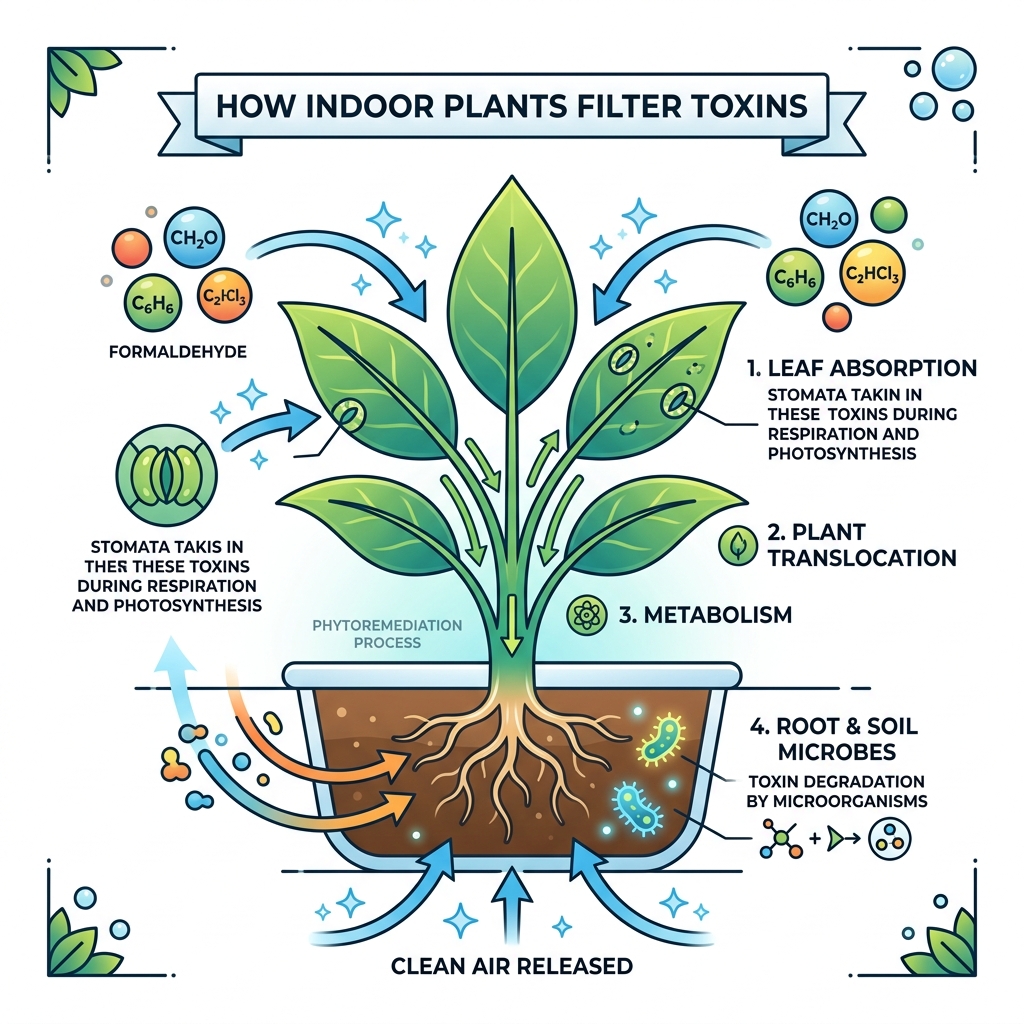
To understand how air purifying plants indoors work, we have to look at a process called phytoremediation. This is a fancy scientific term for using living plants to clean up soil, air, and water. While we often think plants just “breathe in” carbon dioxide and “breathe out” oxygen, they are actually much more sophisticated filters.
In the late 1980s, Dr. Bill Wolverton led the NASA Clean Air Study. He discovered that plants don’t just absorb gases through their leaves; they also move these toxins down to their root systems. Here, microorganisms in the soil break down the pollutants into food for the plant. It is a beautiful, self-sustaining cycle where our “waste” becomes their “dinner.”
The primary toxins these botanical guardians target include:
- Formaldehyde: Found in carpets, upholstery, and particleboard.
- Benzene: Often present in plastics, synthetic fibers, and detergents.
- Trichloroethylene: Found in printing inks, paints, and lacquers.
- Xylene and Toluene: Commonly found in nail polish and adhesives.
If you are looking for specific recommendations for your resting space, you should check out nasas-secret-list-the-best-air-cleaning-plants-for-bedroom-health.
While plants are incredible, we should be realistic about their power. A single plant won’t replace a high-tech air purifier if you have severe allergies to dust or pet dander. Here is how they stack up against mechanical systems:
[TABLE] Plant Filtration vs. HEPA Air Purifiers
| Feature | Indoor Plants | HEPA Air Purifiers |
|---|---|---|
| Removes VOCs | Yes (excellent for chemicals) | Only with Carbon Filters |
| Removes Dust/Pollen | Limited (traps on leaves) | Excellent (99.97% efficiency) |
| Oxygen Production | Yes | No |
| Humidity Control | Adds natural humidity | No |
| Energy Usage | None (only sunlight) | Requires electricity |
| Noise Level | Silent | Fan noise |
As we can see, the best approach is often a combination of both. Plants handle the chemical gases, while purifiers handle the floating dust bunnies.
Top Low-Maintenance Varieties for Beginners
If you’re just starting your journey with air purifying plants indoors, don’t panic! You don’t need a “green thumb” to keep these varieties alive. Some of the most effective air cleaners are actually the hardest to kill.

The Snake Plant (Sansevieria trifasciata)
Affectionately known as “Mother-in-Law’s Tongue” (we promise it’s friendlier than the name suggests), the Snake Plant is a superstar. Most plants release oxygen during the day, but the Snake Plant is a rebel—it releases oxygen at night. This makes it one of the best choices for a bedroom. It is incredibly drought-tolerant; you can basically forget about it for weeks, and it will still keep cleaning your air.
Golden Pothos (Epipremnum aureum)
Also called “Devil’s Ivy” because it is nearly impossible to kill, this trailing vine is a powerhouse at removing formaldehyde. It can grow in almost any light condition, from dim offices to bright living rooms. We love how it looks cascading down from a high shelf or a hanging basket.
Spider Plant (Chlorophytum comosum)
The Spider Plant is a classic for a reason. It is exceptionally good at removing carbon monoxide and xylene from the home. It also produces “pups” or baby plants that you can easily propagate and give to friends. It’s the gift that keeps on giving!
For those looking to start a collection, we recommend browsing our-favorite-air-filter-plants-indoor-collections-for-a-fresher-home to see which styles fit your space best.
Safe and Effective Greenery for Pet Owners
We know that for many of us, our “roommates” have four legs and fur. Unfortunately, many popular air purifying plants indoors (like the Peace Lily or Pothos) can be toxic if chewed on by curious cats or dogs.
Safety is our priority at Futuro Ciencia, so we’ve highlighted the best pet-safe options that still pack a punch in the air-cleaning department.
Areca Palm (Dypsis lutescens)
The Areca Palm is often cited as one of the top air-purifying plants in NASA’s research. Not only does it filter out a wide range of toxins, but it also acts as a natural humidifier, releasing up to a quart of water into the air every 24 hours. It is completely non-toxic to pets, making it a perfect statement piece for a living room.
Boston Fern (Nephrolepis exaltata)
If you struggle with dry air or live in an area with high xylene levels, the Boston Fern is your best friend. These lush, feathery plants love humidity. They are safe for cats and dogs, though they do require a bit more attention in the form of misting and consistent watering.
Bamboo Palm (Chamaedorea seifrizii)
The Bamboo Palm is fantastic for filtering out benzene and trichloroethylene. It stays relatively small compared to other palms, making it great for corners. According to ASPCA safety guidelines, it is non-toxic to both dogs and cats.
Essential Care Tips for Maximum Purification
To get the most out of your air purifying plants indoors, you need to keep them healthy. A sick or dusty plant can’t breathe, and if it can’t breathe, it can’t clean your air!
Leaf Cleaning: The Secret Weapon
Dust is the enemy of air purification. When dust builds up on leaves, it plugs the stomata (the plant’s pores). We recommend gently wiping the leaves with a damp cloth every few weeks. For plants with many small leaves, like the Boston Fern, a gentle “shower” in the sink can work wonders.
Light and Placement
Most air-purifying plants prefer bright, indirect sunlight. Direct sun can scorch their leaves, while too little light can slow down their metabolism, making them less effective at filtering toxins.
Watering and Drainage
The fastest way to kill a houseplant is overwatering. Always ensure your pots have drainage holes. We suggest the “finger test”: stick your finger an inch into the soil. If it feels dry, it’s time to water. If it’s still damp, wait a few days.
Fertilization and Repotting
Plants need food to grow and stay active. During the growing season (spring and summer), use a balanced liquid fertilizer once a month. If you notice roots circling the bottom of the pot or water running straight through, it’s time to repot. Fresh soil provides a new boost of nutrients and helpful microbes that assist in the air-cleaning process.
For a deep dive into specific species, the RHS Growing Guide for Peace Lilies is an excellent resource for mastering one of the most elegant air cleaners.
Frequently Asked Questions about Indoor Air Quality
How many air purifying plants indoors do I need for a standard room?
This is the million-dollar question! While NASA’s original studies were done in small, sealed chambers, real homes are much “leakier.” To see a measurable difference in air quality, research suggests you need about two large plants (in 8-to-10-inch pots) for every 100 square feet of space.
However, don’t feel like you need to turn your home into a literal jungle overnight. Grouping plants together doesn’t just look great; it creates a “microclimate” that increases local humidity and boosts the collective filtration effect.
Can houseplants completely replace a mechanical air purifier?
In short: no. While air purifying plants indoors are incredible at absorbing gaseous chemicals (VOCs), they aren’t very good at catching physical particles. If you are dealing with heavy dust, smoke, or pollen, a HEPA filter is much more efficient. Think of plants as the “chemical specialists” and purifiers as the “dust specialists.” Using them together gives you the best of both worlds.
What are the best low-light air purifying plants indoors?
Not everyone has a sun-drenched sunroom. If you have a dim corner or a north-facing apartment, these plants are your best bets:
- ZZ Plant (Zamioculcas zamiifolia): Extremely hardy and handles low light like a pro.
- Chinese Evergreen (Aglaonema): Comes in beautiful variegated patterns and thrives in shade.
- Snake Plant: As mentioned, it’s a tank and can survive almost anywhere.
- Peace Lily: It actually prefers lower light and will tell you exactly when it’s thirsty by drooping its leaves.
For more insights on low-light champions, check out The Best 10 Houseplants to Purify Your Air, Even in Low Light Rooms or 10 Best Houseplants for Air Purification and Low-Light Environments.
Conclusion
At Futuro Ciencia, we believe that your home should be a sanctuary. Bringing air purifying plants indoors is about more than just aesthetics; it’s about investing in your long-term health and well-being.
Beyond just cleaning the air, plants have been shown to reduce stress, improve mood, and even boost productivity. There is something deeply grounding about tending to a living thing and watching it thrive. Whether you start with a single, indestructible Snake Plant or a lush collection of Areca Palms, you are taking a step toward a fresher, more tranquil home.
Ready to start your green journey? Transform your home with expert indoor plant care and let us help you maintain a vibrant, healthy indoor garden. Happy planting!
