
Why Your Snake Plant Has Yellow Leaves (And What to Do Fast)
Snake plant yellow leaves are almost always a sign of a watering problem — and the fix is usually simpler than you think.
Quick answer: The most common causes of yellow snake plant leaves are:
- Overwatering — the #1 culprit, responsible for over 90% of cases
- Poor drainage — soggy soil suffocates roots even if you water correctly
- Underwatering — less common, but leaves turn dry and brittle rather than soft
- Too much or too little light — bleaching from direct sun, or pale yellowing from low light
- Natural aging — older bottom leaves yellow and die as part of normal growth
- Pests or nutrient deficiency — less likely, but worth checking if other causes are ruled out
Once a leaf turns fully yellow, it won’t go back to green. But fix the root cause now and your plant will bounce back with healthy new growth.
Snake plants (Dracaena trifasciata) are famously tough. They tolerate neglect, low light, and irregular watering better than almost any other houseplant. But even they have limits — and yellowing leaves are their way of telling you something is off.
The good news? With a 95% chance the problem traces back to watering, you can usually diagnose and fix the issue in under an hour.
In this guide, we’ll walk you through every cause, how to tell them apart, and exactly what to do to get your plant healthy again.
Why Are My Snake Plant Yellow Leaves Happening?
When we see snake plant yellow leaves, we are actually witnessing a process called chlorosis. This is a fancy botanical term for when a plant loses its chlorophyll—the green pigment that allows it to turn sunlight into food. Without chlorophyll, the leaf can’t function, and it begins to fade into shades of yellow, orange, or even brown.
While scientific research on plant chlorosis and micronutrients often points to complex chemical deficiencies in large-scale agriculture, in our living rooms, the cause is usually much more “human.” We either love our plants too much (overwatering) or forget them entirely.
However, it is important to distinguish between a “sick” plant and a “sensitive” one. For instance, the popular Sansevieria Laurentii features beautiful yellow variegated edges. If you are new to this variety, don’t panic! Those yellow borders are a feature, not a bug. Furthermore, variegated snake plants actually have less chlorophyll than their solid green cousins, making them slightly more sensitive to light changes and more prone to showing stress signals through yellowing if their environment isn’t stable.
Identifying Natural Aging vs. Disease
Not every yellow leaf is a 911 emergency. Just like humans lose hair, snake plants lose leaves as they mature. This is simply a part of the plant’s natural lifecycle.
How can you tell if it’s just old age? Look at the location. If only one or two of the outermost, bottom leaves are turning yellow while the rest of the plant is pushing out vibrant new growth, your plant is likely just redirecting its energy. It’s “retiring” the old guard to make room for the new recruits.
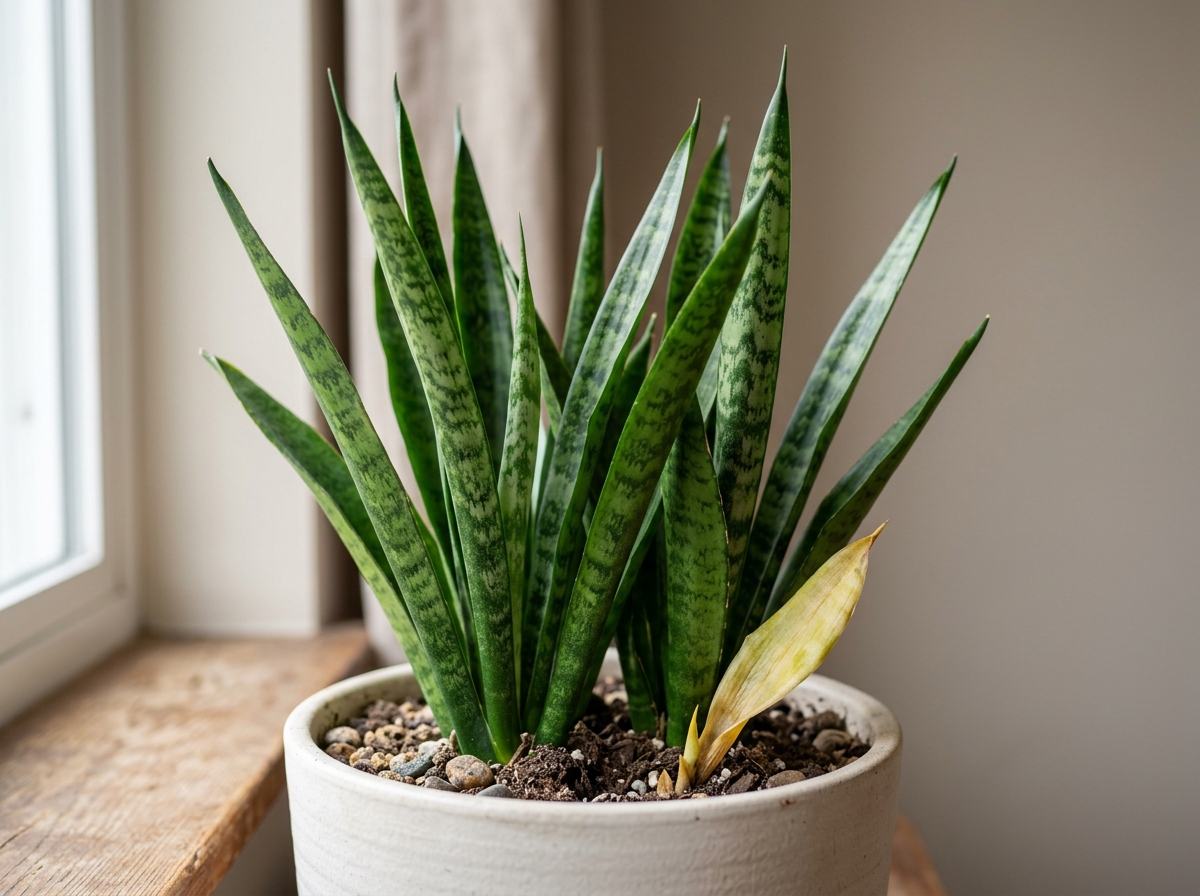
If the yellowing is happening to the new, inner leaves or spreading rapidly across the entire plant, that is when we need to roll up our sleeves and investigate further.
The 90% Rule: Solving Overwatering and Root Rot
We often say that snake plants “thrive on neglect,” and we mean it. Industry experts and experienced growers agree that there is roughly a 95% chance that snake plant yellow leaves are caused by a watering issue. Specifically, overwatering.
When a snake plant sits in soggy soil, its roots cannot breathe. They essentially drown, leading to root rot. This decay starts at the bottom and moves up, which is why you’ll often see mushy, yellow tissue starting at the base of the leaves.
To diagnose this before it’s too late, we recommend the “Bamboo Skewer Test.” Simply push a wooden skewer deep into the soil and leave it for a minute. If it comes out damp or with dark soil clinging to it, do not water! If it’s bone-dry, your plant might actually be thirsty.
To help you distinguish between the two most common watering blunders, we’ve put together this handy comparison:
| Symptom | Overwatered (Root Rot) | Underwatered (Dehydration) |
|---|---|---|
| Leaf Texture | Soft, mushy, or “slimy” | Dry, brittle, or “crispy” |
| Color Pattern | Yellowing starts at the base | Browning/yellowing at the tips |
| Soil Feel | Wet, clumpy, or smells like compost | Bone-dry, pulling away from pot edges |
| Leaf Shape | May droop or fall over | May shrivel or curl inward |
How to Perform Root Rot Surgery
If you’ve confirmed the soil is a swamp and the leaves are mushy, it’s time for surgery. Don’t worry; we’ve seen plants come back from the brink with a little bit of aggressive care.
- Remove the plant: Gently take the plant out of its pot and shake off the old, wet soil.
- Inspect the roots: Healthy snake plant roots are firm and usually white or bright orange. Rotten roots are brown, black, slimy, and often have a foul odor.
- Trim the rot: Use sterilized scissors or a knife to cut away every single bit of mushy root. Be brave—leaving even a little rot can cause it to spread again.
- Air dry: Let the plant sit out in the open air for 12 to 24 hours. This allows the “wounds” from your cuts to callus over.
- Repot: Place the survivor in a clean pot (preferably terracotta, which “breathes”) with fresh, dry cactus soil.
How to Restore Health to Snake Plant Yellow Leaves
Once the root cause is addressed, we need to handle the aesthetic and structural recovery of the plant. A common question we get at Futuro Ciencia is: “Can I save the yellow leaf?” The short answer is no. Once the chlorophyll is gone, that specific leaf won’t turn green again.
Pruning and Repotting Basics
We recommend pruning yellow leaves to prevent them from draining energy from the healthy parts of the plant. Use sharp, sterilized scissors to cut the leaf off as close to the base (the soil line) as possible. This keeps the plant looking tidy and prevents any potential rot in the yellowing leaf from spreading to the rhizome.
When repotting, the soil mix is your best defense against future snake plant yellow leaves. Standard potting soil holds too much water. Instead, create a “gritty” mix. We suggest:
- 2 parts succulent/cactus soil
- 1 part perlite or pumice (for aeration)
- A handful of orchid bark (for drainage)
This mixture ensures that water flows through the pot quickly, giving the roots the moisture they need without the “wet feet” they hate.
Optimal Watering Schedules for Prevention
Preventing yellow leaves is all about timing. During the active growing season (spring and summer), you might water every 2–3 weeks. However, in the winter, snake plants enter a period of dormancy. During this time, they may only need water once a month or even every six weeks.
The best tool you have isn’t a calendar—it’s your finger. Stick your finger two inches into the soil. If you feel any moisture at all, wait. If it’s dry all the way down, it’s time for a deep soak. When you do water, pour until it runs out of the drainage holes, then empty the saucer immediately. Never let your snake plant sit in a pool of water!
Environmental Stress and Pest Management
While watering is the usual suspect, environmental factors can also trigger snake plant yellow leaves.
Light Requirements for Snake Plant Yellow Leaves
There is a common myth that snake plants love the dark. While they tolerate low light, they don’t necessarily love it. In very dark corners, the plant grows slowly, and the soil stays wet for much longer, increasing rot risk. Conversely, putting a snake plant in harsh, direct afternoon sun can bleach the leaves, turning them a pale, sickly yellow or even white (sunburn).
The “Goldilocks” zone for snake plants is bright, indirect light—think near an east-facing window or behind a sheer curtain. Aim for 8–10 hours of this filtered light daily to keep the leaves a deep, healthy green.
Temperature and Pests
Snake plants are tropical natives. They prefer temperatures between 65°F and 85°F. If they are placed near a drafty winter window or directly in front of an air conditioning vent, the “cold shock” can cause leaves to yellow and drop.
As for pests, keep an eye out for spider mites and mealybugs. These tiny sap-suckers drain the plant’s life force, causing yellow spots or stippling on the leaves. If you see tiny webs or white, cottony fluff, wipe the leaves down with an alcohol-dipped swab or spray the plant with neem oil every few days until the intruders are gone.
Frequently Asked Questions about Snake Plant Yellow Leaves
Can yellow snake plant leaves turn green again?
Unfortunately, no. Once a leaf has undergone full chlorosis, the cellular structure has changed and the chlorophyll is gone for good. It is best to prune these leaves at the base so the plant can focus its energy on producing beautiful, new green foliage.
Should I cut off yellow leaves from my snake plant?
Yes. Aside from looking better, removing yellow or mushy leaves prevents potential fungal issues or pests from taking hold in the weakened tissue. Always use sterilized tools to ensure you don’t introduce bacteria into the main “body” of the plant.
Is yellowing normal for snake plants after repotting?
A little bit of “transplant shock” is normal. Your plant might look a bit sad or show slight yellowing for 2–4 weeks after moving to a new home. As long as you’ve used well-draining soil and aren’t overwatering, it should acclimate and stabilize quickly.
Conclusion
At Futuro Ciencia, we believe that anyone can have a green thumb—it just takes a little bit of listening to what your plants are trying to tell you. Snake plant yellow leaves aren’t a death sentence; they are a conversation starter. By adjusting your watering habits, ensuring proper drainage, and providing the right light, you can transform your drooping plant back into a dazzling centerpiece.
Our mission is to help you transform your living space into a tranquil oasis with purifying, brightening plants that stand the test of time. For more expert tips on keeping your indoor jungle thriving, check out more info about indoor plant care and join our community of plant lovers today!
