
Why Getting the Light Right Is Everything for Your Fiddle Leaf Fig
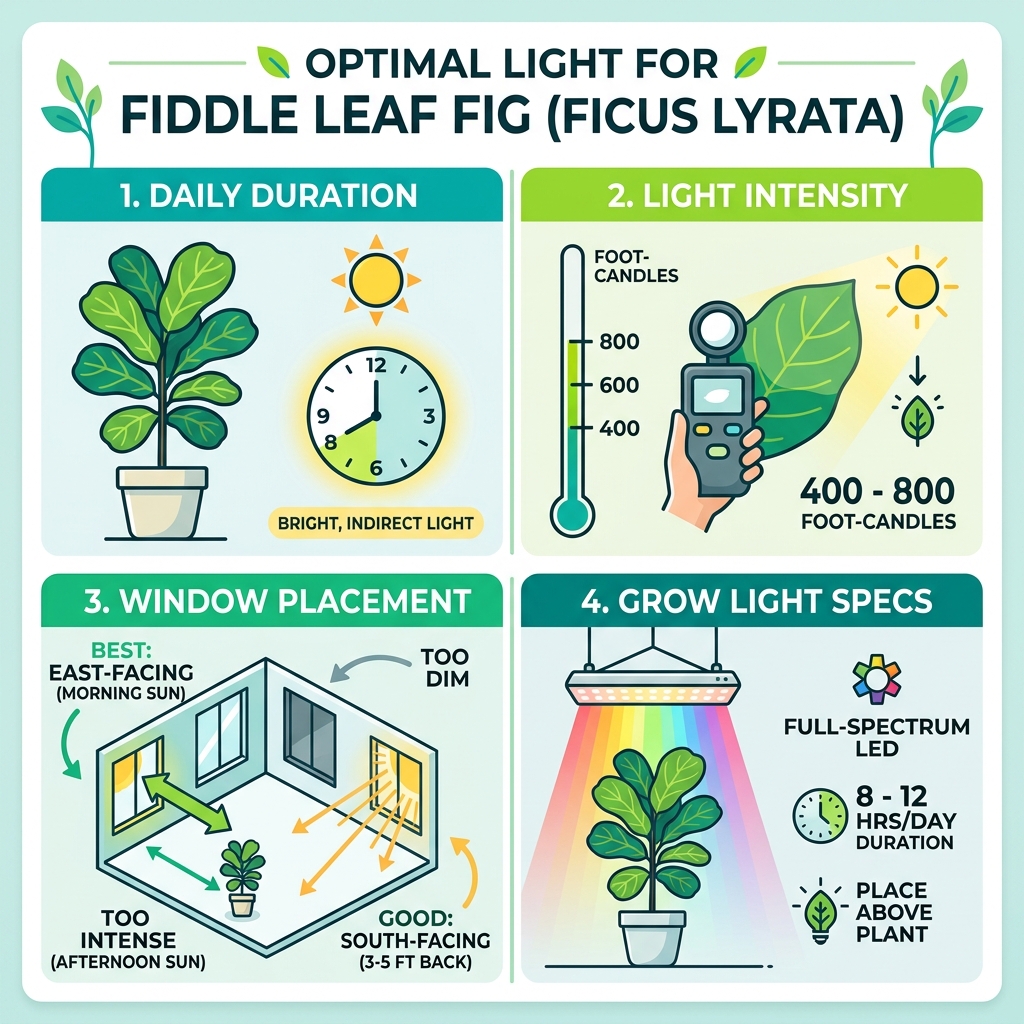
The best light for fiddle leaf fig plants is bright, indirect light for 6 to 8 hours per day — think a spot near a large window where sunlight filters in but never beats directly on the leaves.
Here’s a quick summary:
| Factor | Ideal Condition |
|---|---|
| Light type | Bright, indirect (filtered) |
| Daily duration | 6-8 hours |
| Best window | East-facing (or south, 3-5 ft back) |
| Light intensity | 400-800 foot-candles |
| Artificial option | Full-spectrum LED, 8-12 hrs/day |
Fiddle leaf figs (Ficus lyrata) come from the warm, humid rainforests of West Africa. In the wild, they grow beneath taller trees, soaking up dappled, filtered sunlight for most of the day — not harsh, direct sun.
Indoors, that’s a tough condition to recreate. Most rooms deliver only 20-30% of the light these plants actually need. And when a fiddle leaf fig doesn’t get enough light, it can’t photosynthesize properly. It essentially starts to starve.
The result? Yellowing leaves, stunted growth, and eventually leaf drop — the exact frustrations most owners run into.
Light is the single most important factor in keeping a fiddle leaf fig healthy. Get it right, and most other problems become much easier to manage.
Understanding Natural Sunlight and Window Placement
When we talk about the best light for fiddle leaf fig trees, we have to look at their biological “blueprint.” Because they evolved in native West African rainforests, they are genetically programmed to expect a high volume of light, but it must be filtered through a canopy.
In our homes, we often make the mistake of choosing a spot based on interior design aesthetics rather than the plant’s biological needs. We’ve found that a fiddle leaf fig is rarely happy unless it sits directly in front of a window. Even a few feet of distance can cause light intensity to drop off dramatically. For instance, light intensity right at a window might be 1,000 foot-candles, but just five feet away, it can plummet to a mere 200 foot-candles.
To keep your fig thriving, aim for these baseline conditions:
- Light Duration: 6 to 8 hours of bright, indirect light daily.
- Temperature: Consistent warmth between 60-75°F (15-24°C). Avoid placing them near drafty doors or AC vents.
- Humidity: Ideally 50-60%.
- Safety Note: That Ficus lyrata is mildly toxic to pets and humans if ingested, so placement should also consider the safety of your furry friends.
Finding the best light for fiddle leaf fig Indoors
The direction your windows face determines the “quality” of the light your plant receives. We recommend using a compass app on your phone to be certain of your home’s orientation.
- South-Facing Windows: This is often considered the “gold standard” because it provides steady, all-day light. However, because the sun is so intense here, you should place your plant 3-5 feet back from the glass or use sheer curtains to prevent leaf scorch.
- East-Facing Windows: These are fantastic for fiddle leaf figs. They provide gentle, direct morning sun that isn’t hot enough to burn the leaves, followed by bright indirect light for the rest of the day.
- West-Facing Windows: These get very hot in the afternoon. If you use a west window, you must use a sheer curtain or move the plant back several feet to avoid “sunburn” patches.
- North-Facing Windows: These usually provide the weakest light. While a fig might survive here, it likely won’t put out new growth without supplemental lighting.
Beyond just picking a window, we must remember that plants are phototropic—they grow toward the light. To prevent your tree from leaning or becoming lopsided, rotate it 90 degrees every 2-3 weeks. This ensures every leaf gets its fair share of energy. While you’re at it, don’t forget to fertilize with Fiddle Leaf Fig Plant Food during the growing season to support the energy demands of all that photosynthesis!
Measuring the best light for fiddle leaf fig Success
If you aren’t sure whether your spot is bright enough, don’t guess—measure! We often suggest using a moisture and light meter like this one to get an objective reading of your plant’s environment.
When quantifying light, we look at two main units: Lux and Foot-candles (fc).
- Lux Levels: A reading under 200 lux is considered dark; up to 400 lux is medium; and anything above 400 lux is bright. For a healthy fig, you want to see a total cumulative reading of 600 lux or more when you add up readings taken at 9 a.m., noon, and 3 p.m.
- Foot-candles: The ideal intensity for a fiddle leaf fig measures between 400-800 foot-candles.
If you don’t have a meter, you can use the Hand Shadow Test. Hold your hand about a foot above a piece of white paper near your plant:
- Sharp, Dark Shadow: This indicates bright, direct light (be careful of scorching).
- Soft, Fuzzy Shadow: This is the “sweet spot”—bright, indirect light.
- Faint or No Shadow: This is low light, and your fig will likely struggle here.
Identifying Signs of Improper Lighting
Your plant is an excellent communicator if you know what to look for. When the best light for fiddle leaf fig needs aren’t met, the leaves will be the first to tell the story.
| Symptom | Cause | Solution |
|---|---|---|
| Yellowing leaves & slow growth | Too little light | Move closer to window or add grow light |
| Leggy stems (long gaps between leaves) | Too little light | Increase light and prune to encourage bushiness |
| Brown, crispy patches on leaf tops | Too much direct sun (Scorch) | Move back from window or add sheer curtain |
| Bleached or faded-looking leaves | Too much direct sun | Filter the light or relocate |
| Sudden leaf drop (bottom leaves) | Not enough light (or overwatering) | Check light levels first; ensure soil dries out |
One common mistake we see is ignoring the “dust factor.” Large leaves act like solar panels, but when they are covered in dust, they can’t absorb light efficiently. Regularly cleaning your leaves with Leaf Shine not only keeps the plant looking gorgeous but also maximizes its ability to process the light it receives.
Supplementing with Artificial Grow Lights
Sometimes, no matter how many windows we have, the winter months or a north-facing apartment makes it impossible to provide enough natural sun. This is where modern technology saves the day. Understanding indoor-plant-light-requirements allows us to bridge the gap with artificial sources.
LED grow lights are the most efficient option for fiddle leaf figs. They use 75-90% less energy than old-school HID lights and produce almost no heat, which means you won’t accidentally cook your leaves.
Choosing the best light for fiddle leaf fig: Grow Light Basics
When shopping for special lights for houseplants, look for Full-Spectrum LED bulbs. These mimic the natural electromagnetic spectrum of the sun, including the vital red and blue wavelengths.
- Wattage: A good rule of thumb is 20 to 40 watts per square foot of space. For a medium-sized fig, a 36W-40W LED bulb is usually sufficient.
- Duration: Since artificial light is often less intense than the sun, you should run your grow lights for 8 to 12 hours a day. We highly recommend using a timer to keep this consistent.
- Distance: Position the light 12 to 36 inches above the top of the canopy. If the light is too close, you risk “bleaching” the top leaves.
- PPFD & DLI: For those who love the science, aim for a PPFD (Photosynthetic Photon Flux Density) of 150-300 µmol/m²/s for maintenance, or 300-600 for active growth. Your target DLI (Daily Light Integral) should be 12-18 mol/m²/day.
If you have a very tall tree (over 5 feet), a single light at the top might not reach the bottom leaves. In this case, consider a “multi-angle” approach with a floor lamp that has movable arms or multiple clippable LEDs to ensure the entire “solar panel” of the plant is energized.
Frequently Asked Questions about Fiddle Leaf Fig Light
Can fiddle leaf figs survive in low light?
There is a big difference between surviving and thriving. A fiddle leaf fig can sit in a low-light corner for months, but it will eventually become “leggy,” drop its lower leaves, and stop growing altogether. Furthermore, low light makes the plant much more prone to root rot because it isn’t using water quickly enough. If your plant is already showing signs of distress, you may need a Root Rot Treatment alongside a move to a brighter location.
How do I acclimate my plant to more light?
If you’ve decided to move your fig from a dark corner to a sunny south window, do it slowly! Sudden changes can shock the plant and cause it to drop all its leaves. Move it closer to the window over a period of 1-2 weeks. If you are using grow lights, start with the light further away and gradually lower it to the recommended distance over several days.
Do regular LED bulbs work as grow lights?
Standard household LED bulbs are designed for human eyes, not plants. They lack the specific blue (for foliage growth) and red (for overall health) wavelengths that plants need for photosynthesis. For the best light for fiddle leaf fig results, always choose a bulb rated at a 6500K color temperature or one specifically labeled as “Full Spectrum Grow Light.”
Conclusion
Providing the best light for fiddle leaf fig trees doesn’t have to be a guessing game. By understanding their rainforest origins and using tools like light meters or full-spectrum LEDs, you can ensure your Ficus lyrata remains the vibrant centerpiece of your home.
At Futuro Ciencia, we believe that every plant parent deserves a stress-free experience. Our goal is to help you transform your living spaces into tranquil oases with purifying, brightening plants that actually thrive. By following a consistent light and care schedule, you can stop worrying about leaf drop and start enjoying the lush, green canopy of a healthy tree.
For more expert advice and personalized care schedules, visit our indoor plant care guides and join our community of thriving plant enthusiasts!
