
Why the Right Air Purifiers by Room Type Make All the Difference
Air purifiers by room type are not one-size-fits-all — the best choice depends on your room’s size, purpose, and specific air quality challenges.
Here’s a quick-reference guide to get you started:
| Room Type | Key Challenge | Recommended Feature | Typical Coverage |
|---|---|---|---|
| Bedroom | Allergens, sleep disruption | Quiet/night mode, HEPA | 100-400 sq ft |
| Nursery | Dust, germs, VOCs | Ultra-quiet, HEPA | 100-250 sq ft |
| Living Room | Pet dander, high traffic | High CADR, large coverage | 400-700+ sq ft |
| Kitchen | Cooking odors, smoke, VOCs | Activated carbon filter | 150-400 sq ft |
| Basement | Mold, humidity, poor airflow | High CADR, carbon filter | 500-1,500 sq ft |
| Open Plan | Mixed pollutants, large volume | Very high CADR or multiple units | 700-2,000+ sq ft |
Most people don’t think much about the air inside their homes. But according to the EPA, indoor pollutant concentrations are often 2 to 5 times higher than outdoor levels. And since we spend roughly 90% of our time indoors, that’s a problem worth solving.
The challenge is that every room is different. Your bedroom needs whisper-quiet operation so it doesn’t disrupt your sleep. Your kitchen produces grease, smoke, and odors that need a carbon filter to tackle. Your basement may battle mold and poor ventilation year-round.
Picking the wrong purifier — even a good one — for the wrong room means you’re either wasting money or leaving your air under-protected.
This guide breaks it all down by room, so you can match the right machine to the right space.
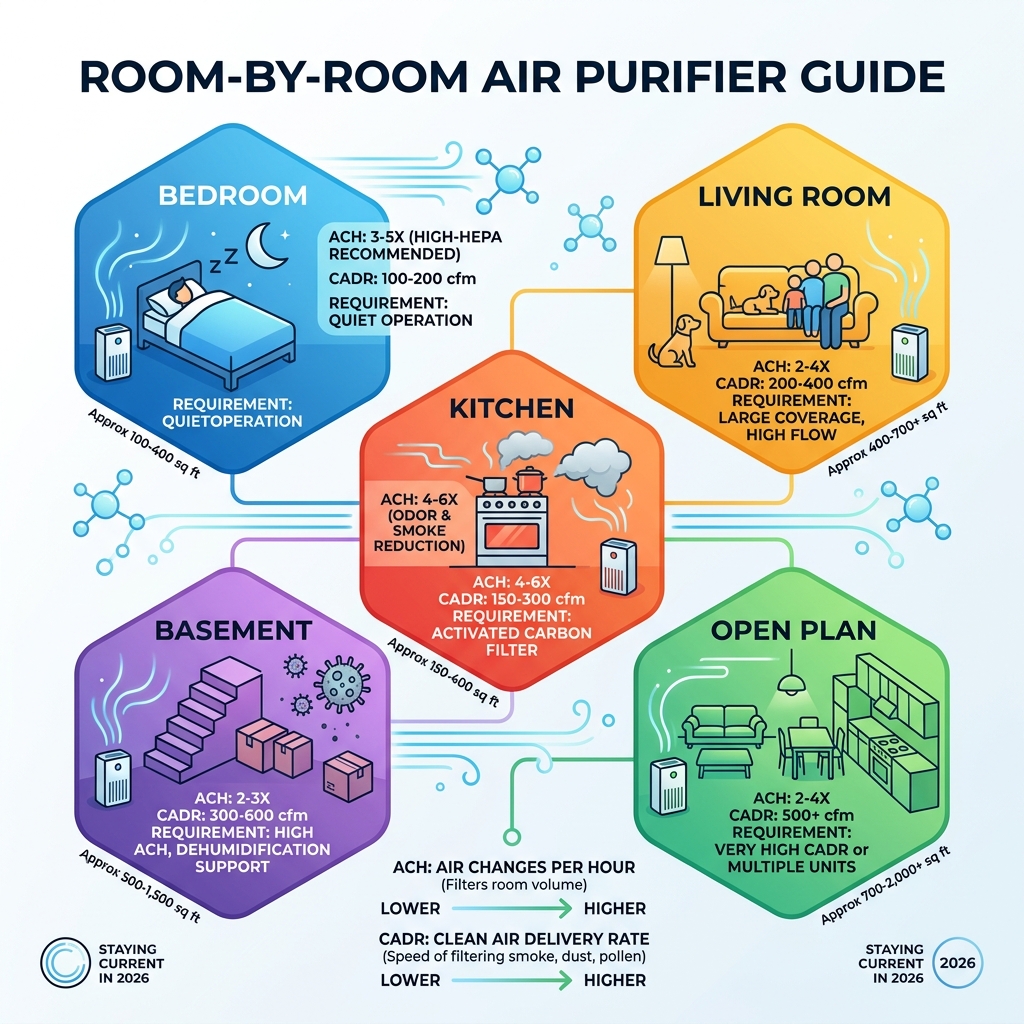
Air purifiers by room type definitions:
The Science of Sizing: Selecting Air Purifiers by Room Type
When we talk about air purifiers by room type, we aren’t just talking about aesthetics. There is a real science behind how these machines interact with the volume of air in a specific space. To get the best results, we need to look at two critical industry standards: CADR and ACH.
Understanding CADR (Clean Air Delivery Rate)
CADR is the gold standard developed by the Association of Home Appliance Manufacturers (AHAM). It measures how much clean air a purifier delivers per minute. Usually, you’ll see three ratings: smoke, dust, and pollen.
Expert tip: Always look for the “Dust CADR” when sizing for general home use. A good rule of thumb is the “two-thirds rule”—your purifier’s CADR should be at least two-thirds of the room’s square footage. For example, a 150-square-foot room needs a CADR of at least 100.
Deciphering ACH (Air Changes per Hour)
ACH tells us how many times the purifier can exchange all the air in a room within one hour. If a manufacturer says a unit covers 1,000 square feet, they might be basing that on only 1 ACH. In reality, for effective cleaning—especially for allergy sufferers—we want a much higher rate.
| Use Case | Recommended ACH | Benefit |
|---|---|---|
| General Use | 2 – 4 ACH | Basic freshness and dust reduction |
| Allergy/Asthma | 4.8 – 5 ACH | Removes triggers before they settle |
| High Risk (Smoke/Mold) | 5 – 6+ ACH | Rapid removal of hazardous particles |
The eACH Metric
In professional settings, we often look at “equivalent Air Changes per Hour” (eACH). This combines the power of your portable air cleaner with the existing ventilation of your home’s HVAC system. If your home has great natural ventilation, you might get away with a slightly smaller unit. However, most modern, tightly sealed homes rely heavily on the purifier to do the heavy lifting. To learn more about how these metrics impact high-performance units, check out this Scientific research on indoor air quality.
Tailoring Technology to Your Living Space

Every room in our home serves a different purpose, and consequently, every room faces unique “invisible enemies.” In the living room, we might be fighting pet dander and hair. In the kitchen, it’s volatile organic compounds (VOCs) from gas stoves and burnt toast. Understanding these challenges is the first step in selecting air purifiers by room type.
Bedrooms and Nurseries: Prioritizing Sleep and Silence
In the bedroom, the primary goal is a restful night. We spend about a third of our lives here, often with the door closed, which can lead to a buildup of CO2 and allergens like dust mites.
For these spaces, quiet operation is non-negotiable. We recommend units with a “Night Mode” that dims lights and drops noise levels to below 25 decibels—quieter than a whisper. The Blue Pure 511 Bundle | Small Room Air Purification System | Blueair is a fantastic choice for these smaller footprints, as it refreshes air in a 189-square-foot space every 12.5 minutes.
To further enhance your sleep sanctuary, we love pairing mechanical purifiers with nature’s own filters. You can find a list of the best green companions in our guide on nasas-secret-list-the-best-air-cleaning-plants-for-bedroom-health.
Living Rooms and Open Spaces: High-Capacity Air Purifiers by Room Type
Living rooms are the heart of the home. They usually have the highest traffic, the most furniture (which traps dust), and are often where our pets lounge. Because these spaces are typically larger or feature open-plan layouts, you need a machine with a serious CADR.
For rooms up to 700 square feet, the Winix XQ – Large Room Air Purifier – Winix America Inc is a powerhouse, featuring PlasmaWave® technology to help neutralize pollutants. If you have an even larger open-concept area, the PuroAir 400 Air Purifier | Large Room 2,000 SQ FT Coverage | PuroAir can treat up to 2,000 square feet in just one hour, making it ideal for those big family gatherings.
Kitchens and Basements: Specialized Air Purifiers by Room Type
Kitchens and basements require a different kind of “muscle.” Kitchens are hotspots for odors and smoke. A standard HEPA filter won’t stop a smell; for that, you need a thick layer of activated carbon. This porous material traps gas molecules and VOCs that mechanical filters miss.
Basements, on the other hand, are prone to dampness and mold spores. They often lack windows, meaning the air becomes stagnant. A smart unit like the Blue Pure 211i Max | Smart Air Purifier for Large Rooms | Blueair is perfect here because its sensors can detect spikes in moisture-related particles and ramp up the fan speed automatically.
Don’t forget that plants can also help manage the “vibe” and air quality in these utility spaces. Check out our-favorite-air-filter-plants-indoor-collections-for-a-fresher-home/ to see which species thrive in varied home environments.
Measuring and Calculating for Maximum Efficiency
Before you hit “buy,” we need to do a little homework. Most people just guess their room size, but when it comes to air purifiers by room type, accuracy saves money.
Calculating Square Footage and Volume
To find your square footage, simply multiply the length of the room by the width (L x W). However, air is three-dimensional! If you have high ceilings (10 feet or more), a purifier rated for a standard 8-foot ceiling will struggle.
If your ceilings are 10 feet high, your room has 25% more air volume than a standard room. In this case, we recommend “oversizing” your purifier by at least 25% to ensure it can still hit that target ACH.
High-End Solutions for Extra-Large Spaces
If you are dealing with a massive “great room” or a commercial-sized home office, standard units might not cut it. The Coway Airmega 450 | Home & Office Air Purifier | Extra Large Spaces Purifier – Cowaymega is designed to clean over 3,000 square feet in an hour. Similarly, the Atem X | IQAir uses “BionicCore” technology to deliver massive amounts of clean air while remaining incredibly quiet—perfect for large spaces where you still need to hear the TV or hold a conversation.
For those smaller nooks and crannies that still need love, our guide on indoor-plants-for-small-spaces-2/ offers great ways to bridge the gap between mechanical and natural purification.
Frequently Asked Questions about Air Purifiers by Room Type
Can an air purifier be too big for a room?
Technically, yes, but it’s rarely a bad thing. While an oversized unit might take up more floor space and cost more upfront, it actually offers a hidden benefit: noise reduction. A large purifier can clean a small room effectively while running on its lowest, quietest fan speed. If you use a tiny purifier in a big room, it has to run on “Turbo” 24/7, which is loud and wears out the motor faster.
Is it better to have one large air purifier or multiple smaller ones?
For open-plan homes, multiple smaller units are often better. Air doesn’t always flow easily around corners or through narrow hallways. By placing two medium-sized units at opposite ends of a large space, you ensure there are no “dead zones” where stagnant air collects. It’s also often more cost-effective than buying one massive industrial-grade machine.
How often should I replace filters in high-traffic rooms?
In high-traffic areas like living rooms or kitchens, filters work harder.
- HEPA filters: Usually last 6–12 months. If you have pets, check them every 3 months.
- Carbon filters: These “fill up” with odors and usually need replacing every 3–6 months.
- Pre-filters: If your unit has a washable fabric pre-filter (like many Blueair models), vacuum it every two weeks to keep the airflow strong!
Conclusion
Choosing the right air purifiers by room type is about more than just matching a square footage number on a box. It’s about understanding the rhythm of your home—where you sleep, where you cook, and where your family gathers. By using science-based metrics like CADR and ACH, you can ensure that every breath you take indoors is as fresh as a breeze in a forest.
At Futuro Ciencia, we believe your home should be a tranquil oasis. Whether you are looking for the latest in HEPA technology or looking to supplement your air quality with our favorite purifying plants, we are here to help you transform your space.
Ready to turn your home into a breath of fresh air? Explore more of our indoor plant care guides and start building your indoor sanctuary today!
