
What an Aloe Plant Air Purifier Actually Does (And What It Can’t)
An aloe plant air purifier is a real phenomenon — but it comes with important limits. Here’s a quick summary before we dive deeper:
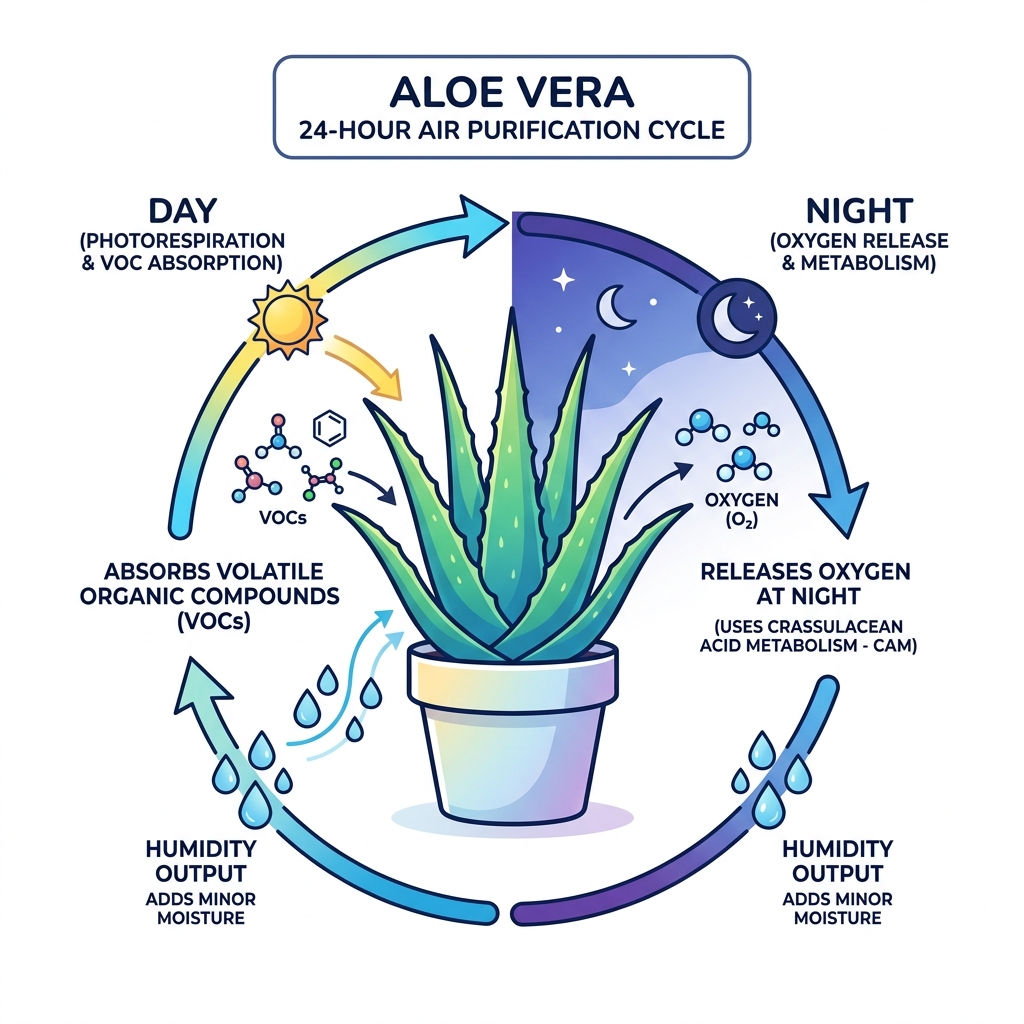
What Aloe Vera can do for your air:
- Absorb VOCs (volatile organic compounds) like formaldehyde and benzene through its leaves
- Release oxygen at night, which most plants don’t do
- Add a small amount of moisture to dry indoor air through transpiration
- Act as a low-cost, low-maintenance supplement to cleaner air
What Aloe Vera cannot do:
- Replace a mechanical air purifier — its Clean Air Delivery Rate is roughly 0.02–0.1 m³/hour vs. 100–400 m³/hour for machines
- Remove PM2.5 particles (fine dust, smoke, pollen) in any measurable way
- Clean a whole room on its own — you’d need 10 to 100 plants per 100 square feet for a noticeable VOC reduction
So, should you bother? Yes — just with realistic expectations.
Aloe vera is one of the plants NASA highlighted in its 1989 Clean Air Study for removing indoor chemical pollutants. That study was real. But it was done in sealed chambers, not open living rooms with windows and foot traffic.
In your home, a single aloe plant won’t transform your air quality. But it does quietly work in the background — absorbing trace chemicals, releasing oxygen while you sleep, and adding humidity to dry rooms. For a busy urban homeowner who wants a low-effort, no-fuss plant that pulls double duty, that’s still a solid win.
The Science Behind the Aloe Plant Air Purifier
When we talk about the aloe plant air purifier effect, we usually start with the 1989 NASA Clean Air Study. This landmark research was conducted to find ways to keep the air clean in space stations. NASA scientists discovered that certain common houseplants could eliminate harmful chemicals from the air.
As NASA published, indoor plants like Aloe Vera can effectively filter out Volatile Organic Compounds (VOCs). These are invisible gases emitted from everyday household items like detergents, paints, glues, and even your new sofa. The study found that certain plants could remove up to 87% of air toxins in just 48 hours under laboratory conditions.
Beyond just removing “bad stuff,” Aloe Vera is a champion at carbon dioxide absorption. Like all plants, it breathes in the $CO_2$ that we breathe out, helping to balance the air in our enclosed living spaces.
How Aloe Vera Filters VOCs
You might wonder how a succulent with no moving parts can act as a filter. The secret lies in its anatomy. Aloe Vera leaves are covered in tiny pores called stomata. Think of these as little mouths that “inhale” air.
When the plant takes in air for What is Photosynthesis, it also pulls in airborne toxins like formaldehyde and benzene. Once these chemicals enter the leaf, the plant’s internal metabolic processes break them down into harmless byproducts.
But here’s a cool “insider” fact: the plant isn’t working alone. Research suggests that a significant portion of toxin neutralization actually happens in the soil. Microorganisms living around the Aloe’s roots help metabolize these pollutants. This is why keeping your plant healthy is so vital; a thriving plant supports a thriving microbial community that cleans your air.
Nighttime Oxygen and Sleep Quality
Most houseplants follow a standard schedule: they produce oxygen during the day (while the sun is out) and release carbon dioxide at night. Aloe Vera is a bit of a rebel. It uses a special type of metabolism called Crassulacean Acid Metabolism (CAM).
Because Aloe evolved in dry, hot climates, it keeps its stomata closed during the day to prevent water loss. It opens them at night to “breathe.” This means an aloe plant air purifier releases oxygen while you sleep.
This nighttime oxygen release makes Aloe Vera an ideal companion for the bedroom. Furthermore, through a process called transpiration, the plant releases moisture into the air. This natural humidity regulation can soothe dry throats and skin, potentially improving your overall respiratory health and sleep quality.
Real-World Effectiveness vs. Mechanical Systems
We love our plants, but we also love the truth. If you look at the Clean Air Delivery Rate (CADR), a single Aloe Vera plant is a tiny player compared to a HEPA filter.
Mechanical air purifiers are designed to move massive amounts of air—typically between 100 and 400 cubic meters per hour. A single houseplant has a CADR between 0.02 and 0.1 cubic meters per hour.
| Feature | Aloe Vera Plant | Mechanical HEPA Purifier |
|---|---|---|
| Primary Target | VOCs (Formaldehyde, Benzene) | Particulate Matter (Dust, Pollen, PM2.5) |
| CADR (m³/h) | 0.02 – 0.1 | 100 – 400 |
| Power Source | Sunlight | Electricity |
| Maintenance | Watering, occasional dusting | Filter replacements |
| Noise Level | Silent | Fan noise (Low to High) |
| Extra Benefits | Aesthetics, Gel, $O_2$ at night | Rapid smoke/smell removal |
One major limitation of plants is their inability to handle particulate matter. If you are struggling with heavy smoke, pollen, or PM2.5 (tiny particles that settle deep in the lungs), an Aloe plant won’t help much. Mechanical filters are specifically engineered to trap these physical particles, whereas plants focus on gaseous chemicals.
Limitations of an Aloe Plant Air Purifier
In a real home, the air is constantly moving. We open doors, walk through hallways, and turn on fans. This “air exchange” happens much faster than a plant can filter. Unlike the sealed, plastic-lined chambers in the NASA study, our homes are “leaky.”
While Aloe Vera is great at absorbing VOCs, it can reach a point of “VOC saturation” if the levels are too high. Also, unlike spider plants, which are incredibly fast growers and can process air quite quickly, Aloe Vera grows more slowly, meaning its metabolic rate for air cleaning is also a bit more relaxed.
Plant Density and Coverage Area
So, how many plants do you actually need? NASA’s original suggestion was at least one plant per 100 square feet of home or office space. However, to see a measurable reduction in VOCs in a typical home environment, experts estimate you might need between 10 and 100 medium-sized plants per 100 square feet.
That sounds like a lot (and a bit like a jungle!), but don’t let it discourage you. We recommend “clustering.” By grouping your Aloe Vera with other air-purifying plants, you create a micro-environment where the air-cleaning effects are more concentrated. Even if you don’t reach the “100 plants” mark, every bit of natural filtration helps.
How to Care for Your Aloe Plant Air Purifier
To maximize the benefits of your aloe plant air purifier, you need a happy plant. A stressed or dying plant isn’t doing much for your air quality.
Aloe Vera needs bright, indirect light. If it doesn’t get enough light, its metabolic rate slows down, and its air-purifying powers diminish. If you’re new to succulents, check out our guide on indoor succulents that are easy to care for.
One of the most common mistakes is using the wrong dirt. Aloe hates “wet feet.” You need a best soil for indoor plants that is specifically formulated for cacti or succulents—something that drains quickly.
Watering and Maintenance for Air Health
Aloe Vera is famous for its drought tolerance. In fact, overwatering is the fastest way to kill it. We suggest following a strict watering schedule for indoor plants, but for Aloe, the “schedule” is simply: wait until the soil is bone dry.
Here is a pro-tip for air purification: dust the leaves. Since the plant absorbs toxins through its stomata, a layer of dust acts like a clogged filter. Every few weeks, take a damp cloth and gently wipe the leaves. This boosts the plant’s photosynthetic efficiency and keeps your “natural filter” running at peak performance. It also prevents root rot, as a healthy, active plant uses its water more effectively.
Best Placement for Maximum Benefit
Where should you put your Aloe?
- The Kitchen Window: Kitchens often have higher levels of VOCs from cleaning products and cooking gases. A sun-drenched windowsill is the perfect spot.
- The Bathroom: Aloe can thrive here if there is a window. It loves the occasional humidity from your shower, which it can help balance.
- The Home Office: Near electronics like printers and computers, which can emit small amounts of chemicals.
- Stagnant Air Zones: If you have a corner of a room where air feels “heavy” or “stale,” placing a cluster of plants there can help move things along.
Aloe Vera vs. Other Air-Purifying Plants
Aloe is fantastic, but it’s part of a larger team. When we design a “tranquil oasis” for our clients, we often mix and match.
- Snake Plant: Like Aloe, it releases oxygen at night. It’s even hardier and can handle lower light.
- Peace Lily: A powerhouse for removing formaldehyde, benzene, and even ammonia. (Warning: keep away from pets!)
- asparagus fern: While not as famous as Aloe, it adds a beautiful texture and contributes to humidity.
- Golden Pothos: This “cubicle plant” is nearly impossible to kill and is excellent at clearing carbon monoxide.
In terms of low-maintenance rankings, Aloe Vera and the Snake Plant usually tie for first place. They are the “set it and forget it” champions of the plant world.
Frequently Asked Questions about Aloe Air Purification
Can one Aloe Vera plant replace a mechanical air purifier?
In short: No. As we mentioned, the CADR of an aloe plant air purifier is about 0.02 m³/h, while a machine is 100+. Think of the plant as a “supplement” rather than a replacement. It’s like taking a vitamin vs. eating a full meal. You should use plants to enhance your environment, but if you have severe allergies or smoke issues, you still need a mechanical filter. Also, the myth that “one plant equals 9 air purifiers” is just that—a myth. It likely stems from a misunderstanding of how much $O_2$ a plant produces.
Is Aloe Vera safe for homes with pets and children?
Aloe Vera contains saponins and anthraquinones. If ingested, these can cause mild to moderate digestive upset (vomiting or diarrhea) in cats and dogs. While it’s not usually life-threatening, it’s best to keep the plant on a high shelf or in a room where pets don’t roam freely. For children, the spikes on some varieties can be a bit sharp, so placement is key!
Does Aloe Vera remove dust and pollen from the air?
Not really. While the leaves might physically trap a few stray dust bunnies, Aloe Vera has no mechanism to “pull” particulate matter out of the air. It is a chemical filter, not a physical one. For dust and pollen (PM2.5), a HEPA filter is far superior.
Conclusion
At Futuro Ciencia, we believe that bringing nature indoors is the best way to create a tranquil oasis in a busy world. While an aloe plant air purifier might not have the raw power of a high-end machine, it offers something no machine can: life, beauty, and a connection to the natural world.
By combining the right care, the right placement, and realistic expectations, you can turn your home into a healthier, brighter space. Whether you’re looking for nighttime oxygen or a natural way to scrub household chemicals, the humble Aloe Vera is a secret weapon worth having.
