
Is Your Parlour Palm Actually Hungry? Here’s What You Need to Know
Parlour palm fertilizer is something most indoor plant owners overlook — until their plant starts looking sad.
Here’s the quick answer:
Best fertilizer for Parlour Palms at a glance:
| What | Details |
|---|---|
| Fertilizer type | Balanced liquid fertilizer |
| Best NPK ratio | 20-20-20 (or 8-2-12-4 for blooming) |
| Strength | Half or quarter strength |
| Frequency | Every 4-6 weeks in spring/summer |
| Winter | Stop or reduce significantly |
| Key watch-outs | Never fertilize dry soil; flush if salt builds up |
The Parlour Palm (Chamaedorea elegans) is one of the most forgiving houseplants you can own. It tolerates low light, doesn’t demand much water, and thrives in average indoor humidity. But here’s the thing — it still needs to eat.
Potting soil loses its nutrients over time. Without a regular feeding routine, your palm can slowly starve, showing signs like yellowing leaves, stunted growth, or leaves dropping for no obvious reason.
The good news? Fertilizing a Parlour Palm isn’t complicated. You just need the right product, the right timing, and a simple routine you can actually stick to.
Understanding the Nutritional Needs of Chamaedorea elegans
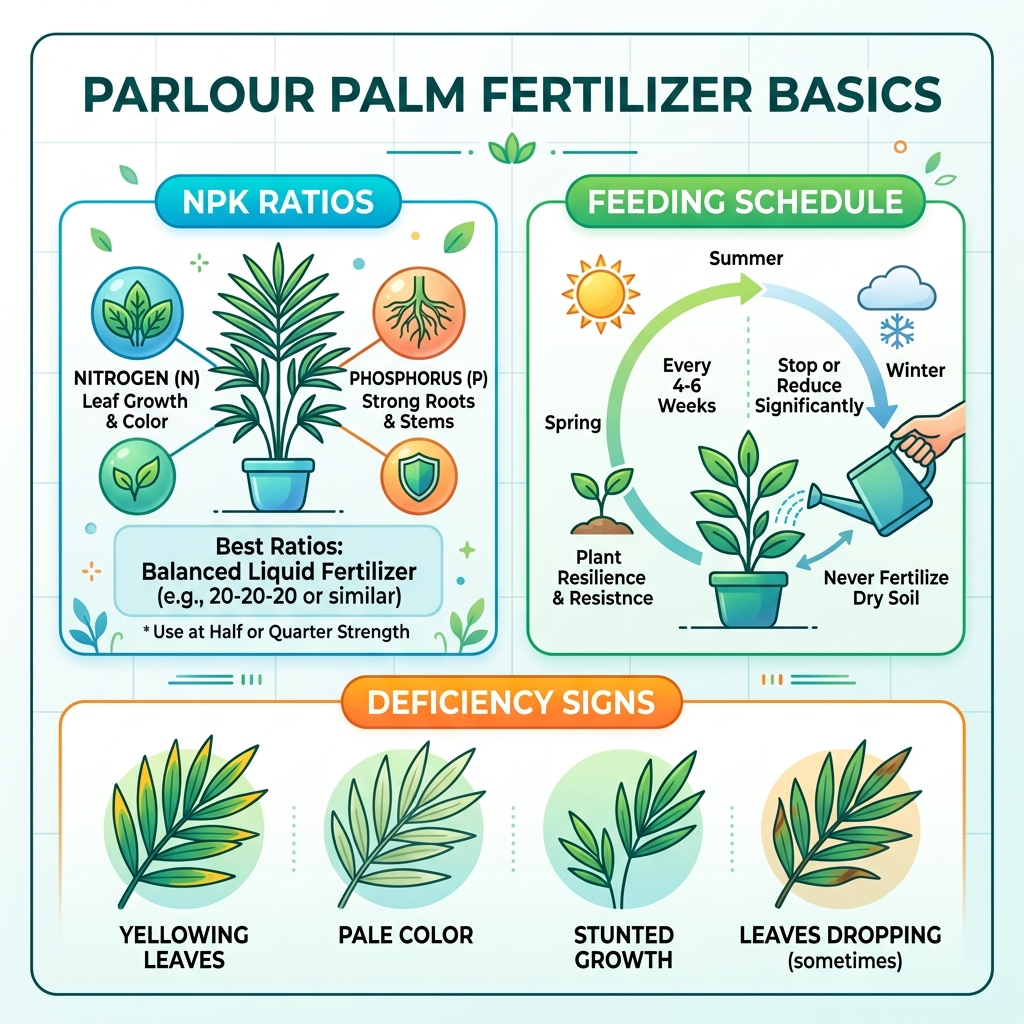
To keep your palm looking like a tropical masterpiece rather than a crispy relic of the Victorian era, we need to understand what’s happening beneath the soil. Like humans need a balanced diet of proteins, fats, and carbs, your palm relies on three primary macronutrients: Nitrogen (N), Phosphorus (P), and Potassium (K).
When you look at a bottle of parlour palm fertilizer, you’ll see three numbers, like 20-20-20. This is the NPK ratio.
- Nitrogen (N): Think of this as the “green-maker.” It’s essential for lush leaf growth and maintaining that vibrant emerald hue.
- Phosphorus (P): This is the “architect.” It focuses on building a strong root system and is the secret ingredient if you want to see those rare, yellow, bead-like blooms.
- Potassium (K): This is the “bodyguard.” It enhances the plant’s overall health and its ability to resist stress from temperature changes or pests.
While a balanced 20-20-20 formula is excellent for general maintenance, some experts suggest an 8-2-12-4 blend (the last number being magnesium) specifically for palms. This helps prevent the common “fizzle-out” that palms experience when they lack specific minerals. If you are just starting out, our indoor plant care tips for beginners can help you master these basics.
| Nutrient | Role in Parlour Palms | Deficiency Sign |
|---|---|---|
| Nitrogen | Leaf development & green color | Yellowing of older leaves |
| Phosphorus | Root growth & flowering | Stunted growth, no blooms |
| Potassium | Water regulation & stress resistance | Brown, “burnt” leaf edges |
Choosing the Best Parlour Palm Fertilizer
Choosing a fertilizer can feel like walking into a pharmacy without a prescription—there are too many options! For Parlour Palms, we generally categorize choices into synthetic and organic.
Synthetic Fertilizers: These are the “fast food” of the plant world. They provide a quick, precise hit of nutrients that the plant can absorb almost immediately. They are great for a quick boost if your palm is looking particularly haggard. However, because they are concentrated salts, the risk of “burning” the roots is higher if you overdo it.
Organic Nutrients: These are more like a “multivitamin.” Options like bone meal, seaweed extract, or worm castings improve the soil structure over time. They release nutrients slowly as they break down, mimicking the natural rainforest floor where these palms originated. If you’re interested in a more natural approach, check out our guide on fertilizing houseplants naturally.
Liquid vs. Slow-Release Parlour Palm Fertilizer
How do you prefer to feed your plant? There are two main delivery methods, each with its own “personality.”
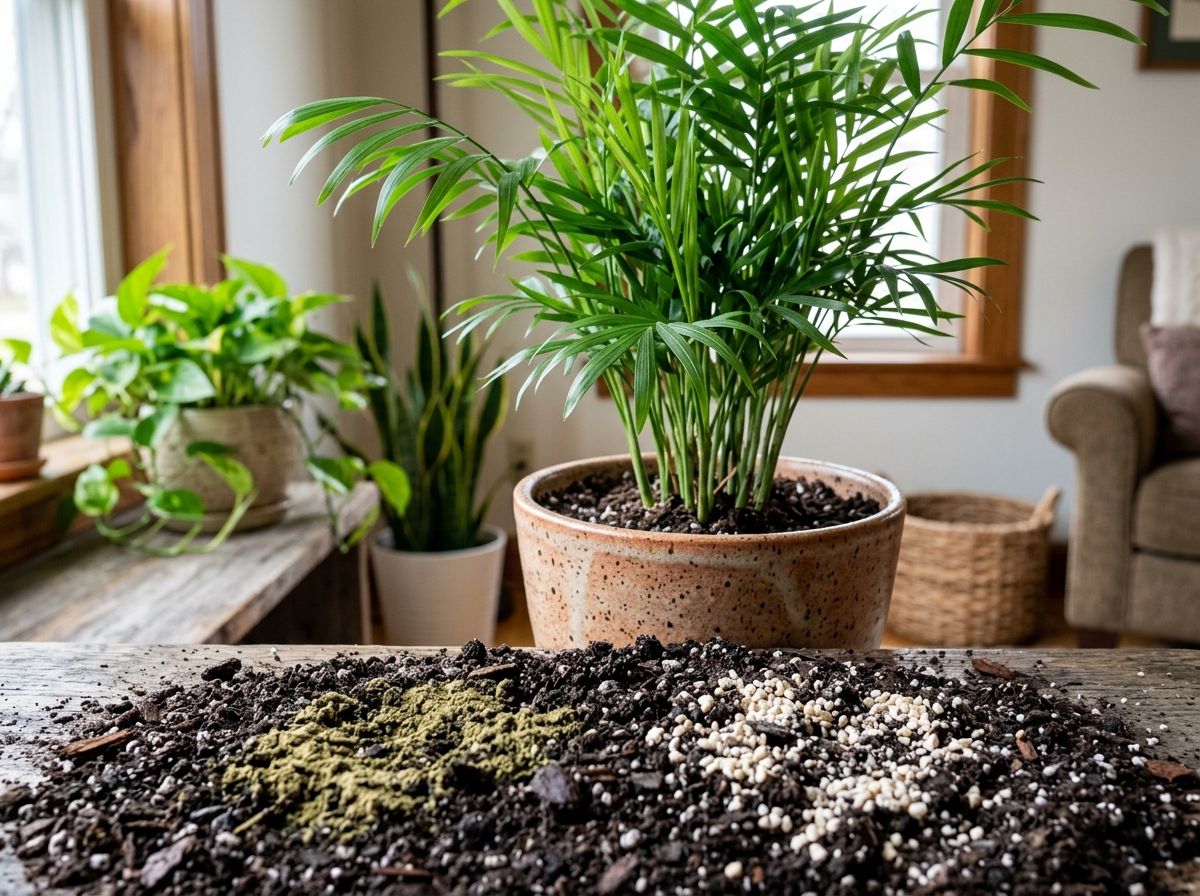
- Liquid Fertilizer: This is our preferred method for Parlour Palms. It gives you total control. You dilute it in your watering can and apply it once a month. Since you control the dose, you can easily scale back if the plant isn’t growing much. It ensures quick absorption but requires you to stay on top of your indoor plant maintenance checklist.
- Slow-Release (Granules or Spikes): Think of this as a “personal chef” for your plant. You sprinkle the granules on the soil or poke a spike in, and it releases nutrients every time you water. It’s convenient for busy plant parents, but it’s harder to stop the flow of nutrients if the plant enters dormancy or shows signs of over-fertilization.
The Ideal Schedule: When to Feed Your Palm
Timing is everything. In the rainforests of Mexico and Guatemala, Parlour Palms have seasons, even if they are subtle. Indoors, they follow the light.
- Spring (The Wake-Up Call): As the days get longer in early spring, your palm begins its active growth phase. This is the best time to start your fertilization routine.
- Summer (The Growth Spurt): During the peak of summer, your palm is working its hardest. Feed it every 4 to 6 weeks.
- Fall (The Wind Down): As light levels drop, your palm’s metabolism slows down. Reduce feeding to every 8 to 10 weeks.
- Winter (The Nap): Most Parlour Palms go dormant in winter. Stop fertilizing entirely during this time. Adding nutrients when the plant isn’t growing is like force-feeding someone who is asleep—it just leads to a “stomach ache” (or in this case, toxic salt buildup in the soil).
To keep track of these seasonal shifts, we recommend setting up a consistent indoor plant care schedule and aligning it with your watering schedule for indoor plants.
Applying Parlour Palm Fertilizer Without Root Burn
The most common mistake we see is “fertilizer burn.” Because Parlour Palms have relatively sensitive, shallow root systems, they can be easily overwhelmed by high concentrations of mineral salts.
The Golden Rule: Never fertilize dry soil.
If you apply fertilizer to bone-dry soil, the roots will soak up the concentrated chemicals too quickly, leading to “root burn.” Always water your plant lightly first to dampen the root ball, then apply your diluted fertilizer.
The Dilution Solution: Most fertilizer labels are written for greenhouse conditions where plants grow at warp speed. For a slow-growing indoor Parlour Palm, we recommend diluting liquid fertilizer to half or even quarter strength. It’s much safer to under-feed than to over-feed. Apply the mixture evenly around the base of the plant, avoiding the stems and foliage.
Troubleshooting Nutrient Issues and Over-Fertilization
Is your palm trying to tell you something? Since these plants grow slowly (often only 2-4 inches a year!), it can take a while for signs of trouble to show up.
Signs of Deficiency (Under-feeding):
- Yellowing Leaves: If the older, lower leaves are turning pale yellow, your palm likely needs more Nitrogen.
- Stunted Growth: If it’s spring and you haven’t seen a new spear in months, it might be starving for a balanced meal.
Signs of Over-Fertilization (The “I’m Stuffed” Look):
- Brown Tips and Edges: While this can be caused by low humidity, it’s often a sign of salt buildup from too much fertilizer.
- White Crust on Soil: If you see a salty, white residue on the soil surface or the rim of the pot, you’ve been too generous with the nutrients.
- Wilting: Paradoxically, too much fertilizer can damage roots so badly they can’t take up water, making the plant look thirsty even when the soil is wet.
The Fix: Soil Flushing If you suspect over-fertilization, don’t panic! Take your palm to the sink or shower and let lukewarm water run through the soil for several minutes. This “leaches” out the excess salts. Let it drain completely and skip the next two months of feeding. For more on managing these nuances, see the-ultimate-guide-to-parlor-palm-low-light-success.
Beyond NPK: Micronutrients and Environmental Factors
While NPK are the stars of the show, “trace elements” are the supporting cast that keeps the production running.
- Magnesium: Essential for photosynthesis. A lack of magnesium causes yellowing between the leaf veins.
- Iron: Keeps the leaves a deep, dark green.
- Boron: This is where Parlour Palms get “dramatic.” They need a tiny bit for cell wall strength, but they are incredibly sensitive to excess Boron. Avoid fertilizers with high boron content, as it can be toxic to them.
Environmental Synergy Your parlour palm fertilizer doesn’t work in a vacuum. Its effectiveness is tied to light and humidity.
- Light: If your palm is in a very dark corner, it won’t be able to process nutrients effectively. Bright, indirect light is the engine that drives nutrient uptake.
- Humidity: Low humidity can lead to moisture loss through the leaves, which can exacerbate the “burning” effect of fertilizers. Keep humidity above 40% if possible.
- Soil pH: Parlour Palms prefer a slightly acidic to neutral soil (pH 6.0 to 7.0). If the soil is too alkaline, the plant might not be able to “unlock” the nutrients you’re providing. Using the best soil for indoor plants from the start makes a huge difference.
And remember, while you’re pampering your plant, it’s good to know that the Parlour Palm is listed on the ASPCA Non-Toxic Plant List, making it a safe choice for homes with curious cats and dogs.
Frequently Asked Questions about Parlour Palm Care
Am I starving my Parlour Palm?
If your plant has been in the same potting soil for more than a year and you haven’t fertilized it, the answer is likely yes. While they are slow growers, they do eventually exhaust the nutrients in their containers. If you see overall paleness or a complete halt in growth during spring, it’s time for a snack.
Should I fertilize my palm in the winter?
Generally, no. We recommend skipping fertilization from November through February. The plant’s metabolism is too slow during the short days of winter to use the nutrients, which can lead to root damage and salt buildup.
What are the best nutrients for Parlour Palm blooming?
To encourage those subtle, yellow, mimosa-like flowers, look for a fertilizer with a slightly higher Phosphorus and Potassium content (the second and third numbers). These act as “personal trainers” for reproductive growth. However, indoor palms rarely bloom unless they are very happy and receiving excellent indirect light.
Conclusion
At Futuro Ciencia, we believe that every indoor space can become a tranquil oasis with the right care. Proper nutrient management is the bridge between a plant that merely survives and one that truly flourishes. By choosing a balanced parlour palm fertilizer, applying it at quarter-strength during the growing season, and keeping an eye out for those subtle “drama queen” signs of distress, you can ensure your palm remains a lush, green centerpiece for decades.
Ready to take your plant parenthood to the next level? Establish a foolproof indoor plant care routine today. Transform your indoor jungle with our expert care guides and watch your Parlour Palm reach its full, feathery potential!
