
What Is Araucaria Heterophylla Norfolk Indoors — and Can You Actually Keep One Alive?
Growing araucaria heterophylla Norfolk indoors is easier than you think — even if you’ve killed every plant you’ve ever owned.
Here’s the quick version of what you need to know:
- Light: Bright, indirect light near a south or east-facing window
- Water: When the top 1-2 inches of soil feel dry (roughly every 1-2 weeks)
- Temperature: Keep it between 65-75°F — no cold drafts, no heating vents
- Humidity: Aim for 50%+ relative humidity; dry air is its #1 enemy indoors
- Growth: Expect about 6 inches per year, reaching 3-8 feet over several years
- Repotting: Only needed every 2-3 years
The Norfolk Island Pine is one of those rare houseplants that looks impressive without demanding constant attention. It has the shape of a perfect miniature Christmas tree — symmetrical, tiered, and softly textured with bright green needles.
But here’s something most people don’t know: it’s not actually a pine at all. It belongs to the ancient Araucariaceae family, a group of conifers that dates back to the age of dinosaurs. True pines (family Pinaceae) are a completely different group.
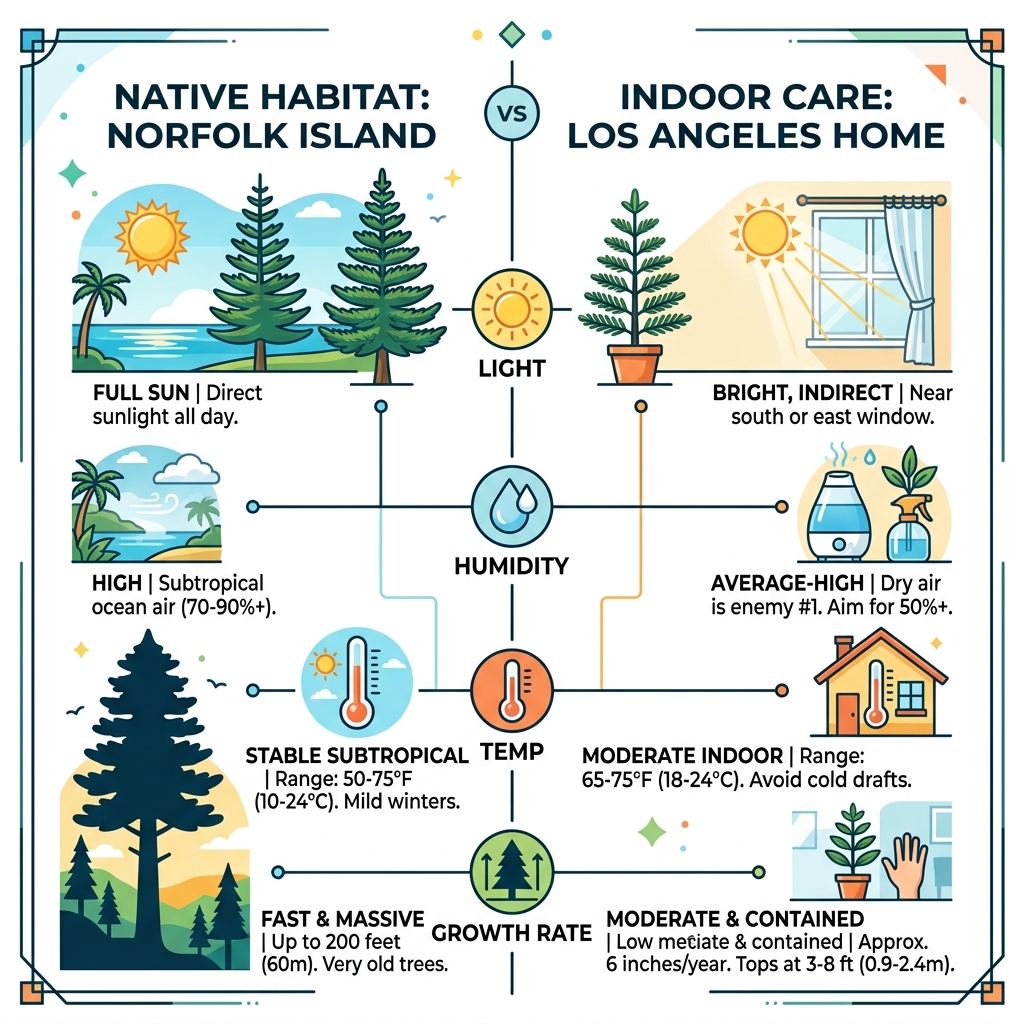
In its native habitat on Norfolk Island — a tiny island in the South Pacific between Australia and New Zealand — this tree can grow to an astonishing 200 feet tall. Indoors in Los Angeles, it’ll top out around 3-8 feet over several years. Much more manageable.
It’s a popular holiday gift plant, often sold decorated as a “Living Christmas Tree.” The good news: unlike a cut tree, this one keeps growing long after the holidays end — for decades, if you treat it right.
The bad news? Most people toss it in January. This guide exists so you don’t do that.
Creating the Perfect Microclimate for Araucaria Heterophylla Norfolk Indoors
To keep your araucaria heterophylla Norfolk indoors thriving, we need to mimic its tropical island roots. Think of your living room as a mini South Pacific retreat. While Los Angeles is generally sunny, the dry air inside our homes—especially when the AC or heater is blasting—can be a shock to this prehistoric beauty.
The ideal spot for your tree is near a window that gets plenty of light but isn’t a magnifying glass for the afternoon sun. A south-facing window with a sheer curtain is the “Goldilocks” zone. If you place it in a dark corner, it will start to drop its lower branches, and unfortunately, those branches do not grow back. Understanding indoor-plant-light-requirements is the first step to ensuring your tree doesn’t become a Charlie Brown special.
Temperature-wise, these trees are quite comfortable in the same range we are: 65-75°F. However, they are sensitive to sudden changes. Keep your tree away from drafty doors or those floor vents that kick out hot air in the winter. For more on seasonal positioning, check out our guide on indoor-plant-placement-tips and indoor-plant-care-during-winter.
Lighting and Rotation for Araucaria Heterophylla Norfolk Indoors
One of the most striking features of the Norfolk Island Pine is its perfect, tiered symmetry. However, plants are naturally phototropic—they grow toward the light. If you leave your tree in one position for months, it will eventually start leaning toward the window like it’s trying to make a break for it.
To maintain that iconic shape, we recommend a simple weekly rotation. Every time you check the soil for water, give the pot a 180-degree turn. This ensures all sides of the tree receive equal energy, preventing “leggy” or one-sided growth. As noted by the Norfolk Island Pine | Home and Garden Education Center, consistent light is the key to dense, lush needle production.
Managing Humidity in Dry Climates
If there is one thing that kills araucaria heterophylla Norfolk indoors faster than anything else, it’s low humidity. In its native habitat, the air is thick with moisture from the Pacific Ocean. In a typical home, humidity often drops below 15%, especially during Santa Ana wind events or winter heating seasons.
When the air is too dry, the tips of the needles turn brown and crispy. To combat this, aim for a humidity level of at least 50%. You can monitor this easily with a cheap hygrometer. Here are three “lazy” ways to boost moisture:
- The Pebble Tray: Fill a shallow tray with pebbles and water, then set the pot on top (ensuring the bottom of the pot isn’t touching the water).
- The Humidifier: Running a cool-mist humidifier nearby is the most effective solution for Los Angeles interiors.
- Misting: While less effective long-term, misting the needles daily provides a temporary boost.
For more deep dives into moisture management, see our humidity-tips-for-houseplants and learn to keep-them-alive-with-these-5-ways-to-take-care-of-plants.
Watering and Feeding Your Indoor Tree
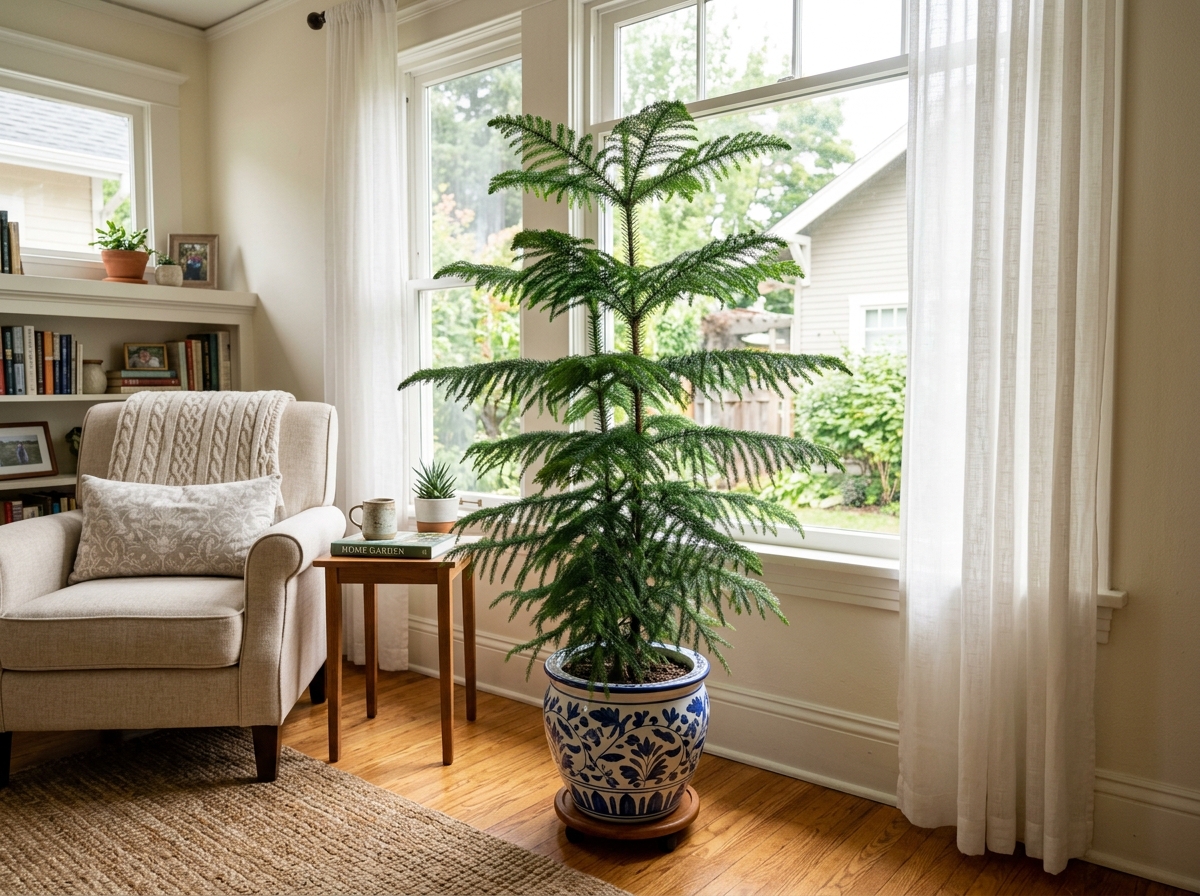
Watering is where many plant parents go wrong. The Norfolk Island Pine likes to stay “evenly moist,” which is plant-speak for “not soggy, but not bone-dry either.”
The best way to tell if it’s time to water is the finger test. Stick your finger into the soil; if the top 1-2 inches feel dry, it’s time for a drink. Always use tepid (room temperature) water, as cold water can shock the tropical roots. When you water, do it thoroughly until water runs out of the drainage holes, then—this is the important part—empty the saucer after about 15 minutes. Letting the tree sit in a pool of water is a fast track to indoor-plant-root-rot-solutions.
For a more structured approach, you can follow a watering-schedule-for-indoor-plants.
| Season | Watering Frequency | Soil Condition |
|---|---|---|
| Spring & Summer | Every 5-7 days | Keep consistently moist |
| Fall & Winter | Every 7-10 days | Allow top 2 inches to dry |
Signs of Watering Stress in Araucaria Heterophylla Norfolk Indoors
Your tree is a great communicator; you just have to know the language.
- Brown, Crispy Needles: Usually a sign of underwatering or critically low humidity.
- Yellowing Branches: This often points to overwatering or poor drainage. If you see this, check our guide on why-are-my-indoor-plant-leaves-turning-yellow.
- Drooping Limbs: Can be a sign of extreme thirst or the beginning of root rot.
If you notice these issues, don’t panic. Learn about fixing-brown-leaf-tips-on-indoor-plants to get your tree back on track.
Seasonal Fertilization Schedule
Since araucaria heterophylla Norfolk indoors grows slowly, it doesn’t need a lot of “food.” During the active growing season (March through September), we recommend using a balanced, water-soluble fertilizer once a month. To be safe, dilute the fertilizer to half the strength recommended on the label—over-fertilizing can lead to weak, spindly growth.
When the days get shorter in the fall and winter, the tree enters a dormancy period. Stop fertilizing entirely during this time to let the plant rest. This is a vital part of a healthy indoor-plant-care-routine. For those who prefer organic options, check out fertilizing-houseplants-naturally.
Potting, Soil, and Long-Term Growth Expectations
One of the reasons people love the Norfolk Island Pine is its longevity. While it grows slowly—adding only about 6 inches of height per year—it can live for several decades as a houseplant. Under good indoor conditions, you can expect it to reach 5-8 feet in about 10 years.
According to research from the New York Botanical Garden, these trees prefer a slightly acidic potting mix. A blend of standard potting soil, peat moss, and perlite or coarse sand provides the perfect balance of moisture retention and drainage. You can find more details in our guide on the best-soil-for-indoor-plants.
Choosing the Right Container
As your tree grows, it will become top-heavy. This means you need a substantial, heavy-bottomed pot to prevent it from tipping over. Ceramic or terra cotta pots are excellent choices because they add weight and stability.
Most importantly, ensure your pot has adequate drainage holes. Without them, water traps at the bottom, leading to root death. For help picking the perfect home for your tree, see selecting-indoor-plant-pots-and-planters and our list of best-containers-for-indoor-plants.
Repotting Frequency and Root Care
You don’t need to repot your Norfolk Island Pine very often. In fact, they prefer being slightly root-bound. Usually, every 2-3 years in the springtime is sufficient for young trees.
Signs that it’s time to move up include roots poking out of the drainage holes or the soil drying out much faster than usual. When you do repot, choose a container only about 2 inches wider than the current one. If you encounter tangled or mushy roots during the process, consult our resources on solutions-for-overcrowded-roots-in-indoor-plants and recognizing-and-remending-root-rot-in-indoor-plants. For a step-by-step walkthrough, check out how-to-repot-indoor-plants.
Troubleshooting Pests, Diseases, and Needle Drop
Even the best-cared-for araucaria heterophylla Norfolk indoors can run into trouble. The most common uninvited guests are spider mites, mealybugs, and scale.
Spider mites are particularly fond of Norfolk Pines in dry indoor air. You’ll know they’re there if you see tiny, fine webbing between the needles. Mealybugs look like small bits of white cotton tucked into the branch joints. If you spot these, act quickly. You can often rinse them off with a gentle spray of water or use insecticidal soap. Our guides on indoor-plant-pests-and-how-to-remove-them and how-to-combat-houseplant-pests offer detailed removal strategies.
Pruning and Maintaining Shape
Here is a critical rule for Norfolk Pines: Never cut off the top. The central leader (the very top vertical tip) is what allows the tree to grow upward. If you “top” the tree, it will stop growing vertically and lose its symmetrical beauty forever.
Pruning should be limited to removing dead or brown lower branches. These naturally occur as the tree ages, but if the drop is excessive, it’s a sign of stress. Use clean, sharp shears to snip them off close to the trunk. For more general advice, see pruning-tips-for-indoor-plants and avoid these common-indoor-plant-care-mistakes.
Dealing with Fungal Issues
While less common indoors, fungal issues like needle necrosis or bleeding canker can occur if the plant is kept too wet or in a room with poor air circulation. If you notice strange spots or oozing on the trunk, it’s time to investigate indoor-plant-fungus-treatment and dealing-with-indoor-plant-fungus. Knowing how to understand-and-treating-houseplant-diseases can save your tree’s life. If things look dire, don’t lose hope—check out how-to-revive-dying-houseplants-2.
Frequently Asked Questions about Norfolk Island Pines
Can I move my Norfolk Island Pine outdoors in the summer?
Yes, but be careful! If you live in Los Angeles (USDA Zones 10-11), your tree will enjoy a summer vacation on a shaded patio. However, it must be protected from direct, scorching sun and heavy winds, which can dry it out instantly. Bring it back inside before temperatures drop below 50°F. For more on its outdoor potential, see Norfolk pine (Araucaria heterophylla).
How do I propagate a Norfolk Island Pine at home?
Propagation is notoriously difficult for home gardeners. You can grow them from seeds if you can find them fresh (they need 70-80°F to germinate), but it takes a long time. Cuttings are even trickier; only a vertical tip cutting will grow into a symmetrical tree. Cuttings taken from side branches will grow horizontally like a weird, flat shrub!
Why is my tree dropping its lower branches?
This is usually a “cry for help” regarding light or humidity. If the tree doesn’t get enough light, it sheds lower branches to save energy for the top. Once a branch drops, it’s gone for good. Ensure your tree is in a bright spot and follow when-indoor-plant-leaves-droop-causes-and-solutions for more troubleshooting.
Conclusion
At Futuro Ciencia, we believe that anyone can transform their home into a tranquil oasis. The Norfolk Island Pine is the perfect “anchor” plant for any Los Angeles living room, providing a touch of ancient, tropical majesty with relatively low maintenance. By following this guide, you’re well on your way to keeping your araucaria heterophylla Norfolk indoors healthy for years to come.
Ready to level up your plant game? Download our indoor-plant-maintenance-checklist or read our indoor-plant-care-tips-for-beginners.
