
Why LED Grow Light Houseplants are Essential
If you have ever watched a favorite Pothos slowly lose its variegation or a succulent stretch into a tall, skinny version of its former self, you’ve witnessed “etiolation.” This is the plant’s way of screaming for help. In the wild, plants have the sun; indoors, they have us. LED grow light houseplants are essential because they provide the specific fuel—photons—that plants need to complete photosynthesis when your windows just aren’t cutting it.

One of the biggest hurdles for indoor gardeners is the change of seasons. During the darker months, the sun sits lower in the sky and the days are much shorter. We’ve detailed how to manage this in our guide on indoor plant care during winter, but the short version is: plants don’t hibernate as deeply as we think. They still need light to maintain their root systems and leaf health.
The technical advantages of LEDs over older technology (like incandescent or fluorescent bulbs) are massive:
- Lifespan: Most high-quality LED grow light bulbs boast a lifespan of 25,000 to 50,000 hours. To put that in perspective, if you run your lights for 12 hours a day, a 50,000-hour light could last you over 11 years. Some premium models, like the Vego Ultimate Grow Light, even claim up to 75,000 hours.
- Low Heat: Unlike old-school bulbs that get hot enough to singe a leaf (or your fingers), LEDs are incredibly efficient at converting energy into light rather than heat. This allows you to keep the light closer to the canopy without the risk of “leaf cook.”
- Energy Savings: Because they produce more “Photosynthetically Active Radiation” (PAR) per watt, you get more growth for every cent spent on your utility bill.
- Year-Round Growth: With a consistent light source, you aren’t limited to the “growing season.” You can propagate cuttings, start seeds, or even enjoy flowers in the dead of January.
Choosing the Right Full-Spectrum Setup
Walking into a store or browsing online for grow lights can feel like accidentally entering a physics convention. You’ll see terms like Kelvins, Lumens, PAR, and PPFD. Don’t let the jargon intimidate you. Choosing the right setup for your led grow light houseplants comes down to matching the light’s output to your plant’s specific needs.
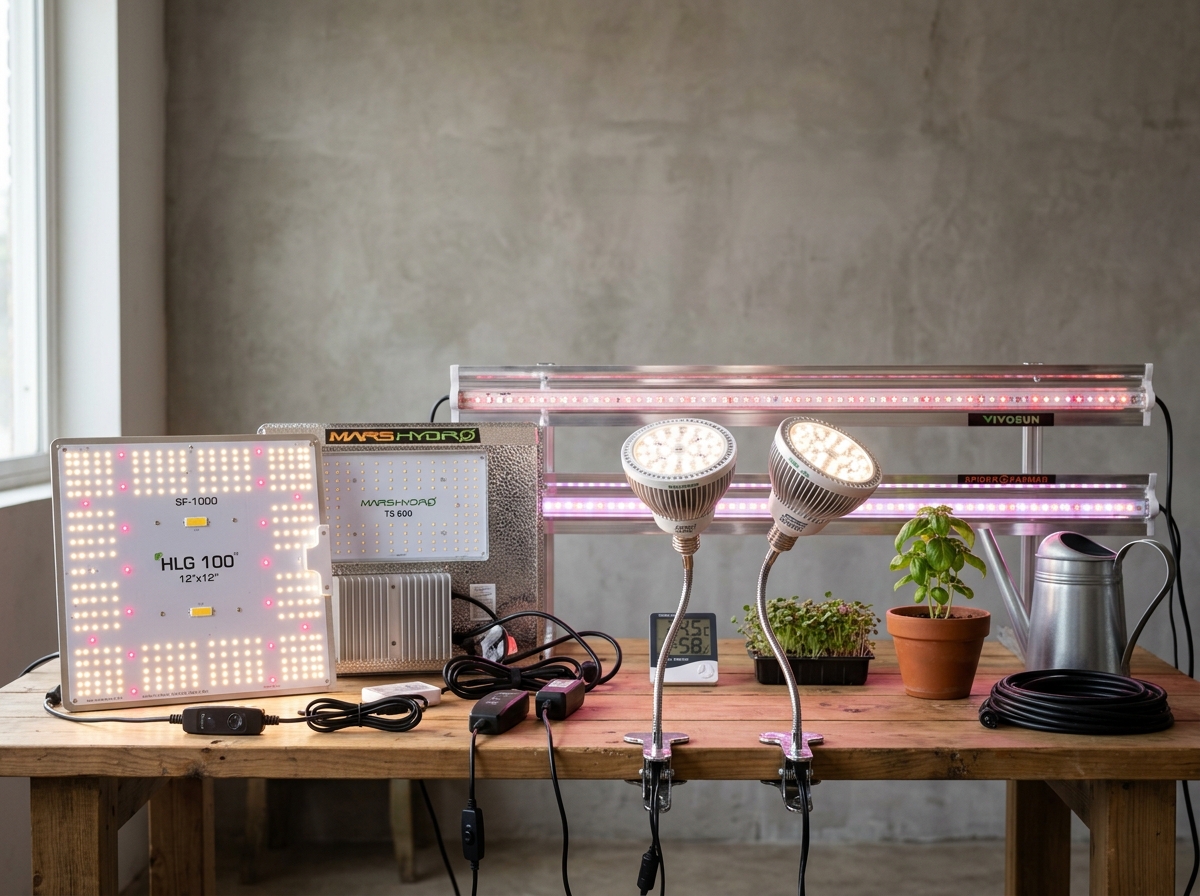
Every plant has a “light budget.” A snake plant is a thrifty spender that can survive on very little, while a Fiddle Leaf Fig is a high-roller that demands a massive daily investment of light. You can learn more about these specific “budgets” in our article on indoor plant light requirements.
When shopping, look for these three factors:
- Form Factor: Do you need a clip-on light for a single shelf, a floor lamp for a tall tree, or a hanging panel for a large collection?
- Wattage: This is the power draw. While “true wattage” tells you how much electricity it uses, it’s also a rough indicator of how much total light energy is being produced.
- Spectrum: Does it look like a neon purple disco, or does it look like natural sunlight? (Hint: Your living room usually prefers the latter!)
Understanding Full Spectrum for LED Grow Light Houseplants
In the early days of LED tech, many lights were “Blurple”—a mix of just blue and red LEDs. While plants love blue light for leafy vegetative growth and red light for flowering, they actually use the entire visible spectrum.
Modern “Full-Spectrum” LED grow lights typically cover the 380-780nm range. This mimics natural sunlight and includes:
- Blue Light (400-500nm): Essential for strong stems and compact, bushy foliage.
- Green Light: Once thought to be useless, we now know green light penetrates deeper into the plant canopy, reaching the lower leaves that blue and red can’t.
- Red Light (600-700nm): The primary driver for photosynthesis and the key to getting your plants to bloom or fruit.
- Far-Red/Infrared: Helps with “shade escape” responses and can speed up the transition between growth stages.
By using a full-spectrum light, you aren’t just keeping the plant alive; you’re providing a balanced “diet” of light that results in more natural-looking growth and healthier root systems.
Measuring Intensity for LED Grow Light Houseplants
How do you know if your light is actually working? You can’t always trust your eyes because human eyes are great at adjusting to dimness. A room that looks “bright” to you might be a “pitch black” basement to a Monstera.
To get serious, we use Foot-candles (fc) or Lux to measure intensity. For those growing more “technical” crops, PPFD (Photosynthetic Photon Flux Density) is the gold standard, measuring exactly how many “light bullets” hit a square meter every second.
Here is a quick cheat sheet for common led grow light houseplants:
| Plant Type | Light Needs (Foot-candles) | Example Plants |
|---|---|---|
| Low Light | 50 – 250 fc | Snake Plant, ZZ Plant, Pothos |
| Medium Light | 250 – 1,000 fc | Monstera, Philodendron, Dracaena |
| High Light | 1,000 – 3,000+ fc | Succulents, Citrus, Fiddle Leaf Fig |
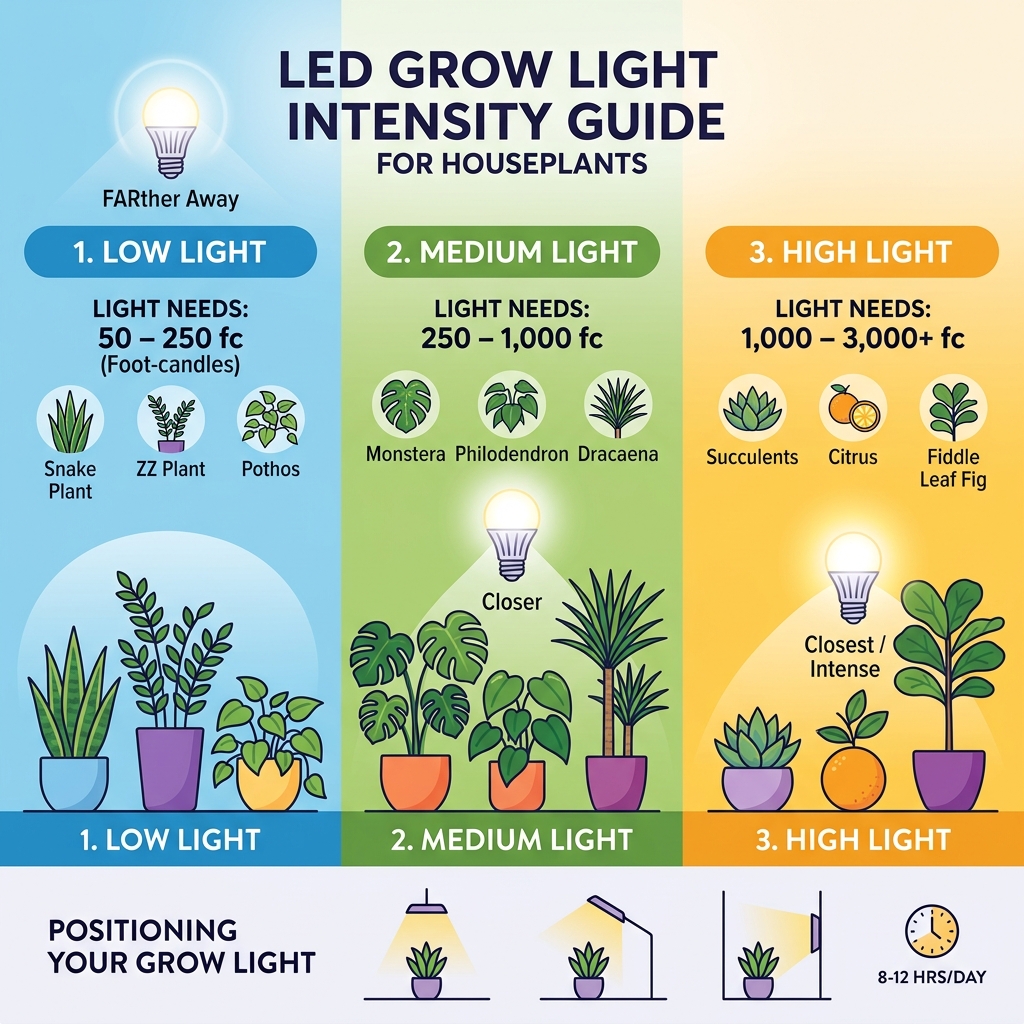
Pro Tip: Use a light meter app on your phone or a dedicated device to measure the light at the leaf surface. You’ll be shocked at how quickly intensity drops as you move the light away. For example, a premium light like the Soltech Aspect can output over 8,000 fc at 1 foot, but that drops to 500-800 fc at 4 feet. If you have a plant in a dark corner, check out our tips for indoor plant care for low light to see how to supplement effectively.
Positioning and Scheduling for Success
Once you have your light, the “where” and “how long” are your next big decisions. Unlike the sun, which moves across the sky, a grow light is stationary. This means you have to be the “sun manager.”
Distance Matters: If the light is too far away, the plant will stretch (etiolate) to find it. If it’s too close, you might see “bleaching” or crispy brown spots on the top leaves.
- High-intensity lights (like 60W+ panels): Keep them 12–24 inches away.
- Lower-power clip-ons (5W-20W): These can often sit 6–12 inches from the foliage.
- Adjustable stands: Use a stand like the LumiDuo Pro Floor Grow Light which allows you to adjust the height from 37″ to 77″ as your plant grows.
The 12-16 Hour Rule: Plants are not machines; they need to sleep just like we do. During the “dark period,” plants finish the second half of photosynthesis (the Calvin Cycle), where they actually turn that stored energy into growth.
- Standard Houseplants: 12 hours on, 12 hours off.
- High-Light/Growth Boost: 14–16 hours on.
- Never 24/7: Leaving lights on constantly stresses the plant and can lead to weird growth patterns or death.
For those just starting out, we’ve compiled more details in our indoor plant care tips for beginners to help you find that perfect rhythm.
Blending Grow Lights with Home Decor
The biggest complaint about grow lights used to be that they looked… well, industrial. Nobody wants a purple-glowing spaceship in their mid-century modern living room. Fortunately, the industry has shifted toward “aesthetic” lighting.
You can now find led grow light houseplants that look like high-end furniture. For example:
- Tripod Lights: Models like the LumiTripod Floor Grow Light use warm white LEDs (around 4000K) that look like a cozy reading lamp but provide a massive 1800+ lumens of plant-growing power.
- Decorative Bulbs: You can buy “Grow Bulbs” (like those from SANSI) that fit into your existing stylish lamps. This is perfect for indoor plants that thrive in low light that just need a little “nudge” to stay healthy.
- Smart Integration: Many modern lights, such as the LumaLight LED Grow Light, come with dimming knobs or app controls, allowing you to lower the brightness when you’re hosting a dinner party and crank it up when you leave for work.
Choosing between “Warm White” and “Daylight” is also a decor choice. Warm white (3000K-4000K) feels cozy and inviting, while Daylight (5000K-6000K) feels crisp, clean, and energizing. Both work for plants, so choose what makes your room feel best!
Frequently Asked Questions
How far should LED grow lights be from houseplants?
Generally, 12 to 18 inches is the “sweet spot” for most medium-intensity LED lights. However, this depends on the wattage. If you see your plant’s leaves turning yellow or developing dry, brown patches directly under the light, move it back 6 inches. If the plant is leaning toward the light or growing “leggy,” move it closer.
Can I leave grow lights on 24/7?
No! Plants need a period of darkness to process the energy they gathered during the day. A 24-hour light cycle will eventually exhaust the plant, leading to stunted growth or failure to bloom. Use a simple plug-in timer or a light with a built-in timer (like the Full Spectrum Plant Grow Light G2Pro) to automate a 12-hour cycle.
Are LED grow lights safe for pets and children?
Yes, LED grow lights are much safer than older HID or fluorescent lights. They don’t contain mercury, they don’t shatter as easily, and they run much cooler, meaning a curious cat or toddler is unlikely to get burned. Most high-quality LEDs also filter out harmful UV rays, making them safe for human eyes in a living space—though you still shouldn’t stare directly into any high-powered bulb!
Conclusion
At Futuro Ciencia, we believe that everyone deserves a home that feels like a sanctuary. By using led grow light houseplants, you’re not just buying a gadget; you’re investing in the health of your indoor oasis. Whether you’re reviving a struggling Fiddle Leaf Fig or starting an indoor herb garden, the right light makes all the difference.
Ready to take the guesswork out of your plant parenting? Pair your new lighting setup with our custom indoor-plant-care-schedule to ensure your leafy friends get exactly what they need, when they need it. Happy growing!
