You Don’t Need a Green Thumb to Keep Plants Alive

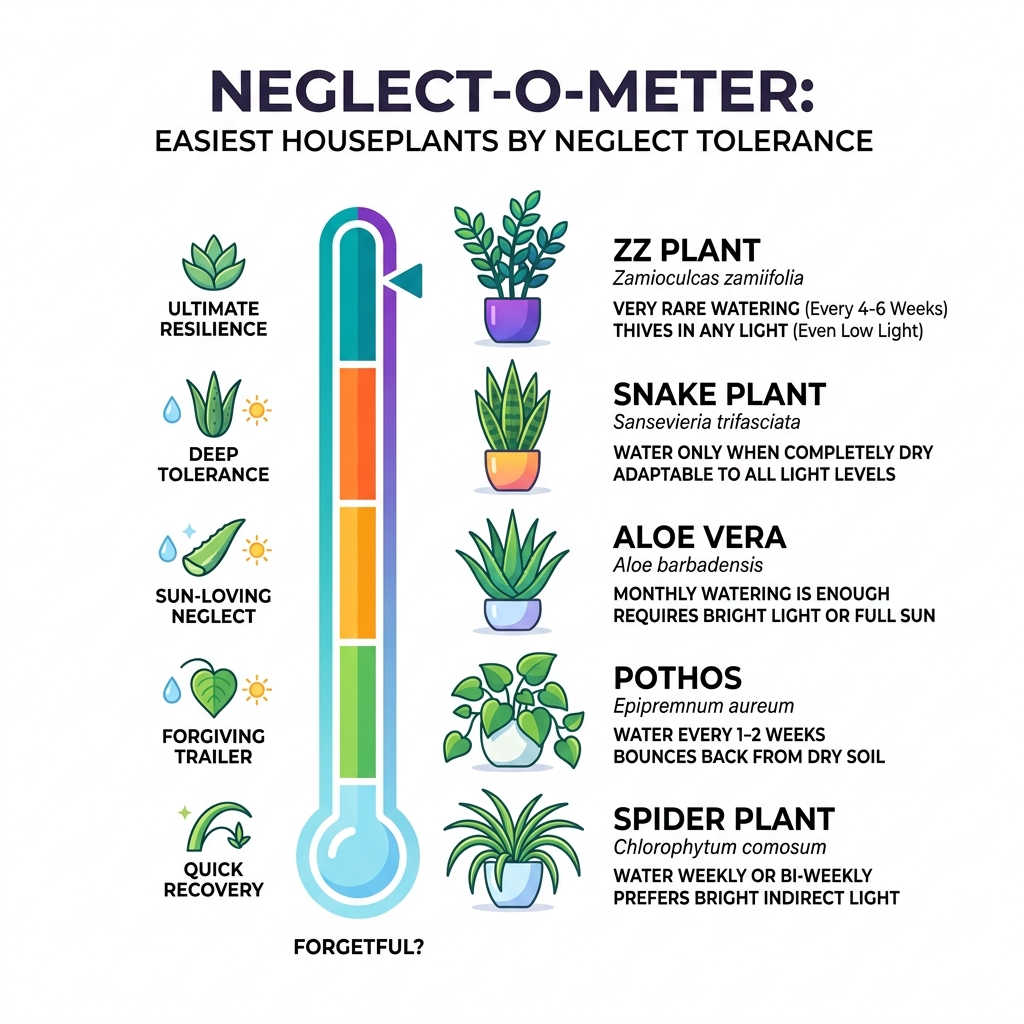
The easiest plants to look after indoors are ones that tolerate neglect, bounce back from missed waterings, and thrive in a range of light conditions. Here’s a quick answer:
Top easiest houseplants for beginners:
| Plant | Watering Frequency | Light Needs |
|---|---|---|
| Snake Plant | Every 2-3 weeks | Low to bright indirect |
| ZZ Plant | Every 4-6 weeks | Low to bright indirect |
| Pothos | Every 1-2 weeks | Low to bright indirect |
| Spider Plant | Every 1-2 weeks | Bright indirect |
| Aloe Vera | Monthly | Bright indirect to full sun |
How many times have you brought home a plant full of good intentions, only to find limp, yellowing leaves a few weeks later? You’re not alone.
The truth is, most plant deaths aren’t caused by neglect — they’re caused by choosing the wrong plant for your lifestyle. A fussy plant in a busy home is always going to struggle.
The good news? There’s a whole category of houseplants that practically look after themselves. They store their own water. They shrug off low light. They forgive you for forgetting about them for weeks at a time.
Research even backs up the benefits of keeping them around — studies show indoor plants can reduce psychological stress and boost productivity. All the more reason to find ones that won’t add to your stress.
This guide covers exactly which plants belong in your home, and how little effort they actually need.
What Makes These the Easiest Plants to Look After?
When we talk about the easiest plants to look after, we aren’t just talking about plants that stay alive; we’re talking about plants that thrive while you’re busy living your life. At Futuro Ciencia, we believe that your home should be a tranquil oasis, not a source of chores. The secret to a “hard-to-kill” plant lies in its natural evolutionary adaptations.
Most low-maintenance plants originate from harsh environments—think arid deserts or the dimly lit floors of tropical rainforests. Because of this, they possess several key traits:
- Drought Resistance: Many of these plants, like succulents and ZZ plants, have thick, fleshy leaves or underground rhizomes (bulbs) designed specifically to store water for weeks or even months.
- Adaptability: They aren’t “divas.” While a Fiddle Leaf Fig might drop its leaves if you move it three inches to the left, easy-care plants are tolerant of temperature fluctuations and varying humidity levels.
- Light Flexibility: The best beginner plants can handle “low light” conditions, meaning they can survive in north-facing rooms or corners far from a window.
Scientific research supports the idea that bringing these resilient beauties indoors does more than just decorate a room. A study published in the Journal of Physiological Anthropology found that active interaction with indoor plants can reduce physiological and psychological stress compared to mental work. By choosing plants that don’t require constant “work,” you maximize these stress-relief benefits.
For those with packed schedules, following indoor plant care tips for busy people is the best way to ensure success.
Top 5 Easy-Care Comparison Table
| Plant Variety | Typical Watering | Ideal Light | Best Feature |
|---|---|---|---|
| Snake Plant | 2-4 weeks | Any light | Indestructible |
| ZZ Plant | 4-6 weeks | Low to Medium | Thrives on neglect |
| Pothos | 1-2 weeks | Medium indirect | Fast-growing vine |
| Spider Plant | Weekly | Bright indirect | Pet-safe & cute |
| Peace Lily | Weekly | Medium | Tells you when thirsty |
Top Low-Maintenance Plants for Your Home

Ready to start your indoor jungle? You don’t need a greenhouse or a degree in botany. Starting with easy indoor plants for beginners allows you to build confidence. We recommend beginning with just one or two plants to see how they adapt to your specific home environment before expanding your collection.
If you’ve historically struggled with plants, focus on indoor plants that survive neglect-2. These varieties are the “heavy hitters” of the plant world—resilient, beautiful, and remarkably forgiving.
Snake Plant: The Ultimate Easiest Plant to Look After
If there were a hall of fame for the easiest plants to look after, the Snake Plant (Sansevieria) would be the first inductee. Also known as “Mother-in-Law’s Tongue,” this plant is famous for its stiff, sword-like leaves that grow vertically, making it perfect for tight corners or windowsills.
- Why it’s easy: It is a succulent that stores water in its upright leaves. It can go for several weeks—sometimes a full month in winter—without a single drop of water.
- Light: While it prefers bright indirect light, it is legendary for its ability to tolerate low light conditions where other plants would wither.
- Benefit: It is one of the few plants that continues to produce oxygen at night and is highly efficient at filtering air pollutants like formaldehyde and benzene.
For those who travel often or work long hours, these are truly hardy indoor plants for busy people. Just remember: the only real way to kill a Snake Plant is by overwatering it. When in doubt, leave the watering can in the closet.
ZZ Plant: The King of Low Light
The Zamioculcas zamiifolia, or ZZ plant, looks like it belongs in a high-end interior design magazine with its waxy, deep green leaves. However, it’s actually one of the most rugged plants you can own.
- The Secret: Underneath the soil, the ZZ plant has potato-like bulbs called rhizomes. These act as water reservoirs.
- Watering: You only need to water this plant once every 4 to 6 weeks. If you forget it for two months? It might go dormant, but it usually stays green and waits patiently for your return.
- Office Hero: Because it can thrive under fluorescent office lights and requires so little attention, it is one of the premier low-maintenance plants for offices.
Pothos: The Indestructible Vining Easiest Plant to Look After
Often called “Devil’s Ivy” because it is nearly impossible to kill, the Pothos is the quintessential trailing plant. It can grow 12 to 18 inches in a single month under the right conditions, creating a lush, tropical feel in no time.
- Versatility: You can let it trail down from a bookshelf, or train it to climb up a trellis or moss pole.
- Communication: Pothos is a “communicator.” When it’s thirsty, the leaves will droop slightly. Give it a drink, and within a few hours, it perks right back up.
- Propagation: It’s incredibly easy to turn one plant into ten. Simply snip a vine below a “node” (the little brown bump where a leaf meets the stem), place it in a glass of water, and watch roots grow in a week or two.
Check out more easy-to-grow-indoor-plants to find different variegations of Pothos, like the ‘Marble Queen’ or the ‘Neon.’
Spider Plant: The Pet-Friendly Choice
If you have curious cats or dogs, the Spider Plant (Chlorophytum comosum) is a fantastic choice. Unlike the Snake Plant or ZZ Plant (which are mildly toxic if ingested), the Spider Plant is non-toxic to pets.
- Appearance: It features long, arching leaves with white stripes. As it matures, it sends out long stems with “spiderettes”—tiny baby plants that dangle like little spiders.
- Resilience: It’s very forgiving of inconsistent watering and thrives in the typical humidity of most homes.
- Apartment Living: Because they look stunning in hanging baskets, they are among the best indoor plants for apartments where floor space might be limited.
Essential Care Tips for Busy Plant Parents
Even the easiest plants to look after need a little bit of love. The goal is to work smarter, not harder. Here is our Futuro Ciencia “Lazy Gardener” protocol:
- The Finger Test: Before you water, stick your finger two inches into the soil. If it feels damp, walk away. If it’s bone dry, it’s time for a drink.
- Drainage is Non-Negotiable: Always use a pot with a hole at the bottom. If water sits at the bottom of the pot with no escape, the roots will rot, and the plant will die. This is the #1 mistake beginners make.
- Dust the Leaves: Every few months, wipe the leaves with a damp cloth. Dust blocks sunlight and prevents the plant from “breathing” (photosynthesizing) efficiently.
- Seasonal Shifts: Plants grow slower in the winter. During these months, you should cut your watering frequency in half.
For more specific advice on drought-tolerant species, read our guide on low-water-indoor-plants and indoor-plants-that-survive-neglect.
Benefits of Keeping Easy-Care Houseplants
Beyond their aesthetic appeal, low-maintenance plants are hard-working members of your household. They are nature’s air purifiers. A famous NASA study demonstrated that common houseplants can remove toxins like trichloroethylene, formaldehyde, and benzene from the air.
- Mood and Productivity: Studies have shown that having greenery in your workspace can increase attentiveness and memory retention by up to 20%.
- Tranquility: There is a unique satisfaction in seeing a new leaf unfurl on a plant you’ve successfully kept alive. It turns a sterile room into a living space.
If you want the beauty of flowers without the fuss of a rose garden, consider low-maintenance-flowering-indoor-plants, or explore other indoor-plants-that-need-little-care to round out your collection.
Frequently Asked Questions about Easy Houseplants
Which plants tolerate low light conditions best?
The “big three” for low light are the ZZ Plant, the Snake Plant, and the Cast Iron Plant. These plants can survive in windowless offices or hallways as long as there is some ambient light (even from overhead fluorescent bulbs). While they won’t grow as fast as they would in a sunny window, they will remain healthy and green.
How often should low-maintenance plants be watered?
Most easy-care plants prefer to dry out between waterings. For succulents like Aloe Vera or Snake Plants, every 3-4 weeks is usually plenty. For vining plants like Pothos, every 7-10 days is standard. Always remember that plants go into a “dormancy” period in the winter and require significantly less water. For more on this, see our tips on indoor-succulents-that-are-easy-to-care-for.
What common mistakes should beginners avoid?
- Overwatering: Loving your plant to death with too much water is the most common pitfall.
- Direct Sun: Putting a low-light plant in a south-facing window can “scorch” the leaves, leaving brown, crispy spots.
- Frequent Moving: Plants like to acclimate to their environment. Moving them from room to room every few days stresses them out.
- Ignoring Drainage: As mentioned before, “wet feet” (roots sitting in water) leads to root rot, which is often irreversible.
Conclusion
Becoming a plant parent doesn’t have to be a full-time job. By selecting the easiest plants to look after, you can enjoy the air-purifying and mood-boosting benefits of nature with just a few minutes of effort each month.
At Futuro Ciencia, we are dedicated to helping you transform your living or working space into a tranquil oasis. Whether you are looking for brightening plants for a dark corner or a resilient companion for your desk, we have the resources to help you succeed.
Transform your home with our expert plant care guides and start your journey toward a greener, more peaceful home today!
